
discipline "Sociology"
on the topic: “Family and marriage”
1. Family is a unit of society
The family is the primary unit of the social community of people, based on marriage or blood relationship, one of the oldest social institutions that arose much earlier than classes, nations, and states. The essence of a family is determined by its functions, structure, and the role behavior of its members.
The family is the primary and most important institution of society due to the functions that it implements. It is through the family that generations of people are replaced, a person is born in it, the human race continues, primary socialization and parenting take place, and finally, such a noble function as caring for the elderly is realized. The family has the organization of life, consumption, as well as a significant part of economic and economic functions.
Family structure is the totality of relations between its participants, including relations of power. Authoritarian families are distinguished, in which there is a strict subordination to the head of the family, more often to the husband, children to parents, and the family of a democratic type, where the distribution of roles, power does not occur in accordance with traditions, but on the basis of personal qualities, abilities of spouses, they are characterized by equality in acceptance decisions, voluntary distribution of duties.
The main role relations in the family: husband, wife, mother, father, mother-in-law, mother-in-law, eldest child, youngest child, etc.
2. Family life cycle
The family life cycle can be built according to various criteria, but when selecting them, it should be taken into account that this is a cycle, i.e. the frequency of occurrence and regularity of family events should be reflected (more precisely: the cyclical nature is found when family generations change, but when moving to nuclear families with divorces and remarriages, the regularity of events is also quite detectable).
According to the criterion of parenthood, only four phases are distinguished: go to the stage of pre- and grandfatherhood, reproductive and socialization parenthood, and at least five key events: marriage and the breakdown, the birth of the firstborn and the last child, the marriage of one of the children, or the birth of a grandson.
The concept of a life cycle is often used to describe the sequence of events from birth to death, although its more precise meaning refers to the sequence of stages of parenthood throughout life, from the birth of children through their departure from home to the birth of their own children. At the population level, the cycle repeats from generation to generation. Some people do not have children and therefore do not enter the intergenerational life cycle. The life cycle is generally known as the family cycle of the sequence of stages of parenthood, primarily determined by variations in the size and structure of the family.
If the stages of the family are distinguished depending on events related to the age of the children and the change in their life situation, as well as the separation of adult children from the parent family, there can be much more events and stages of the cycle. In any case, all of them are accompanied by an indication of the length of marriage at one time or another, which allows you to calculate the total duration of family life and the duration of the individual stages. This characteristic of family changes is often used in sociological demography and contains a lot of information. For example, to reduce the period of reproductive parenthood, one can judge a decrease in the birth rate and approaching a solid one-year-old, and by a reduction in the phase of prenatal parenting, a drop in marriage.
From its inception to its disintegration, the family goes through a series of stages that are the subject of demographic analysis. As a rule, a family appears at the time of marriage. A family grows with the birth of every child. From the birth of the last child until the first child leaves the house, the size of the family remains constant. In connection with the marriage of children, the size of the family gradually decreases to its original size (two people). With the death of the first, and then the second spouse, the family cycle ends.
3. Premarital behavior
In the premarital period, some promising problems appear that are found in marriage, which can be called “birth injuries”. The place and situation of an acquaintance affect the fate of marriage; the first impression of each other is positive, negative, ambivalent (both positive and negative), indifferent (indifferent); the duration and content of the courtship period; initiator of the marriage proposal (man, woman, other interested persons); thinking time of the marriage proposal; marriage situation.
A positive prognosis of marriage is associated with the following factors of premarital history: a mutually positive first impression of each other; Acquaintance in a situation of work and study; courtship period from 1 to 1.5 years; the manifestation of a marriage proposal by a man; acceptance of the marriage proposal after a short (up to 2 weeks) deliberation; support of marriage registration with a wedding celebration.
Such facts of premarital period as a negative or non-reciprocal impression of each other negatively affect the fate of marriage; short (up to 6 months) or long (more than 3 years) courtship period; disapproval of choice by family and friends; manifestation of direct or indirect initiative on the part of a woman; forced marriage decision (for example, as a result of pregnancy); Continuous pondering of the marriage proposal. These unpleasant or unacceptable facts require the couple to compensate, additional efforts to smooth out negative experiences. Active work is needed on oneself, on the characteristics of one's character, behavior. Unable to deal with this, future spouses endure from the prenuptial period chronic injuries that are directly or indirectly detected in the marriage.
The modern family is built mainly on marriage. Marriage is a historically determined form of relationship between a man and a woman, through which society organizes their relationship, both in legal and in moral and ethical terms. Marriage is a very complex range of relationships between people: from natural biological to economic, legal, ethical, socio-psychological, aesthetic, etc.
The content of marriage is determined by the degree of development of society. The more primitive social relations are, the more space in the family-marriage union is occupied by purely physiological and economic factors. The more developed the society, the greater the role in marriage is played by socio-psychological, ethical, aesthetic and, of course, sexual moments.
Sociologists distinguish three motives for marriage: a love marriage, a marriage of convenience and a marriage of pattern. Sociologists distinguish three motives: a marriage of love, a marriage of convenience and a marriage of pattern. The motive for love in marriage does not need comment. A pattern marriage takes place when the argument is triggered: "All my peers start families, no matter how late I am." In such cases, not fully understood sex drive, the desire to have children, dominates. Sometimes a person believes that motives of love are at the core. In fact, such love comes down to the fact that he or she chooses the more preferable from several candidates.
As in any social institution, the family is based on a conscious act, document, contract, socially sanctioned. And the family is necessarily built on certain values, ideals, norms, which in different societies can be different.
The family as a social institution has both of its features, which we identified earlier. The first is the satisfaction of certain social needs: the reproduction of the human race, the socialization of the individual, the regulation of sexual relations, the solution of certain economic problems. Until now, in most societies, the family is the most important economic unit, especially in rural areas.
The second sign - the family is a system consisting of elements: husband, wife, children, older generation, grandchildren, etc. This system gives family members certain functions that to some extent restrict individual freedom.
When considering the family as a system, the question arises of the structure of the family. In terms of structure, two main types of families are distinguished: kinship and matrimonial. A related family is based on consanguinity of a large number of members of a small group. The basis of a married family is a couple of people connected by marriage. Husband and wife live with their children separately from other relatives who have little influence on the affairs of such a family.
A related family is based on consanguinity of a large number of members of a small group. Such a family is an association of relatives together with their spouses and children. Within such a family at least three generations cohabit at the same time - grandfathers and grandmothers, spouses and grandchildren. The basis of such a family are brothers and sisters, together with husbands and wives and their children. Here, a married man or a married woman is primarily attached to the parental family and only then enters the family of the wife or husband. A person is bound by the main obligations and responsibilities with the family in which he was born. Thus, a woman in raising children may not depend on her husband, but completely depend on her brothers and sisters. That is, women’s brothers and sisters decide how to raise children, what kind of education to give them, etc.
A child in such a family has a great opportunity for communication and socialization, preparation for more social roles. If the mother leaves the family, her relatives may play her role. In such families, children are more protected from social problems.
This type of family was common until the twentieth century, and now it is common in societies with a non-European culture. In these families, a man is recognized as the head, and certain economic circumstances are associated with this, especially the institution of private property.
7. Modernfamily: Role Distribution
The role distribution parameter includes two components: 1) who is the main in the family and 2) who is mainly involved in raising children (in particular, spends more time with them) and has a significant impact on the nature of socialization of citizens, on the model of parent-child relationships and on educational strategies used by parents.
The patriarchal type of distribution of family roles implies the primacy of the father; the mother is given the function of raising children; the modern model of the distribution of roles in the family provides for the equal rights of the spouses, both in relation to decision-making and in terms of educating the younger generation.
Inequality between spouses, characteristic of the patriarchal distribution of roles, is often associated with hierarchical relationships between parents and children - in such families, children are usually not allowed to have their own point of view, if it differs from the parent, parental and parental relations are expected from them usually built on suppression.
With the egalitarian structure of family roles, on the contrary, a different tendency is more often observed - attitudes toward children as equals, tolerance for dissent, encouragement of children's disputes with parents.
The structure of the distribution of roles in Russian families varies from the patriarchal type to the modern one - representatives of younger generations were raised more often in families with an egalitarian distribution of family power between parents and with equal participation of both spouses in the educational process.
8. The problem of family leadership
Three types of leadership can be distinguished, determined by the position in the family, which both husband and wife aspire to.
Model One: Equal Partners. With this distribution, a woman does not give up her leadership positions, even in the case of high pressure of gender-role stereotypes (for example, when the husband is Muslim and adheres to traditional values \u200b\u200bregarding the role of the wife in the family), and seeks to "share" responsibilities with the man in the family. The exercise of the right to “equal leadership” is possible in the case of a woman’s economic independence from a man, with a high value for her work, which sometimes exceeds the value of family relationships.
Consideration of a relationship model in which partners seek leadership, but do not overwhelm each other, are not stuck on minor issues, sometimes thanks to the direct efforts of a woman, shows that this type of relationship allows you to keep your family together and make progress, although this requires some effort on both sides . In this situation, a man has to abandon the prevailing stereotypes, which does not always happen quickly and easily.
The second model: "The first in a pair." Despite the fact that men always aspire to leadership in family relations, many women are leaders in the family in all respects. Men calmly or not always calmly give this championship, preferring to be in second positions.
In some cases, a man gives up a leading position in the family after he is convinced that “everything is better for the wife” and tries to provide her with the most comfortable family conditions, realizing that the wife “is the breadwinner of the family”.
This is the most dramatic model of family relations, as a man is forced to "surrender his leadership position." However, the degree of dramatic development of these relations depends on the wife’s behavior strategy and proceeds more gently, the less the woman reminds the man of the existing inequality and the more sincere respect for his work and efforts for the benefit of the family.
Model Three: “Just a Wife,” in which a man is the head of the family. In such families, as a rule, men are 7–10 years older than their wives and have potential advantages: in the form of a good education, or a strong character, or a “common past”.
Divorce, that is, legally fixed breakup of marriage, is the antithesis of marriage, its shadow side. A sociological analysis of the problems of divorce (sociology of divorce) is, to a certain extent, an analysis of the problems of marriage itself, mainly its negative aspects.
Society is interested in the stability of family relations, as this ensures healthy relationships between spouses, has a beneficial effect on the upbringing of children, and facilitates the solution of a number of social problems (housing, social welfare, employment, etc.). Consequently, in the most general form, the state and society cannot but see in the divorce evidence of ill-being in the sphere of family relations. From this point of view, divorce is a social evil.
At the same time, divorce should be viewed from other perspectives. With regard to each particular marriage, the issue of the undesirability or desirability of a divorce cannot be resolved unambiguously. In some cases, divorce is not only not a social evil, but, on the contrary, it is necessary.
Marriage is a free and voluntary union between a man and a woman. Freedom of marriage implies freedom of divorce. Freedom of divorce is the flip side of freedom of marriage, an integral part of individual freedom.
10. Consequences of a divorce
Significantly negative effect of divorce on fertility. In some cases, the woman after the divorce remains lonely, and on the “threshold” of the divorce abstains from giving birth to children. With the increase in the number of divorces, the number of people who do not want to remarry after a divorce has increased.
An increase in the number of divorces leads many couples and their children to deeply experience family distress, usually associated with divorce. Divorce immediately seriously affects the moral condition of children.
Divorces increase the number of single-parent families. A specific system of relations between mother and child is created in them, patterns of behavior are formed, which in some respects are an alternative to the norms and values \u200b\u200bon which the institution of marriage is based.
Divorce affects divorced spouses themselves. A very common feeling of anxiety, impatience, coming from broken habits and the loss of familiar roles.
As a mass phenomenon, divorces play a predominantly negative role both in changing fertility and in raising children. Firstly, due to divorce, the productive period in a woman’s life decreases. Secondly, in the event of an unsuccessful first marriage, the time of the first childbearing may be much delayed (which is also undesirable from a medical point of view). Thirdly, the unfavorable relations in the family that precede the divorce can have a negative impact on the woman’s reproductive attitudes, although in other cases this influence can be neutralized by the woman’s desire to create and strengthen a new family.
Divorce is assessed as good only if it changes for the better the conditions for the formation of the child’s personality and puts an end to the negative impact on the child’s psyche of marital conflicts. A family can live if it performs poorly or does not perform at all any of its functions except the parent. A family dies if it ceases to do what for which it is raising children.
11. Family and social class
Inequality in a pair can be triggered by several factors and include:
1) material inequality;
2) age inequality (when a woman is 10-12 years older than her partner);
3) career inequality;
4) inequality of social origin and the resulting inequality of cultures.
The manifestation of social inequality is amplified when the family “outsider” suddenly turns into a breadwinner and a leader, and the cultural leader suddenly loses his advantages.
List of references
Kapitonov E.A. Sociology of the twentieth century - Rostov-on-Don: Phoenix, 2006.
Smelser N. Sociology. - M., Thought, 2000.
Sociology. Lecture course. / Ed. SOUTH. Volkova. - Rostov-on-Don: Phoenix, 2006.
Toshchenko Zh. T. Sociology. General course. - M., Prometheus, 2004.
A source:
BIGEST BANK OF ABSTRACTS
in the discipline “Sociology” on the topic: “Family and marriage” 1. The family is the unit of society. The family is the primary unit of the social community of people based on marriage or blood relationship.
http://www.0zd.ru/sociologiya_i_obshhestvoznanie/semya_i_brak.html
3.14. Family and marriage
A family - This is a small social group based on marriage and consanguinity, whose members are connected by common life, mutual assistance, moral and legal responsibility. The family is a system of relations between husband and wife, parents and children. As a social institution, the family interacts with the state and other social institutions. Sociology considers the family from two main positions: as small social group; as social institution.
1. How small social group - the subject of the study is intra-family relations (relations between spouses, between parents and children, between other family members).
2. How social institution - The emphasis is on the relationship between the family and the state (society), as well as the social functions of the family.
The family, a broader concept and social phenomenon, includes, as a rule, the institution of marriage. However, there may be cases when marriage and family exist as if by themselves. Such extramarital relations in the family are usually called civil marriage.
A family - a single social community, the integrity of which is ensured by the complementarity of the sexes, social functions and roles.
Family Social Status - one of the types of social statuses in society and determines the individual’s place not only in the family structure, but also in the general structure of society. Family statuses are divided into: marital status (wife, husband); parental (mother, father); children (son, daughter, brother, sister); intergenerational (grandfather, grandmother, grandson, granddaughter, etc.).
Family social role - Prescribed and expected behavior due to the occupied family status.
Social functions of the family
* Reproductive - birth of children, reproduction of a biological species. Thanks to this function, the family not only reproduces itself, but also ensures the replacement of outgoing generations by new members of society.
* Existential - The function of caring and protecting their members, ensuring their social and psychological safety.
* Economic and household - the joint production of material goods and their distribution, the organization of cohabitation of family members and the maintenance of their physical health and well-being.
* Primary social control function - moral and social regulation of the behavior of family members in various spheres of life.
* Recreational - the function of restoring and strengthening the physical, moral and spiritual forces of man.
* Social status - reproduction of the social structure of society. By acquiring new social statuses in the family (“husband”, “wife”, “father”, “mother”, etc.), the individual replaces the statuses of his predecessors (parents) in the social structure and thereby reproduces the social structure.
* Leisure - Organization of rational leisure for all family members.
* Hedonistic (from Greek - pleasure) is a function of mutual pleasure, pleasure, love, happiness, etc.
Marriage - 1) historically established, socially regulated relations between men and women, establishing their mutual rights and obligations in a family organization; 2) the regulatory institution governing relations between all family members, between the family and the state.
* group marriage - the marriage union of several men and women (most characteristic of the early stages of development of primitive society);
* polygamous marriage - marriage of one spouse with several. Polygamy can be of two types: polygyny - the marriage of one man with several women; polyandry - the marriage of one woman with several men (Southeast India, Tibet, Ceylon, New Zealand, Hawaii);
* monogamous marriage - the marriage of one man with one woman. Such marriages are most characteristic of the Christian world and for democratic countries in which legal gender equality exists. But such marriages are 5 times less likely than polygamous;
* pair marriage - equal marriage between a man and a woman, which took place during the transition from matriarchy to patriarchy (period of barbarism);
* exogamous marriages - based on customs prohibiting marriages within a particular social community, for example, within a clan, phratry, community. Such marriages presuppose the creation of a marital relationship outside a given sibling group;
* endogamous marriages - based on the customs of marriage within a particular social community - a tribe, caste, nation, denomination, etc.
There are also such varieties of marriage, such as: love marriage, marriage of convenience, holy marriage, dynastic marriage, civil marriage, purchased marriage, marriage with abduction, unequal marriage, remarriage and others.
Social features of marriage
- social approval and legal registration of the rights and obligations of spouses in relation to each other and to children, as well as children to their parents;
- regulation of sexual relations between men and women in society;
- regulation of economic and household relations between spouses, as well as between all family members;
- regulation of relations between the family and the state;
- legal registration of the social status of each family member. For example, by registering a marriage, a person immediately acquires the status of “wife” or “husband”, “co-owner” and / or “heir” of certain material values \u200b\u200b(state).
1. According to the criteria of dominance in a family organization:
– Matriarchal family - Women dominate the family. The pedigree is on the female line.
– Patriarchal family - the dominant role in the family is played by the male owner. A woman in such a family, as a rule, is also the property of her husband. The pedigree is on the male line.
– Egalitarian family - equal power relations of spouses with interchangeable social roles.
2. Depending on the complexity of the family structure:
– extended family - a complex family, including representatives of several generations of relatives (grandparents - grandfather, grandmother, parents - mother, father, children - son, daughter, etc.).
– Nuclear family - consisting of two generations - parents and children.
3. Depending on the number of children in the family: small children (1-2 children); medium children (3-4 children); large families (5 or more children); childless (married couples who do not want or are not able to have children); incomplete (families with children, but without one or both parents).
The most characteristic of the current state of society are two main types of families: patriarchal and egalitarian.
Signs of a patriarchal family
The priority of family-wide (clan) interests over individual.
The main criterion for marriage is not the personal choice of the young, but the economic and other interests of the patriarchal family.
The complex social composition, as a rule, includes several generations of men with wives, children and other relatives.
Large families. Having a large number of children in a natural production mode is economically advantageous.
Prohibition of individual intervention in the reproductive cycle (prevention and termination of pregnancy).
Weak social and geographical mobility. Children learn and inherit the social statuses and roles of their parents and remain in the family.
All family property is collectively owned and inherited through the male line.
In a traditional patriarchal family, all relations are built on the basis of customs and traditions that do not take into account the individual characteristics and preferences of spouses and other family members.
Signs of an egalitarian family
The priority of individual interests over the family (generic).
The main criterion for marriage is the personal choice of the couple themselves.
A simple two-generation social structure consisting, as a rule, of parents and children.
Small size. The lengthening of the period of socialization of children and the increase in the costs of their maintenance, upbringing and education, as well as the desire of spouses to realize themselves in other non-family activities, weakening reproductive motivation.
Individual fertility planning.
Intensive social and geographical mobility. Each family member (like the family as a whole) can choose and repeatedly change the type of activity and place of residence.
Legal equality in the ownership and inheritance of family property.
The main signs of the crisis of the modern family
- Small and childless families. Late marriages and the desire of spouses to realize themselves in business, creativity and other non-family activities does not allow them to devote a sufficient amount of time to giving birth and raising children. The personal egoism of the spouses overcomes the natural feelings of preservation and reproduction of a kind.
- Reduction of marriage. An increase in the total number of people who have never married.
- Increase in the number of divorces. In a democratic society, divorce is one of the attributes of personal freedom.
- An increase in the number of single-parent families. An increase in the number of divorces and illegitimate births leads to the growth of single-parent families.
- An increase in the number of orphans, as well as street and street children. The crisis of the family, extramarital birth leads to the fact that women in labor abandon their children; other parents are deprived of parental rights due to the fact that they are not able (for one reason or another) to fulfill their parental responsibilities.
- Orphanage, homelessness and neglect, as a consequence of the crisis of the institution of the family, at the next stage become one of the causes of this crisis. Adult children who have grown up outside the family or in a dysfunctional family, as a rule, are not able to create a full-fledged family themselves.
- Decrease in the paternal educational role. The increase in the number of divorces and the illegitimate birth of children lead to an increase in the number of single parent families. In such families, paternal education is virtually absent. Children raised in maternal families adopt stereotypes of maternal education and transfer them to the education of their children. The crisis of the modern family is also evidenced by the facts of the emergence and legal registration of the so-called same-sex quasi-families in some democratic countries, which, because of the same-sex "marriage" partners, cannot have children together.
State recognition of the value of the family, its role in social development and education of future generations is enshrined in the Constitution of the Russian Federation. The main obligations for material content, social and legal protection, upbringing, education of children are the family and the state. The following federal programs have been developed and are being implemented:
1. The concept of the federal target program “Children of Russia” for 2007–2010, including subprograms: “Healthy Generation”, “Gifted Children” and “Children and Family”.
2. The national program of demographic development of Russia for the period 2006–2015.
3. From January 1, 2007 to December 31, 2016, a form of state support for Russian families raising children is provided - maternal (family) capital.
4. State support program for large families in the Russian Federation for 2008–2015.
5. National charity program "Support to the family and the child for 2012-2017."
6. Decree of the President of the Russian Federation of June 1, 2012 No. 761 "On the National Strategy of Actions for Children for 2012-2017."
7. On May 24, 2013 in Moscow the Constituent Congress of the All-Russian Public Organization “National Parent Association for Social Support of the Family and the Protection of Family Values” was held.
Traditional marriageIn the USSR, marriage is a voluntary union of a man and a woman in which spouses are completely equal. In the USSR, only marriage concluded in state bodies for the registration of acts of civil status (registry offices), as well as marriage committed in religious rites before the formation or restoration of the Soviet registry office bodies, is recognized. Until 1944, the so-called actual marriage (registered).
According to the Family Code of the Russian Federation, the following legally significant signs of marriage are distinguished.
The condition for marriage is:
In Russia, marriage is not allowed:
In secular states, to which Russia belongs, as well as in a number of denominations, dissolution of the marriage union (divorce) is allowed - on various grounds. In Russia, with the consent of both spouses who do not have common children, divorce is possible in the registry office. If one of the spouses is against divorce, as well as in the presence of common minor children (even with the mutual consent of the divorced), the divorce is made through the court. To protect the rights of children if the wife is expecting a child, the husband is not entitled without her consent even to file a lawsuit for divorce.
In different religious systems, the procedure for divorce can be either much more complicated than in the Russian Federation, or much simpler. Say, the dissolution of a Catholic marriage is almost impossible, and in Muslim law, for a husband to divorce, it is enough to pronounce a special phrase. Nevertheless, even this simplicity is limited by other institutions.
In Russia, just over 1 million couples annually get married, while about 700 thousand families file for divorce.
Social Studies. Full course of preparation for the Unified State Examination Shemakhanova Irina Albertovna
3.14. Family and marriage
A family - This is a small social group based on marriage and consanguinity, whose members are connected by common life, mutual assistance, moral and legal responsibility. The family is a system of relations between husband and wife, parents and children. As a social institution, the family interacts with the state and other social institutions. Sociology considers the family from two main positions: as small social group; as social institution.
1. How small social group - the subject of the study is intra-family relations (relations between spouses, between parents and children, between other family members).
2. How social institution - The emphasis is on the relationship between the family and the state (society), as well as the social functions of the family.
The family, a broader concept and social phenomenon, includes, as a rule, the institution of marriage. However, there may be cases when marriage and family exist as if by themselves. Such extramarital relations in the family are usually called civil marriage.
A family - a single social community, the integrity of which is ensured by the complementarity of the sexes, social functions and roles.
Family Social Status - one of the types of social statuses in society and determines the individual’s place not only in the family structure, but also in the general structure of society. Family statuses are divided into: marital status (wife, husband); parental (mother, father); children (son, daughter, brother, sister); intergenerational (grandfather, grandmother, grandson, granddaughter, etc.).
Family social role - Prescribed and expected behavior due to the occupied family status.
Social functions of the family
* Reproductive - birth of children, reproduction of a biological species. Thanks to this function, the family not only reproduces itself, but also ensures the replacement of outgoing generations by new members of society.
* Socialization of personality.
* Existential - The function of caring and protecting their members, ensuring their social and psychological safety.
* Economic and household - the joint production of material goods and their distribution, the organization of cohabitation of family members and the maintenance of their physical health and well-being.
* Primary social control function - moral and social regulation of the behavior of family members in various spheres of life.
* Recreational - the function of restoring and strengthening the physical, moral and spiritual forces of man.
* Social status - reproduction of the social structure of society. By acquiring new social statuses in the family (“husband”, “wife”, “father”, “mother”, etc.), the individual replaces the statuses of his predecessors (parents) in the social structure and thereby reproduces the social structure.
* Leisure - Organization of rational leisure for all family members.
* Hedonistic (from Greek - pleasure) is a function of mutual pleasure, pleasure, love, happiness, etc.
Marriage - 1) historically established, socially regulated relations between men and women, establishing their mutual rights and obligations in a family organization; 2) the regulatory institution governing relations between all family members, between the family and the state.
Types of marriage
* group marriage - the marriage union of several men and women (most characteristic of the early stages of development of primitive society);
* polygamous marriage - marriage of one spouse with several. Polygamy can be of two types: polygyny - the marriage of one man with several women; polyandry - the marriage of one woman with several men (Southeast India, Tibet, Ceylon, New Zealand, Hawaii);
* monogamous marriage - the marriage of one man with one woman. Such marriages are most characteristic of the Christian world and for democratic countries in which legal gender equality exists. But such marriages are 5 times less likely than polygamous;
* pair marriage - equal marriage between a man and a woman, which took place during the transition from matriarchy to patriarchy (period of barbarism);
* exogamous marriages - based on customs prohibiting marriages within a particular social community, for example, within a clan, phratry, community. Such marriages presuppose the creation of a marital relationship outside a given sibling group;
* endogamous marriages - based on the customs of marriage within a particular social community - a tribe, caste, nation, denomination, etc.
There are also such varieties of marriage, such as: love marriage, marriage of convenience, holy marriage, dynastic marriage, civil marriage, purchased marriage, marriage with abduction, unequal marriage, remarriage and others.
Social features of marriage
- social approval and legal registration of the rights and obligations of spouses in relation to each other and to children, as well as children to their parents;
- regulation of sexual relations between men and women in society;
- regulation of economic and household relations between spouses, as well as between all family members;
- regulation of relations between the family and the state;
- legal registration of the social status of each family member. For example, by registering a marriage, a person immediately acquires the status of “wife” or “husband”, “co-owner” and / or “heir” of certain material values \u200b\u200b(state).
Family typology
1. According to the criteria of dominance in a family organization:
– Matriarchal family - Women dominate the family. The pedigree is on the female line.
– Patriarchal family - the dominant role in the family is played by the male owner. A woman in such a family, as a rule, is also the property of her husband. The pedigree is on the male line.
– Egalitarian family - equal power relations of spouses with interchangeable social roles.
2. Depending on the complexity of the family structure:
– extended family - a complex family, including representatives of several generations of relatives (grandparents - grandfather, grandmother, parents - mother, father, children - son, daughter, etc.).
– Nuclear family - consisting of two generations - parents and children.
3. Depending on the number of children in the family: small children (1-2 children); medium children (3-4 children); large families (5 or more children); childless (married couples who do not want or are not able to have children); incomplete (families with children, but without one or both parents).
The most characteristic of the current state of society are two main types of families: patriarchal and egalitarian.
Signs of a patriarchal family
The priority of family-wide (clan) interests over individual.
The main criterion for marriage is not the personal choice of the young, but the economic and other interests of the patriarchal family.
The complex social composition, as a rule, includes several generations of men with wives, children and other relatives.
Large families. Having a large number of children in a natural production mode is economically advantageous.
Prohibition of individual intervention in the reproductive cycle (prevention and termination of pregnancy).
Weak social and geographical mobility. Children learn and inherit the social statuses and roles of their parents and remain in the family.
All family property is collectively owned and inherited through the male line.
In a traditional patriarchal family, all relations are built on the basis of customs and traditions that do not take into account the individual characteristics and preferences of spouses and other family members.
Signs of an egalitarian family
The priority of individual interests over the family (generic).
The main criterion for marriage is the personal choice of the couple themselves.
A simple two-generation social structure consisting, as a rule, of parents and children.
Small size. The lengthening of the period of socialization of children and the increase in the costs of their maintenance, upbringing and education, as well as the desire of spouses to realize themselves in other non-family activities, weakening reproductive motivation.
Individual fertility planning.
Intensive social and geographical mobility. Each family member (like the family as a whole) can choose and repeatedly change the type of activity and place of residence.
Legal equality in the ownership and inheritance of family property.
The main signs of the crisis of the modern family
- Late marriages.
- Small and childless families. Late marriages and the desire of spouses to realize themselves in business, creativity and other non-family activities does not allow them to devote a sufficient amount of time to giving birth and raising children. The personal egoism of the spouses overcomes the natural feelings of preservation and reproduction of a kind.
- Reduction of marriage. An increase in the total number of people who have never married.
- Increase in the number of divorces. In a democratic society, divorce is one of the attributes of personal freedom.
- An increase in the number of single-parent families. An increase in the number of divorces and illegitimate births leads to the growth of single-parent families.
- An increase in the number of orphans, as well as street and street children. The crisis of the family, extramarital birth leads to the fact that women in labor abandon their children; other parents are deprived of parental rights due to the fact that they are not able (for one reason or another) to fulfill their parental responsibilities.
- Orphanage, homelessness and neglect, as a consequence of the crisis of the institution of the family, at the next stage become one of the causes of this crisis. Adult children who have grown up outside the family or in a dysfunctional family, as a rule, are not able to create a full-fledged family themselves.
- Decrease in the paternal educational role. The increase in the number of divorces and the illegitimate birth of children lead to an increase in the number of single parent families. In such families, paternal education is virtually absent. Children raised in maternal families adopt stereotypes of maternal education and transfer them to the education of their children. The crisis of the modern family is also evidenced by the facts of the emergence and legal registration of the so-called same-sex quasi-families in some democratic countries, which, because of the same-sex "marriage" partners, cannot have children together.
State recognition of the value of the family, its role in social development and education of future generations is enshrined in the Constitution of the Russian Federation. The main obligations for material content, social and legal protection, upbringing, education of children are the family and the state. The following federal programs have been developed and are being implemented:
1. The concept of the federal target program “Children of Russia” for 2007–2010, including subprograms: “Healthy Generation”, “Gifted Children” and “Children and Family”.
2. The national program of demographic development of Russia for the period 2006–2015.
3. From January 1, 2007 to December 31, 2016, a form of state support for Russian families raising children is provided - maternal (family) capital.
4. State support program for large families in the Russian Federation for 2008–2015.
5. National charity program "Support to the family and the child for 2012-2017."
6. Decree of the President of the Russian Federation of June 1, 2012 No. 761 "On the National Strategy of Actions for Children for 2012-2017."
7. On May 24, 2013 in Moscow the Constituent Congress of the All-Russian Public Organization “National Parent Association for Social Support of the Family and the Protection of Family Values” was held.
From the book The Big Book of Aphorisms the authorMarriage See also “Marriage and Marriage,” “Husbands and Wives,” “Divorce,” “Wedding,” “Bachelors.” Marriage is the continuation of love by other means. Gennady Malkin In love they lose their minds, they notice a loss in marriage. Moses Safir Marriage for love we call marriage, in which
From the book Women Can Do Anything: Aphorisms the author Dushenko Konstantin VasilievichMarriage of the BRIDE In our time, you can’t live with a man for six months, so that you will not be declared a bride. Brigitte Bardot Bride - these are one rights and no duties; a wife is one duty and no rights. Vladimir Mass and Mikhail Chervinsky The bride is a woman whom
From the book Love is a hole in the heart. Aphorisms the author Dushenko Konstantin VasilievichPAYMENT MARRIAGE, LOVE MARRIAGE Love marriage is a marriage in which a wealthy man marries a beautiful and rich girl. Pierre Bonnard Literate people can get married by declaration, and illiterate only by love. Don Aminado Marriage for Love? Well can it be
From the book Woman. Textbook for Men [Second Edition] the author Novoselov Oleg Olegovich From the book Jurisprudence: Cheat Sheet the author author unknown From the book Life Guide: Unwritten Laws, Unexpected Advice, Good Phrases made in USA the author Dushenko Konstantin VasilievichMarriage A man who loves a woman very much, asks her to marry him - that is, change her name, quit her job, give birth and raise his children, wait for him when he comes home from work, move with him to another city when he changes work. Hard
From the book Encyclopedia of the author's lawyerMarriage MARRIAGE is a properly executed voluntary and equal union of a man and a woman, concluded with the aim of creating a family. There are three main theories that explain the nature of B.: B. as a sacrament, contract theory and B. as a specific legal institution. Each Marriage 1. Matrimonial relations legally registered. 2. Spoiled, substandard, flawed production items. The neighborhood of these two concepts looks somewhat anecdotal, however, the realities of being allow us to perceive it as a natural connection between the two sides.
From the book Murphy's Complete Laws by Bloch ArthurMarriage - naked facts and truths - this contract will cost you dearly ... Conversations are a cheap thing. Wedding rings - no. WESTERN MARRIAGE marriage is much easier to enter than to get out of it. CHANCE FOR MARRIAGE1. A single 30-year-old woman has only a 20 percent chance of getting married. 2. At
From the book Woman. Manual for men the author Novoselov Oleg Olegovich From the book Woman. A textbook for men. the author Novoselov Oleg Olegovich5.3 Marriage - Nowadays, men are afraid of marriage. - Yes, you know, before marriage I did not know what fear is. The conversation of two modern men A good deal marriage will not be called. Male Pun Forming a family, a man and a woman enter into a relationship. This relationship
From the book The Big Book of Wisdom the author Dushenko Konstantin VasilievichFamily See also “Marriage”, “Relatives” Happiness is when you have a big, friendly, caring, loving family in another city. George Burns * Family - a group of people who are connected by blood bonds and quarrel money issues. Etienne Rey * It's hard to feed your own at the same time
From the book The Big Book of Aphorisms about Love the author Dushenko Konstantin VasilievichMarriage is ... Marriage is a community of men and women, a community of all life, communication in divine and human law.? Digest of Justinian, a set of Roman law (VI century.) Marriage - not cohabitation, but consent.? Ulpian, Roman lawyer (c. 170 - 228) Marriage - the promise of happiness and acceptance
From the author’s bookMarriage for love, marriage for convenience Marrying is interesting only for love; to marry a girl just because she is cute is like buying an unnecessary thing in the market just because she is good.? Anton Chekhov, Russian writer (XIX century). To marry without love as well.
Epigraph to the lesson:
It’s not difficult to marry, it’s hard to be married. ( Unamuno)
Happy is he who is happy at home. ( L. Tolstoy)
Key concepts:
Equipment:
During the presentation lesson, the new material is presented in the form of a series of slides with text, tables, allowing the teacher to organize a discussion of the proposed questions on the slides
The entire presentation consists of 20 slides. During the lesson, the necessary material is gradually displayed on the screen, and the main issues of this topic are considered.
Students should know:
Students should understand what:
Students should be able to:
Lesson type: combined with elements of practical exercises
During the classes
Plan
1. What is family and marriage
2. Family Functions
3. Types of families
4. Forms of marriage
5. Marriage
Teacher's introduction
Students are already familiar with the concept of "family." In this regard, the study of a new topic can begin with a conversation
For many centuries, marriage and family are integral elements of the social structure of any society. They are considered fundamental social institutions that ensure the reproduction and sustainability of human society.
There were times when families did not exist. People lived in a primitive herd. Everything was common. And the children too.
But those days are over. The family has existed for thousands of years. And everyone knows that living in a family is better than without a family.
1. What is a family?
Following the students' suggestions, the word is to the teacher.
Teacher explanation:
The task :
Answer the question: "Is this a family?"
Enter the result in the table:
Example No. What is the composition of the family What are the grounds for family tiesSlide No. 5-9
1. Evdokia Pavlovna - a widow, lives with her daughter in a hostel of the enterprise in which she works
2. Vladimir and Elena are spouses. They have no children. They live on their own, renting an apartment in the same housing block.
3. Ivan Petrovich is 47 years old. He never married, but a month ago he adopted a three-year-old child.
4. Marina and Sergei Sidorov have two children. They do not have their own angle, and they live with their parents.
5. Tatyana and Oleg met 2 years ago and have been living together for 7 months, renting an apartment together.
A family is a collection of persons connected by a relationship of marriage, kinship or adoption, living together and sharing a common household
Currently, family relations are regulated by the new Family Code of the Russian Federation, effective since 1996, the federal law "On acts of civil status", and the new Civil Code, part 1. The Civil Code regulates the property rights of spouses and the representation of minor children by parents
Slide number 10
Article 1, part 2 of the Family Code:
A marriage concluded only in the bodies of acts of civil registration is recognized.
You can put an equal sign between the concepts family and marriage?
What role does marriage play in creating a family?
Marriage is a legal act providing legal registration of a family. The word "marriage" came from the old Russian word "bracci", that is, to select, choose the good, reject the bad
Marriage is a free and equal union of a man and a wife, concluded in compliance with the order and conditions established by law, aimed at creating a family and generating mutual personal and property rights and obligations between spouses.
Slide №11
Article 10, Part 2 of the Family Code:
The rights and obligations of spouses arise from the date of state registration of marriage in the registry office.
The basis of family life is the love and mutual responsibility of a man and a woman. The harmony of the sexual relations of the spouses is of great importance, but the spiritual and moral connection of the husband and wife is no less important.
2. Family Functions
Slide №12
The functions of the family in society are diverse. We list only the main ones:
As you can see, the family has all the primary signs of a social structure, of which the main ones are the ability to reproduce, the division of labor, inheritance and the development of culture. Just as a human body is made up of cells, so society, in fact, is made up of families. And just as a person cannot be healthy, if the cells of his body are sick, so a society with dysfunctional families cannot be healthy.
Slide number 13
Slide №14
3. Family types:
In the history of different peoples, different traditions of family life, types of family took shape. if in modern society is more common Nuclearfamily - that is, a family of spouses (they are the core of the family, lat. nucleus means the core) and their children, then in antiquity and now among many peoples was common extended, or a related family, including, in addition to parents and children, relatives of different generations living on the same household.
For those societies where the nuclear family is the predominant type of family life, certain characteristics of demographic processes are also characteristic, namely: relatively late marriage, low birth rates, relatively frequent divorces, and in the second half of the 20th century, statistics more and more often recorded a decrease in the number of officially registered registered marriages and the growth of extramarital births. In social terms, in such countries, as a rule, there is a well-developed system of institutions helping the family: child care facilities, health care, and service enterprises.
Assignment: work in groups.
Each group determines the circle of its family, distributes responsibilities, establishes the principles of its family.
Slide №15
4.Forms of marriage and family.
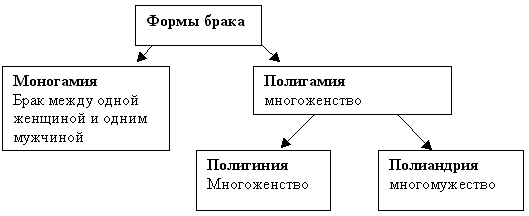
Each of the considered social institutions - marriage and family - implies the existence of its various forms. So, the dominant form of marriage in the modern world is monogamy (monogamy) as the marriage of one man with one woman. But there is polygamy (polygamy), and its most common form is polygyny (polygamy) as a culturally approved and enshrined form of marriage in Muslim countries.
5. Marriage.
You can love and live without the desire to create a family. Some do so.
Met a man and a woman. We liked each other and decided to "converge." Children are born. Everyone lives happily. But their relationship with the state was not registered. Can this group of people be considered a family? (Yes)
A family is a small group based on marriage or consanguinity, whose members are connected by common life and moral responsibility.
Imagine they have no children. Is it possible in this case to call their union a family?
Deeply believing parents of young people insisted on a wedding in the church. There was no registration with state bodies. Can this couple be called a family? (not)
What role does marriage play in creating a family?
(A marriage is a family union of a man and a woman that infringes on their rights and obligations in relation to each other and to children. If marriage is not concluded, then the legal union of the family union has not taken place. And so many rights and obligations that are regulated by law have not arisen. And this can have legal consequences.)
A brief entry in a notebook
Signs of marriage:
6. Legal basis of family-marriage relations
The central problem of the subtopic is the legal foundations of family and marriage relations. It includes a number of aspects:
Work with the Family Code of the Russian Federation
Slide№17-18
The indicated aspects of family life are regulated by the Family Law of the Russian Federation:
Chapter 3 SCRF article 11 The order of marriage
1. Marriage is made in the personal presence of persons entering into marriage, after a month from the date of application to the registry office.
In some cases, the monthly period may be changed, reduced or increased, but not more than 1 month.
Article 12. Marriage conditions
1. For the conclusion of a marriage, mutual voluntary consent of the man and woman who marry and the achievement of marriageable age are required.
Art. thirteen. Age of marriage
1. Marriage age is established from 18 years.
If there are good reasons, at the request of the couple, it can be reduced to 16 years. Good reasons: the pregnancy of the bride, the birth of a child, the draft of the groom in the army.
Art. 14 Circumstances Preventing Marriage
Marriage is not allowed between:
Art. 15. Medical Examination of Marrying Persons
3. If one of the persons entering into marriage hides the presence of a sexually transmitted disease or HIV infection from the other person, the latter has the right to apply to the court with a request to declare the marriage invalid.
A brief entry in a notebook
Slide №19
The validity of the marriage:
Slide №20
The marriage is not valid:
Assignment: "Family Hearth"
Divided into two subgroups, stand facing each other. The first group plays the role of supporters of a family lifestyle. Their task is to convince their partner that without a family a person cannot be happy and healthy, more often they commit crimes, etc. but to convince his partner of this, not only words are needed, but also serious arguments and arguments, including the example of his family. The second group is supporters of a lonely lifestyle. Their task is to answer all the arguments and arguments of supporters of family bonds to defend their point of view. Time - 3 minutes to prepare.
The final part of the lesson. Summarizing on the topic.
D / S 18. answer the questions on page
Literature:
“Marriage is a free and equal union of a man and a woman, concluded in compliance with the order and conditions established by law, with the goal of creating a family and generating mutual personal and property rights and obligations between spouses. In the Old Russian lexicon, the word "brachy" meant something to select (choose the good or reject the bad). Hence the ambiguity of the word “marriage” both in family law and in everyday speech (“rejected goods”). There is no such ambiguity in other languages. So, in the Ukrainian, Belorussian, Polish, Czech and other languages \u200b\u200bof the Slavic peoples, the marriage union is defined by the word “sweetheart” (from the ancient Slavic term “sweetheart”, “sweeten”, which means “agree”). Based on the provisions of the law and theory, we can distinguish following signs of marriage. First, marriage is a union of a man and a woman. The word union is broader than the word deal or contract. In addition to the distribution of responsibilities in the family (if this is done precisely and definitely in the family), the union of a man and a woman involves a certain spiritual community, their pre-disposition towards each other, and preference for others. Secondly, marriage is a single-marriage union, i.e. An alliance in which only one partner is preferred. Thirdly, marriage is a free union.
Marriage is free and voluntary, as is, in principle, free and divorce. Fourthly, marriage is an equal union. A man and a woman who marry are equal both in terms of personal rights (for last name, place of residence, choice of profession, raising their children), and in relation to property acquired by joint labor during marriage. Fifth, and this sign is mandatory, as is the sixth, marriage is such a union that is registered with the registry office (civil registry offices). Sixth, marriage is a union that gives rise to legal rights and obligations between spouses. This applies to both men and women. If the rights of one of the parties turn out to be violated, then the court will defend them.
To conclude a marriage, it is necessary for marriages to reach the marriageable age established by the legislation of the country. In many societies, there is a ban on closely related marriages. In some countries, there are some other restrictions on marriage. A marriage enjoys the protection and patronage of laws only when it is concluded in compliance with established conditions and entails certain legal consequences in the field of personal and property rights and obligations of spouses in relation to each other and to children. ”
(Based on materials from the SCRF)
21. What is the definition of “marriage” given by the author of the article? On the basis of what did the ambiguity of the definition of “marriage” arise?
24. Provide a text clause indicating areas in which marriage has legal consequences. Write down two conditions for legal marriage that are not named by the author of the text.
Marriage is an equal union of a man and a woman, concluded in compliance with the order and conditions established by law, aimed at creating a family and generating mutual personal and property rights and obligations between spouses.
The ambiguity of the definition arose because in the Old Russian lexicon the word "brachy" meant something to be taken away (choose the good or reject the bad).
The correct answer should include:
differences between the concepts of “prenuptial agreement, transaction” and “marriage union”. The word “union” is broader than the word “deal” or “contract”, except for the distribution of responsibilities in the family (if this is done precisely and definitely in the family), the union of a man and woman implies a kind of spiritual community, their predisposition to each other, preference over another;
free marriage: marriage is free and voluntary, as freely divorce.
Mandatory characteristics of the marriage: 1) registration with the registry office and the generation of legal obligations between the parties;
Argument: the law protects any of the parties from violation of its rights (the law prevents the parties from violating the rights of the other side, the law imposes obligations on each of the parties) and is able to enforce the performance of their duties in marriage.
There are “legal consequences in the field of personal and property rights and obligations of spouses in relation to each other and to children”.
Legal marriage conditions:
legal capacity of those entering into marriage;
the person entering into marriage should not be in another registered marriage;
marriage between adoptive parents and adopted children is not allowed.