
While we usually think of women when we talk about breasts, men have breasts, too. Like women, men may cope with breast pain, breast enlargement, nipple pain, and even breast cancer.
Unfortunately, it can sometimes be embarrassing for men to bring up concerns about their breasts. And men may not talk to other men about breast pain.
Let's take a close look at some possible causes of breast pain or swelling in men, including when men may need to be concerned about male breast cancer.
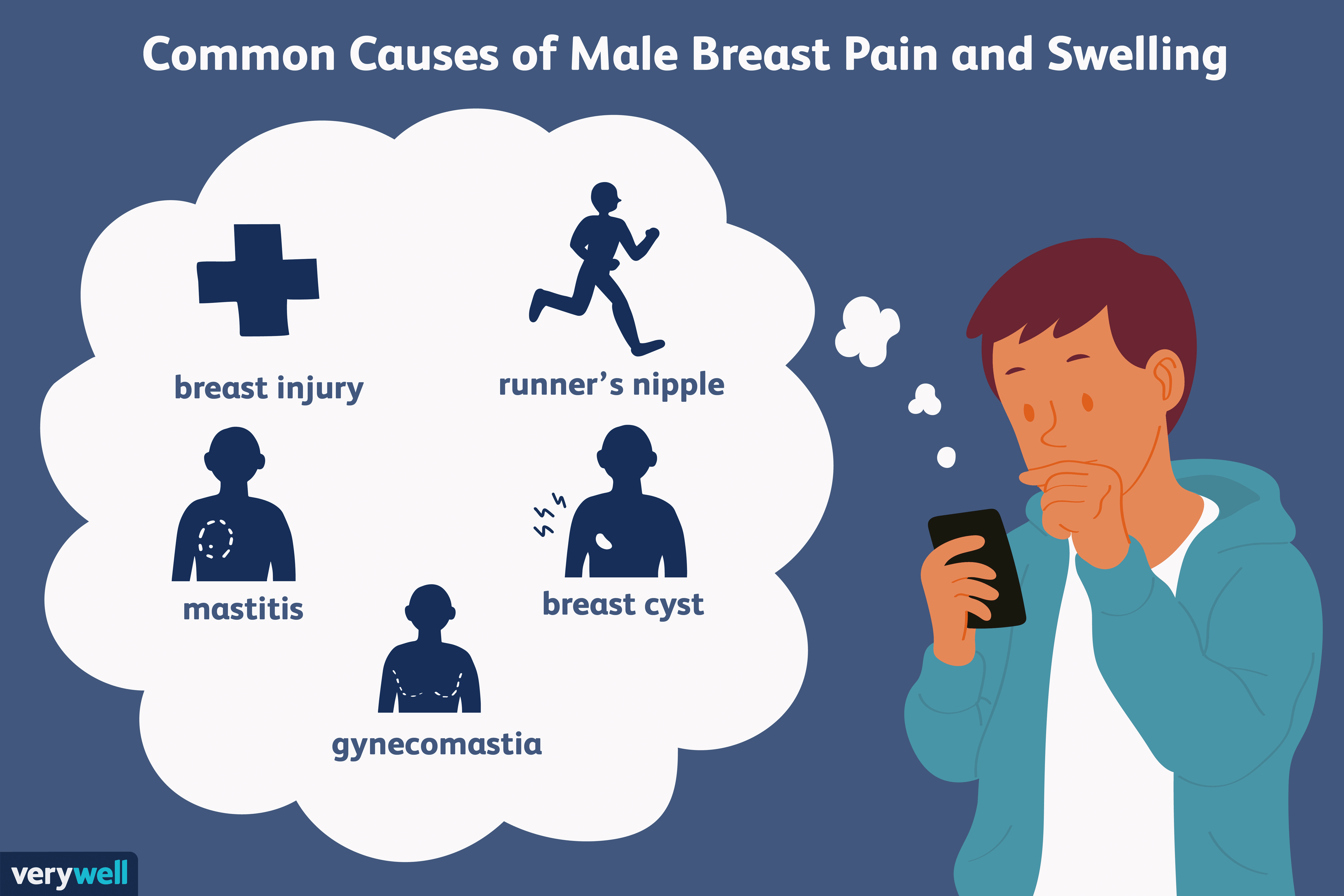
Verywell / Emily Roberts
Before puberty starts and hormones change, breasts look the same in those who were assigned female at birth and those who were assigned male. Children's breasts in both sexes are mainly skin, fat, and connective tissue that supports the nipple and areola.
In the early teen years, sex-specific hormones start to transform bodies for adulthood.
In men, testosterone promotes testicle growth and usually keeps breasts from developing.
In women, estrogen signals milk-producing glands to develop and increases breast size. Pregnancy completes female breast development.
Men often experience breast growth during their teen years. It's a normal process caused by hormone changes. This can make breasts swollen and tender, but probably won't cause breast pain.
This abnormal growth in breast tissue (gynecomastia) occurs in men over the age of 50. It happens because the body naturally starts to make less testosterone.
Age isn't the only thing that can influence breast growth. Any condition that increases estrogen or decreases testosterone can cause gynecomastia. Even young boys and teens can develop it.
Other causes of gynecomastia include:
Certain drugs can also cause gynecomastia, including:
Long-term use or overuse of these medications can increase the risk, especially in older men.
Often, there's more than one factor involved in gynecomastia. For example, someone may have mild gynecomastia because of their age or weight. Then it might get more obvious after they start taking medicine that causes gynecomastia.
Men can experience swollen breasts for a number of reasons, like hormone changes and weight gain. Other causes include getting older (men over age 50 have a higher risk), certain medical conditions, and some medication side effects.
Most causes of male breast pain are benign (not cancer). The pain can be caused by hormone changes, infections, injuries, or even causes that are hard to pinpoint. Some common causes of male breast pain include:
Men might have breast pain if they have a breast injury, infection, irritation, cyst, or noncancerous breast tumor called a fibroadenoma.
Breast cancer in men is much less common than in women. There are 100 cases diagnosed in White women for every case diagnosed in White men. But considering how common breast cancer is in women, male breast cancer does occur.
Male breast cancer is a rare disease and makes up only 0.5% to 1% of all breast cancer cases.
Still, about 2,000 men are diagnosed with breast cancer in the United States each year. Most cases happen to men over the age of 60.
Common risk factors include:
Symptoms of breast cancer in men and women are similar and include:
Most men with breast cancer don't experience any pain. But don't assume a painful breast lump isn't cancer either. It's always worth seeing your doctor for an evaluation.
Symptoms in areas of the body can occur if the cancer has spread (metastatic breast cancer).
This can include:
Men with a family history of breast cancer can do a male breast self-exam (MBSE). This is an easy way to be aware of any breast changes.
Men and women with the mutated BRCA1 or BRCA2 gene have a higher risk of breast cancer.
There are also non-BRCA gene mutations associated with breast cancer. Some of these increase the risk of breast cancer in men. It's important to know your family history of cancer so you can be proactive and get screened for these mutations.
Keep in mind that a family history of other types of cancer can be just as important. For example, BRCA2 mutations increase the risk of breast, prostate, and pancreatic cancer.
If you have a strong family history of cancer, it's important to see a genetic counselor.
Gene testing for cancer risk is still somewhat new, but a good genetic counselor may be able to tell if you're at risk even if your testing is negative.
Male breast cancer is less common than breast cancer in women, but it does still occur and affects about 2,000 men in the United States each year. Symptoms to watch out for include a swollen or lumpy breast, nipple discharge, or scaly skin on your breast.
Breast pain and swelling can happen to men. In many cases, the cause is not of major concern. For example, hormone changes, medication side effects, breast irritation, benign cysts, and other non-serious causes could be to blame.
However, breast pain and swelling can also be due to breast injury, infection, or an underlying medical condition—including cancer.
Be sure to bring your breast pain and swelling up to your doctor. Seek an evaluation as soon as possible if you are also experiencing symptoms like nipple discharge or breast lumps.
The incidence is extremely low, especially compared with women. In 2021, there were about 2,650 new cases of male breast cancer. In contrast, 330,840 women were diagnosed with breast cancer.
Gynecomastia typically results in both breasts being equally swollen, smooth/firm/easily movable breast tissue, and normal breast skin and nipples. Breast cancer, on the other hand, may cause swelling in one breast, rubbery/hard/fixed breast tissue, red skin or sores, and deformed or leaky nipples.
It can be. The five-year survival rates for men with breast cancer range from 22% to 97%, depending on the disease stage when they're diagnosed. The survival rate for all stages combined is 84%. Keep in mind that other factors affect someone's prognosis, including overall health and advances in treatment.