
Nipple pain occurs when you have an aching, tenderness, tingling, throbbing, or burning sensation on your nipple. The pain may or may not be connected with more general breast pain.
It can happen in men as well as women. Depending on the cause of the nipple pain, it can include the areola. This is the ring of pigmented skin around the nipple.
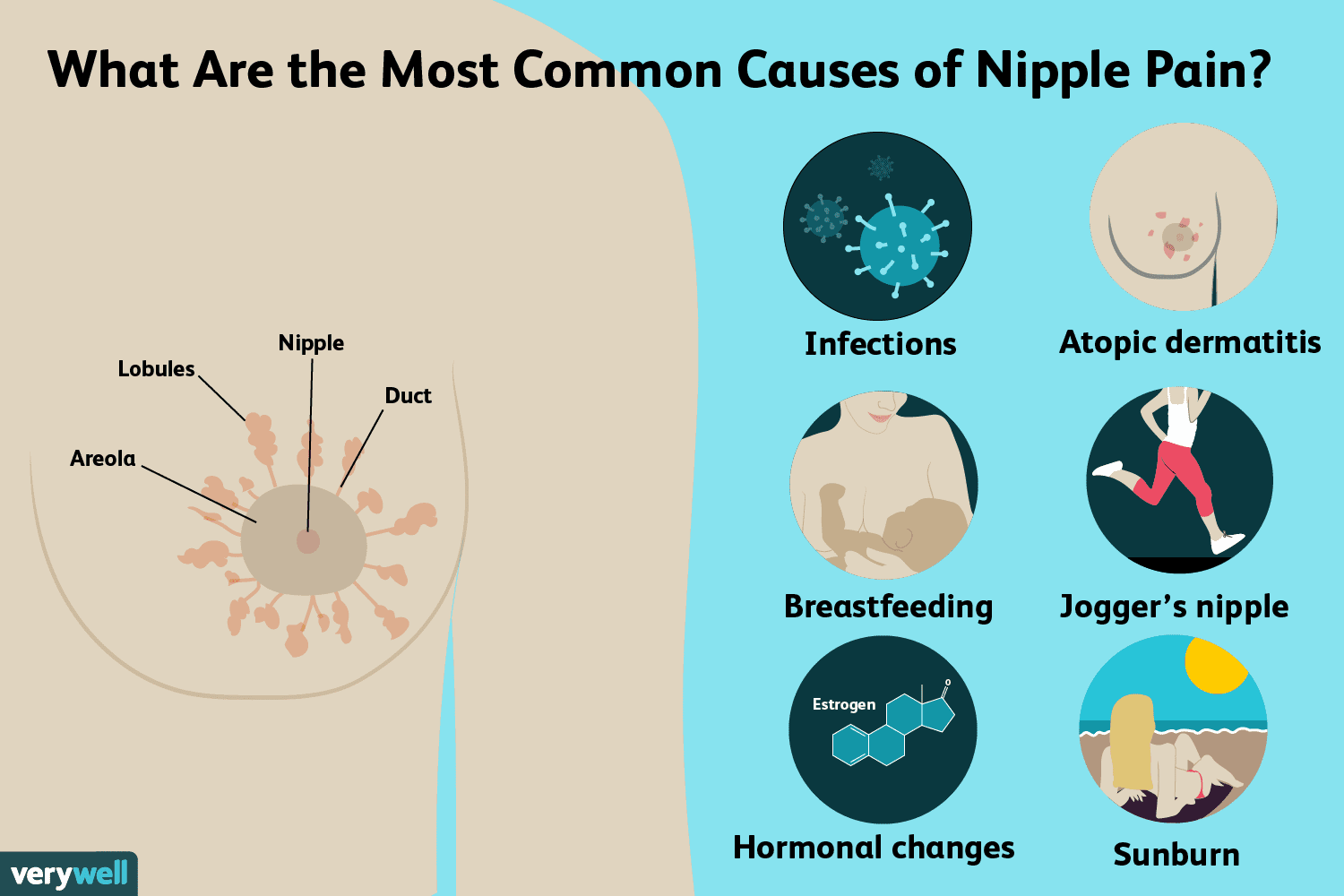
Nipple pain can come from several different causes, but most are not serious. Usually, nipple pain comes from some sort of trauma to the nipple. The most common traumatic causes of nipple pain are breastfeeding, sexual activity, or "jogger's nipple."
Nontraumatic nipple pain is less common. It's still not likely to be serious, but there are signs to look for. It is often caused by the same things that can cause more generalized breast pain.
This article will discuss what causes nipple pain and when you should see a doctor.
Verywell / Alexandra Gordon
Nipple pain can be divided into traumatic—pain from an injury—and nontraumatic pain. Traumatic pain causes are easier to treat. Sometimes that trauma can be subtle and tricky to recognize, however.
The most important way to identify the cause of nipple pain is to consider what you were doing right before the pain started. Some will be obvious causes. Others will not.
All of the most common causes of nipple pain are non-life-threatening. But some do benefit from being treated by a doctor.
Jogger's nipple is a friction burn that comes from clothing rubbing on the nipples. It's very common in runners, especially new runners, and it can affect both men and women. Usually, both nipples are involved.
The irritation can get pretty raw. In the worst cases, the nipples can even bleed. The treatment is to keep the nipples covered and moist, like a burn. If you give it time, it will heal.
For women, the right sports bra will often help avoid future nipple irritation. And most experienced runners don't complain of this type of nipple pain.
But friction burns can lead to nipple pain even when there is no running involved. And they mostly come from bras that don't fit correctly. Try different undergarments to prevent irritation. Applying moisturizer and giving time for the burn to heal will also help.
Mastitis is an infection of the mammary ducts. It can cause nipple pain or more general breast pain. The nipples can become involved in other skin infections, as well, especially if they are already irritated or chapped.
Yeast infections are also fairly common in the nipples. This is especially likely for women who are breastfeeding.
Nipple pain and soreness before a period or during pregnancy are very common. Usually, fluid shifting around in mammary ducts causes swelling. It then causes nipple pain and more general breast soreness. Hormonal nipple pain is completely normal.
Just like friction and breastfeeding, nipple play during sex can lead to irritation and nipple pain. Usually, this problem only lasts for a short while and goes away with a little time to heal. Again, moisturizer is helpful during the healing process.
Breastfeeding is a well-known cause of nipple pain. Just like friction burns, both breastfeeding and expressing (pumping) milk can lead to chapped, irritated, painful, and sometimes bleeding nipples. The right breastfeeding technique can help avoid irritation.
Atopic dermatitis is also known as eczema, a condition that leads to flaky, itchy skin. Atopic dermatitis can affect the nipples as well as the breasts. It's relatively common to find atopic dermatitis on the nipples and areolas. It can happen to one or both nipples.
Most patients who have atopic dermatitis of the nipple also have atopic dermatitis on other parts of their bodies. Eczema can be difficult to treat. There are some over-the-counter medications that can help, but a trip to the doctor might be necessary for particularly stubborn cases.
Some people develop allergies to soaps, laundry detergents, conditioners, or lotions that end up causing a rash, redness, or itching. Nipples are often the first to get irritated by new allergies. And the first sign could be nipple pain.
Sunburns can happen, especially for nipples that don't often see the light of day. This is a potential for both sexes when going topless. So don't forget the sunscreen.
Some causes of nipple pain are less common, and most of these require a visit to the doctor for proper diagnosis. If nipple pain is accompanied by any change in shape or discharge (stuff coming out of the nipple other than during breastfeeding), see a doctor.
Nipple pain that comes with an inverted nipple or a lesion on the nipple or areola can be Paget's disease. Paget's disease can affect the mammary gland or be extramammary (outside the mammary gland). When the nipple is involved, it's considered mammary Paget's disease (MPD). It is highly associated with cancer.
Paget's disease can cause flaky, crusty skin on the nipple that looks similar to eczema. But atopic dermatitis that only affects the areola has no chance of being Paget's disease. That's because the nipple must be involved when you have this particular medical condition.
Paget's disease requires diagnosis by a doctor, usually after doing a biopsy. And Paget's disease only affects one side.
Erosive adenomatosis of the nipple is a benign tumor of the nipple. It requires diagnostic tests to be able to rule out Paget's disease.
Nipple pain by itself does not usually need a doctor's care. If the pain is unbearable or continues for more than 72 hours and the patient has stopped any activity that might be causing the nipple pain, see a doctor.
Breastfeeding mothers experiencing nipple pain should speak to a lactation consultant or the baby's pediatrician. In some cases, the baby could have a short frenulum, a thick bit of tissue attached to the base of the tongue.
This can get in the way of the baby latching onto the nipple properly when breastfeeding. If that's not the case, the doctor or lactation consultant can help with techniques to improve both feeding and nipple care.
When nipple pain is accompanied by growths, discharge, inverted nipples, or the nipple is warm to the touch, see a doctor. You should also see your doctor if the pain has no obvious cause and only affects one nipple.
To diagnose nipple pain, the doctor will ask about your medical history and perform a physical exam. Traumatic causes of nipple pain will be ruled out first. Some causes are easy to determine, such as:
The doctor might have to do tests such as imaging or a biopsy to determine the cause of the nipple pain.
Imaging tests and biopsies are the two most common types of tests that doctors might prescribe for nipple pain. Imaging tests can include mammograms or ultrasounds.
Time is the most common treatment for nipple pain. In most traumatic cases, nipple pain heals on its own as long as the activity that led to the irritation is corrected.
Other treatments depend on the cause of the nipple pain. They might require a doctor to guide the treatment.
Nipple pain occurs when you have an aching, burning, throbbing, tingling, or tender sensation on your nipple. Most nipple pain is normal and nothing to worry about. It could be caused by an allergic reaction, eczema, hormonal changes, sexual activity, or sunburns. In rare cases, nipple irritation may require a trip to the doctor.
If the pain is caused by an activity, either take steps to avoid that activity or find out how to reduce or manage the irritation it is causing.