
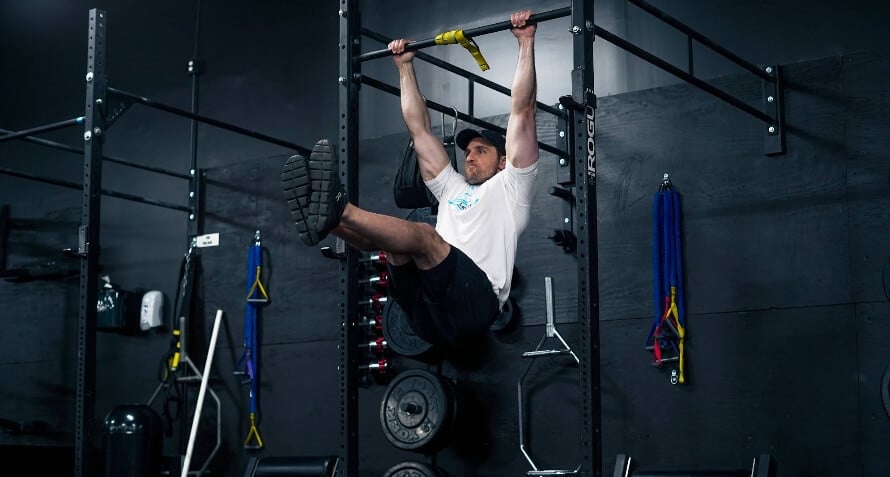
Lower ab training requires two things:
Research shows that ab exercises that involve lifting your legs toward your chest (rather than pulling your chest toward your waist) emphasize the lower portion of your abs more than the upper.1
The reason for this is basically what you’d expect: the part of your abs closest to whatever you’re lifting has to work the hardest.
That means exercises like captain’s chair leg raises, reverse crunches, and scissor kicks emphasize the lower abdominal muscles a bit more than other ab exercises.
That said, the problem with most of these exercises is that they’re body weight exercises that make it difficult to add weight to over time.
Other exercises that are easier to load, like the weighted sit up and cable crunch, still train the lower abs. And because these allow you to train with heavier loads, they’re arguably better all-around exercises for building a six-pack.
Technique is also paramount when it comes to training your abs. If you aren’t mindful of how you perform each rep, it’s easy to rely on other muscles like the hip flexors, which reduces the muscle-building stimulus for your lower abs.
To train your lower abs effectively, you can use the same cue for all of the exercises on this list: as you perform each rep, imagine curling your belt buckle to your bellybutton. This helps you posteriorly tilt your pelvis (which basically means flexing your glutes so your hips shift forward slightly), which research shows better activates your lower abs.234
An important point before you continue:
You’re probably reading this article because you want to get a six-pack or at least improve the definition of your abs. And these exercises will help you do that … if you’re lean enough.
If you have too much body fat, though, you’ll never get six-pack abs regardless of how much or how perfectly you train your lower abs.
For most men, this means reducing your body fat percentage to about 12% or lower. For women, 20% or lower. And since lower-ab fat tends to be the most stubborn, you may need to get even leaner than this to make your lower abs really pop.
The good news, though, is that as you get leaner, even small increases in your abdominal muscle mass become magnified.
Below are two lower ab workout routines, each designed for a different equipment setup. Pick the one that matches what you have access to.
Each routine includes two short workouts—Workout A and Workout B. Do both of these workouts once per week for a total of two lower ab workouts every seven days.
A quick word on programming: rather than doing these as standalone ab workouts, it’s best to add them to the end of two of your existing workouts on non-consecutive days.
For example, if you train Monday, Wednesday, and Friday, you could add lower ab workout A to the end of your Monday workout, and lower ab workout B to the end of your Friday workout.
Looking at these exercises, you may think, “That’s it? Just two exercises per workout?”
Yes, and that’s by design.
Most people do far too many exercises, thinking they need to work the abs from all different angles using myriad different movements, targeting every muscle that makes up their six-pack. This is a waste of time.
The truth is that you only need to do a handful of ab exercises for a few hard sets each week to maximize your ab definition.
While many people think you need to do hundreds of reps to “sculpt” your abs, the opposite is true. The abs are a muscle like any other, and they grow in response to resistance training like any other.
That means picking a few, effective exercises, doing a moderate number of reps per set, pushing yourself hard on each set, and gradually increasing the weight and reps over time (using a system like double progression).
That said, there are many good ab exercises, and so long as you’re using proper technique and training hard, it’s fine to try different options and see which ones you like best. Hence, while you only need to do one or two ab exercises per workout, I’ve included a variety of options below for you to choose from.
You don't need supplements to build muscle, lose fat, and get healthy. But the right ones can help. Take this quiz to learn which ones are best for you.
Take the Quiz

If you want to develop your abs as quickly and efficiently as possible, do these two ab workouts. Each starts with a weighted ab exercise to force your abs to produce high levels of tension, and then a bodyweight exercise to train your abdominal muscles at slightly different angles, with an emphasis on the lower abs.
To progress your weighted lower ab workouts, focus on two things: training hard and gradually increasing the difficulty.
First, finish most sets 1–2 reps shy of “failure“—the point where you can’t complete another rep with good form, despite giving your all.
To judge this, ask yourself at the end of each set, “How many more reps could I have done?” If the answer is more than two, increase the weight or reps on your next set to make it more challenging.
Second, increase the weight or reps over time. For example, if your workout calls for 10–20 reps of the cable crunch and you complete 20 reps in a set, increase the weight by 5 pounds for your next set.
If for whatever reason you don’t have access to weights or simply don’t want to do weighted ab exercises, do these two bodyweight ab workouts. They aren’t as effective as the weighted workouts, but they’re a workable substitute.
Just note that once you can do 20 reps of each exercise (or hold a plank for more than 2+ minutes), you’ll want to start incorporating weighted ab exercises into your routine to avoid plateauing.
Below are the 8 best exercises to include in your lower ab workouts.
Some involve bringing your legs toward your chest, which emphasizes the lower portion of your abs. Others—like the cable crunch and weighted situp—train your entire abs (including your lower abs), and make it easy to apply progressive overload.
Both types belong in a good lower ab workout: leg lifts train your lower abs more directly, while the others let you keep adding weight over time, which is the primary driver of muscle growth.5
Why: The cable crunch trains your ab muscles through a full range of motion, keeps constant tension on the muscles throughout each rep, and allows you to incrementally add weight over time. These three attributes make the cable crunch one of the single best ab exercises you can do.
How to:
Expert Tip: Keep your hips and knees locked in the same position throughout each rep. If you bend or straighten them as you crunch, your hip flexors and glutes start helping with the movement, which makes the exercise easier for your abs.
Why: Like the cable crunch, the weighted situp trains your ab muscles through a full range of motion and allows you to incrementally add weight over time. Some people also find it more comfortable than the cable crunch and feel it better targets their ab muscles. The main downside is that the exercise is relatively easy at the top of the movement (when your chest is closest to your knees) and much more difficult when you’re leaning back, but it’s still better than most exercises in this regard.
How to:
Expert Tip: Keep a firm grip on the weight and make sure you don’t let it slide down your chest—this makes the exercise easier and less effective. Instead, keep it positioned as high on your chest as you comfortably can, just below your chin.
Why: The ab wheel rollout trains your entire core—including your lower abs—isometrically. As you roll forward, your abs have to fight the urge to let your lower back collapse, and as you roll back, they have to pull your body in. Although it’s a bodyweight exercise, which generally aren’t as effective as weighted exercises, it’s actually one of the most demanding ab exercises you can do. Ab wheels are also simple, inexpensive, and found in most gyms, making them a practical option for almost any training setup.
How to:
Expert Tip: Do the movement smoothly. If you find yourself jerking the wheel back and forth, make the exercise easier by not extending the wheel as far forward. To make the exercise harder, you can a) allow the wheel to roll farther forward, b) raise your knees off the floor so you’re balancing on your toes, c) elevate your feet a few inches off the ground d) slow down the movement so it you expose your abs to more time under tension.
Why: The main benefit of the captain’s chair leg raise is that it’s convenient—most gyms have one—and quite challenging for a bodyweight exercise. Most people can only do about 8–10 strict reps per set. This means it produces a high level of tension despite being harder to progress than something like a cable crunch.
How to:
Expert Tip: If you’re not strong enough to lift your legs when they’re perfectly straight, it’s fine to start with a slight bend in your knees. Over time, work toward straightening your legs to gradually increase the resistance. If the regular captain’s chair leg raise feels too easy, you can also add weight by using ankle weights or pinching a small dumbbell between your feet, but this becomes impractical with anything other than relatively light weights.
Why: The captain’s chair knee raise is an easier version of the captain’s chair leg raise. It’s the same exercise, but you bend your knees as you lift your legs, making each rep easier. If you can’t get at least 6–8 strict reps of the captain’s chair leg raise, try the knee raise instead.
How to:
Expert Tip: If you can’t lift your knees all the way to your chest, lift them as high as you can—your thighs parallel to the floor is a good starting point. As you get stronger, work toward bringing your knees closer to your chest.
Why: The reverse crunch is one of the best places to start with lower ab training because it makes the posterior pelvic tilt cue easy to apply and requires minimal equipment and space. It’s also easy to learn and perform, so it’s a great starting point for beginners.
How to:
Expert Tip: Don’t let your legs fall back to the floor between reps. Lowering them slowly keeps your abs working through the entire rep, not just the lifting half of it.
Why: The reverse crunch with hip lift trains your abs the same way as a regular reverse crunch, but the added hip lift at the top increases the total range of motion and likely gives your lower abs a bit more stimulation. It’s a good progression once standard reverse crunches start feeling easy.
How to:
Expert Tip: Press your feet straight up toward the ceiling at the top of the rep, not back over your head. Pushing your feet backward shifts the load to your lower back instead of your abs.
Why: The plank is a uniquely challenging bodyweight exercise—most people struggle to hold this position for more than about 1 minute before needing a break, which means it produces a high level of tension in your abdominal muscles.
How to:
Expert Tip: When you’re learning the plank, do it next to a mirror so you can check your form. Once you know what a flat back feels like—no drooping hips, no butt in the air—you’ll be able to hold the position well anywhere.
How many calories should you eat? What about "macros?" What foods should you eat? Take our 60-second quiz to get science-based answers to these questions and more.
Take the Quiz
You don’t need supplements to build lower ab muscle. That said, the right ones can make the process easier. Here are three worth considering:
Want even more specific supplement advice? Take the Legion Supplement Finder Quiz to learn exactly what supplements are right for you.
Check out these articles: