
Stage 0 breast cancer, often called ductal carcinoma in situ (DCIS), is an early form of breast cancer that originates in the milk ducts of your breast. About 20% of all newly diagnosed breast cancers are DCIS. "In situ" means that the cancer is contained in the ducts or lobules and has not spread to other areas of the breast or lymph nodes.
When caught and treated at stage 0, DCIS has an excellent prognosis.
This article will outline the symptoms, treatments, and advice for coping with early-stage breast cancer.
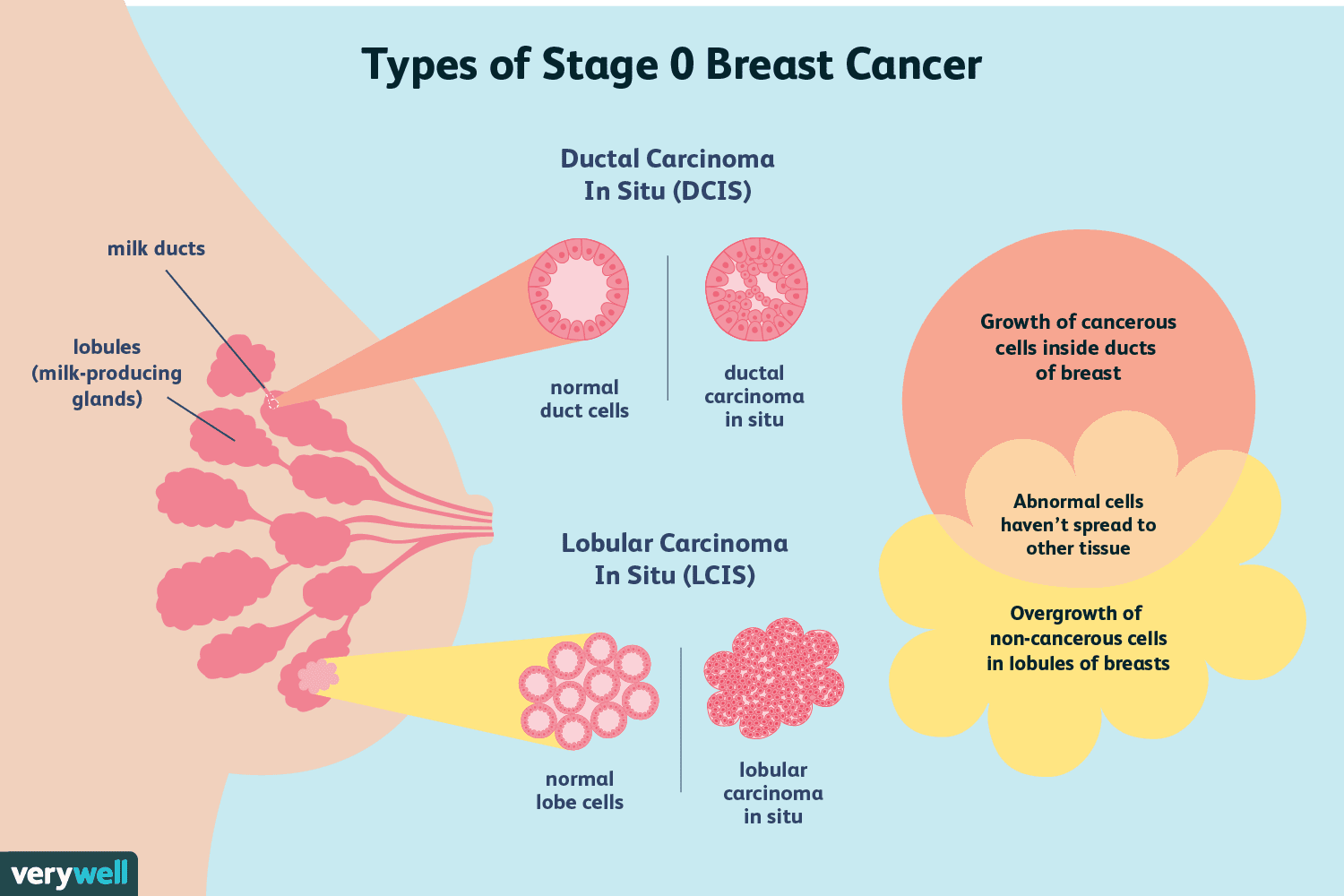
Ductal carcinoma in situ, whether it is found in the lining of your milk ducts or inside the lobes where breast milk is produced, is a contained clump of abnormal cells. Oncologists call it stage 0 because it hasn't broken out of place (has not spread beyond what's called the basement membrane) or invaded other tissues.
There is some debate over whether to consider DCIS precancer or noninvasive cancer. Generally, DCIS is considered noninvasive cancer, while lobular carcinoma (LCIS) is considered a precancerous condition, also called lobular neoplasia.
Learning that your condition is precancerous may make you worry that it will inevitably progress to cancer. This is not always the case, however, precancerous conditions like LCIS should be monitored closely.
A mammogram will detect the abnormal cells in DCIS. The next step is to have a needle biopsy, which is performed to remove the cells in question and have them analyzed under a microscope by a pathologist. Your doctor will help you translate the pathology report to help you make decisions about whether to treat immediately or "watch and wait."
You can ask for a copy of your pathology report to get a second opinion, and most pathologists will encourage you to do this. Getting a second opinion can be done by telehealth instead of having to have an-person visit in a lot of cases.
The staging system most often used for breast cancer is the American Joint Committee on Cancer (AJCC) TNM system. The TNM Staging System is based on the extent of the tumor (T), the extent of spread to the lymph nodes (N), and the presence of metastasis (M). Numbers or letters after T, N, and M provide more details about these classifications. Using this classification system, stage 0 can be grouped as follows:
Once the T, N, and M are determined, they are combined, and an overall stage of 0, 1, 2, 3, or 4 is assigned.
Not all stage 0 breast cancers require treatment. Some oncologists may recommend active monitoring, or a watch-and-wait approach, to see if the carcinoma will remain stable or if it will progress. Others recommend standard cancer treatments such as surgery, radiation, or chemotherapy.
In terms of patient perspectives, some people would prefer having any suspicious areas removed if there is a chance that stage 0 could become invasive cancer, whereas others are more comfortable with a conservative approach of waiting, along with careful follow-up.
Numerous factors will affect your treatment plan. Some of these include:
Treatment options may include a lumpectomy (surgery to remove the cancerous tissue and a rim of normal tissue around it), followed by radiation (using high doses of radiation to kill cancer cells), or mastectomy (surgery to remove the breast) if there's a concern that there may be other regions of cancer in the breast or if there's a strong family history of breast cancer.
Hormone therapy may follow for at least five years, with tamoxifen often used for premenopausal women and aromatase inhibitors for those who are postmenopausal, as they block estrogen in hormone-receptor positive breast cancers.
Get our printable guide for your next doctor's appointment to help you ask the right questions.
The outlook is good for people diagnosed with stage 0 breast cancers. When localized stage 0 breast cancer is detected early and treated, the five-year relative survival rate is 90%, according to the American Cancer Society.
After treatment for stage 0 breast cancer, you face a small risk of recurrence or the future development of invasive breast cancer. Your healthcare provider may recommend more frequent exams and/or tests so any future cancers can be caught and treated early.
Better understanding of what stage 0 breast cancer is (and isn't) is one of the best steps you can take to cope with your diagnosis. It puts your condition in perspective and can help temper worries.
Although it's common to feel helpless at first, know that the more you educate yourself about treatment options and the emotional aspect of the diagnosis, the better prepared you'll be to deal with the road ahead.
An organization called CancerCare.org has individual counselors and support groups to help connect you with others in the same situation. They also offer education and financial assistance.
Stage 0 breast cancer, DCIS, is the earliest stage of localized breast cancer, affecting approximately 49,290 women this year. Being diagnosed at this early stage sets you up for an excellent outcome. After getting a diagnosis, the pathology report and a second opinion will help you and your medical team make the best decisions for your treatment and follow-up care.
A cancer diagnosis can be overwhelming. But with a stage 0 diagnosis, you're facing the best-case scenario by catching it early. Work closely with your healthcare provider to create a treatment plan that's best for you, and move forward with the knowledge that what you have is not only treatable but highly curable.
Yes, and recurrence may be related to age. Younger women are more likely to be at risk for local recurrence and may opt for treatment sooner.
Not always. Some physicians recommend a wait-and-see approach. If the cancer does not stay localized, surgery—whether it is a lumpectomy or mastectomy—may be recommended.
Anyone can be at risk for stage 0 breast cancer. Risk increases if you have a direct relative with breast cancer or if you carry genetic mutations for breast cancer, like BRCA1/BRCA2.
Having a mastectomy is a very personal decision. You should talk with your physician and an oncology surgeon who specializes in breast cancer to talk about your options. If you have a family history of breast cancer, you may have a higher sense of urgency to have this procedure rather than waiting it out.
Learn More: Mastectomy: An Overview