
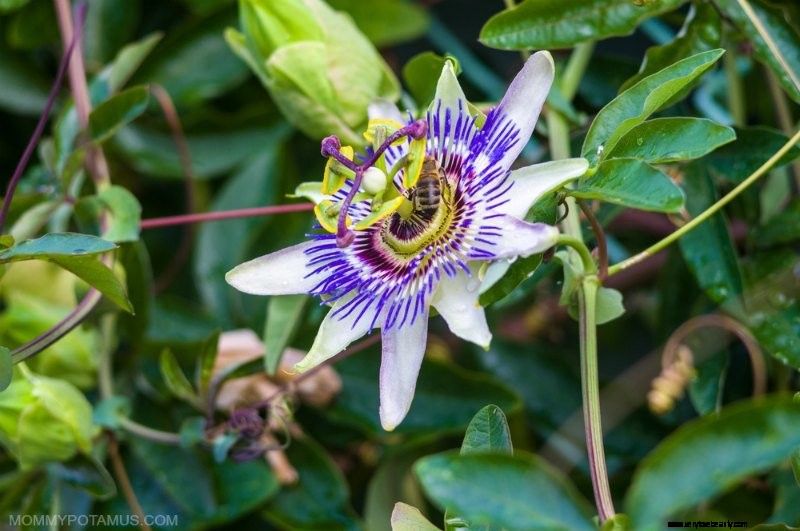
Used for centuries throughout South and Central America, the stunningly gorgeous passionflower vine (Passiflora incarnata) has long been renowned for its ability to support restful sleep, calm mental chatter and more.
Of course modern life is very different – we always get enough sleep (especially parents) and never feel like like our minds won’t shut off – so now it’s just cultivated for its beauty.
Or not. 🙂
Also known as apricot vine, purple passionflower, passion vine and corona de cristo, passionflower has become an essential part of my herbal toolkit. It’s therapeutic effect on the nervous system is helpful for both kids and adults, and it’s super easy to prepare as a tea.
It’s a climbing vine that produces gorgeous flowers and bright yellow passion fruits – also called maracujas or maypops – that are around the size of an egg. If you’ve ever tasted store-bought fruit punch, you’ve experienced the distinctive flavor of passion fruit. (Or at least something similar to it. I’m not sure what the ingredients were when I tried it as a kid, but these days the most the most popular brand uses corn syrup and flavorings instead of the real fruit.)
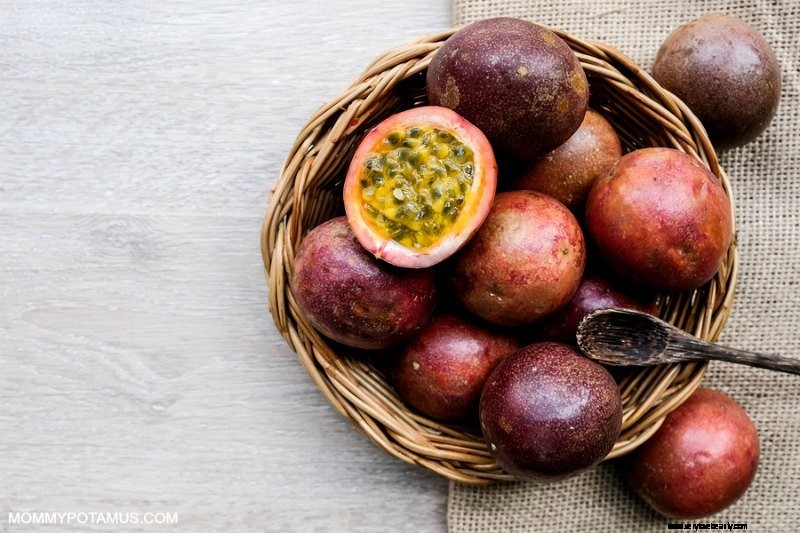
According to one of my herbal books, they’re called “maypop because children in the south jump on it, to make it pop.” It can be peeled and eaten raw, or made into juice or jam.
From a therapeutic standpoint, the petals, leaves and vine of the passionflower vine are what you want for brewing tea, making a tincture, or using topically as a poultice. All three contain bioactive compounds that produce a gentle sedative effect, including:
We’ll dive into the benefits of passionflower soon, but first I want to mention that – as always – none of these statements have been evaluated by the FDA, this article is not medical advice, and it is not meant to diagnose or treat any condition. If you have a question about whether this herb (or any other) is right for you, please talk with a qualified healthcare provider. Okay, let’s dive in!
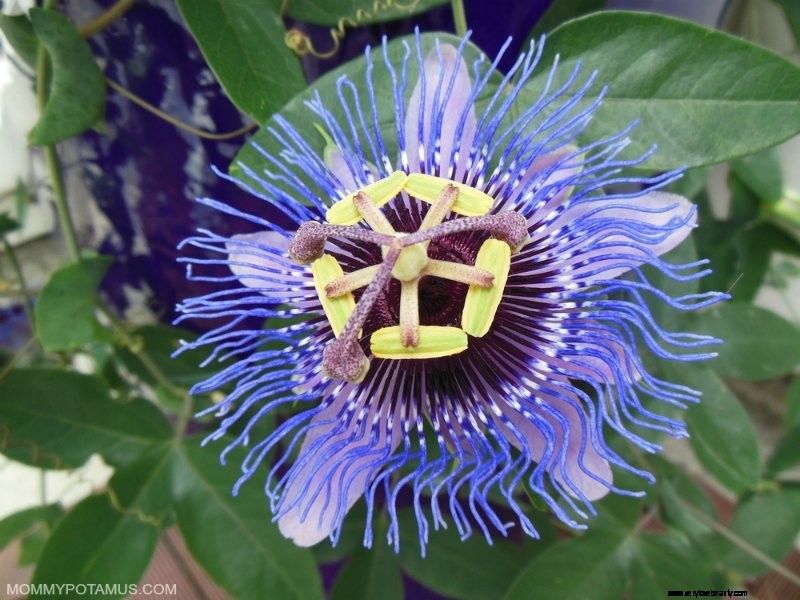
Although its name has led many to believe that it’s an aphrodisiac, passionflower doesn’t refer to romantic passion. The name was coined by 16th century travelers who thought that different parts of the flower symbolized the passion of the Christ.
So what’s special about passionflower, and how does it compare to other herbs? In Medical Herbalism, David Hoffman classifies the relative strength of hypnotic herbs (aka herbs that support restful sleep) like this:
Mild: Mugwort (Artemisia vulgaris), Wood Betony (Stachys officinalis), Motherwort (Leonurus cardiaca), Chamomile (Matricaria recutita), Big-leaved Linden (Tilia platyphyllos)
Moderate: California Poppy (Eschscholzia califonrica), Pasque flower (Pulsatilla vulgaris), Skullcap (Scutellaria lateriflora), Vervain (Verbena officinalis)
Strong: Hops (Humulus lupulus), Wild Lettuce (Lactuca virosa), Jamacian dogwood (Piscidia erythrina), Passionflower (Passiflora incarnata), Valerian Root (Valeriana officinalis)
Although not a comprehensive list, you can see that passionflower and another herb I’ve written about – valerian root – are considered among the most potent sleep-supporting herbs. That may be in part because both herb support gamma-aminobutyric acid (GABA) production, which is one of the main sedative neurotransmitters our brain makes. (4) (5)
GABA is associated with a positive mood, a sense of tranquility, restful sleep, and calm focus. (6) (7) (8) (9) Stress and poor sleep can cause us to burn through our stores more quickly than usual, so in challenging times it may be helpful to support GABA production.
According to WebMD, low levels of GABA may be linked to anxiety and/or mood disorders and chronic pain. (8) Other possible symptoms of low GABA are difficulty relaxing, feeling overwhelmed, becoming easily frustrated, and bowel issues. (10) The conversion of serotonin to melatonin, which is often called “The Sleep Hormone,” is dependent on GABA. (11)
Other supplements that may be helpful for supporting GABA are:
The relationship between passionflower and GABA plays a significant role in the benefits we’ll talk about later below, but the other constituents I mentioned earlier also contribute to the benefits.
Here are the top traditional uses, plus what modern research has to say about them.
According to herbalists David Winston and Steven Maimes, passionflower is helpful for:
“The person [who] can’t shut off his mind at night, and . . . lays in bed thinking about the day, yesterday, tomorrow, last month, next month, what if this, and if only that. I have had patients tell me it’s like having a talk radio station in their heads and they can’t find the off switch. Passionflower is the off switch.” (12)
Modern research seems to support this perspective. In this clinical trial, an extract containing passionflower, valerian root and hops had a beneficial effect on both sleep quality and duration.
Passionflower is a nervine, which is “a category of herbs with the capacity to act therapeutically on the nervous system by eliciting a calming effect on excited nerves. By helping us navigate high-stress demands on a cellular level, these plants and nutrients can deepen and strengthen our energetic reserves and support our ability to rebound more quickly from challenging situations.” (13)
Nervines are often used along with adaptogens during challenging times to increase our resilience during acute or long-term stress. (13) (14)
The indole alkaloids in passionflower may have a positive effect on neurotransmitters other than GABA – dopamine, serotonin and noradrenaline to be specific – that are tied to our overall mood. (15)
“Passionflower is a relaxing nervine, often combined with other nervines to reduce stress and tension and to aid sleep. It helps to quiet mental chatter.” – The Modern Herbal Dispensatory
Commission E, which is basically the German version of the FDA, supports its use for easing nervous restlessness. (16)
Some research suggests that it may be also helpful for hyperactive children. (17)
Although more research is needed, a 2016 study found that passionflower reduced stress levels and improved spatial memory in rats. The researchers believe these effects are likely due to passionflower’s effect on GABA.
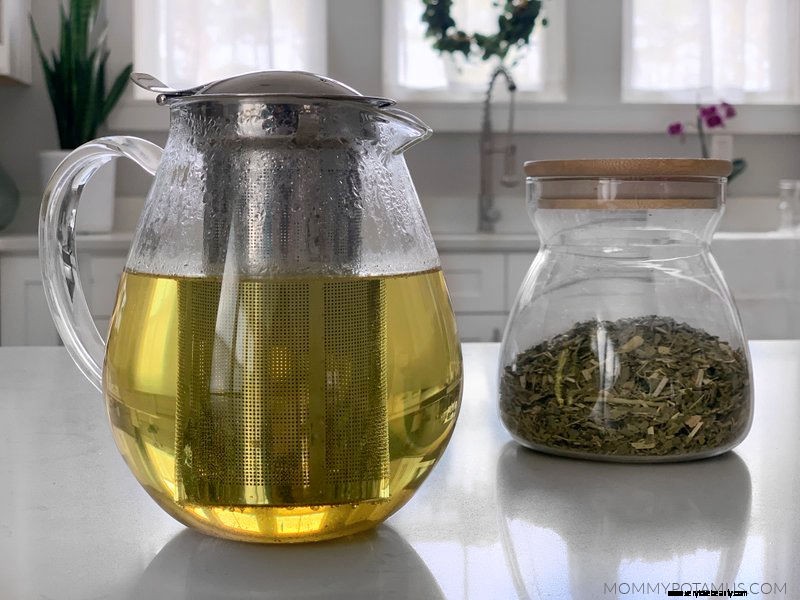
This relaxing passionflower tea recipe can be consumed before bed to support deep, restful sleep. It can also be sipped throughout the day to quiet mental chatter, increase resilience to stress, and lift mood.
Tinctures are potent (even at small doses), rapidly absorbed (making them fast-acting), portable, and long-lasting (they have the longest shelf-life of any herbal preparation). Here’s how to make one using dried or fresh passionflower:
You’ll want to use 1 gram (by weight) dried herb and 5 milliliters (by volume) menstruum, aka the liquid used to extract the herb. This ratio can be doubled, tripled or more, as long as the ratio stays the same.
Although intuitively it seems like a menstruum with a higher alcohol content would be best for extraction, it’s actually best to use a vodka (or brandy or whatever you prefer) that is 50-65% alcohol by volume (100-130 proof). Here’s why: Alcohol and water extract different constituents, so using a menstruum that has a lower alcohol content and more water yields a more full-spectrum extraction.
You’ll want to use 1 gram fresh herb (by weight) to 2 milliliters (by volume) menstruum. Because fresh passionflower leaves, stems and flowers naturally contain a lot more water than the dried herb, you’ll want to use a menstruum with a higher alcohol content. The menstruum will draw out the water and dilute the final product so that it’s similar in alcohol content to the one made with dried passionflower. Many herbalists suggest 160-190 proof.