
You may have been diagnosed with or are worried about breast cancer. If so, you may wonder how fast it develops, grows, and spreads.
The concern comes with questions like when the cancer started, how fast it will double in size, and how quickly it might spread to lymph nodes, bones, or other regions of the body. The answers vary based on your own genetic makeup, the type of cancer, and how far it may have advanced already.
This article looks at the factors that can affect the growth rate of cancer, and how long it takes one of these tumors to develop. It also explains why the answers are important for people living with breast cancer today.
Verywell / Laura Porter
People with a breast cancer diagnosis often wonder how long ago the cancer first started. This is never easy to answer. Some experts suggest that it's likely that many tumors begin a minimum of five years before they are detected.
One main reason for why people ask about how fast breast cancer grows, or its doubling time, is when they consider how long to wait to begin treatment. This growth rate also is important to understand if you have a lump and have been advised to simply observe it over time.
In general, the growth of breast cancer can be quite variable, but several studies provide at least an estimate of what may be happening.
Unless your healthcare provider is extremely confident that a lump is benign, it should be evaluated right away rather than waiting.
Cancer begins when there are genetic changes, called mutations, in a normal breast cell. These changes happen in genes that control the growth of the cell. These changes may occur over a long period of time, even decades, before a cancer cell forms.
These tumor cells multiply and divide exponentially, meaning that one cell becomes two, two cells become four, and so on. That's why a tumor size will increase more rapidly, the larger it becomes.
That said, not all cells are dividing at the same time. The cancer's growth can change at different stages as a tumor forms. Compared with many types of cancer, breast cancer has a "low growth fraction." This means that the proportion of cancer cells that are in an active cell cycle is low.
Some tumors, such as lymphomas and some leukemias, have much higher growth fractions. They may be active for a much shorter period of time before they are detected, even in children.
Why Doesn't the Body Get Rid of Cancer Cells?An important way to think about how fast a breast cancer grows is by looking at what's called the volume doubling time. Growth rate is a part of tumor doubling time, which is exactly what it sounds like. It is the amount of time it takes for a tumor to double in size.
It would be unethical to leave a cancer untreated to see how rapidly it will grow, so researchers estimate the doubling time. However, when looking at these models, it becomes clear that doubling time estimates vary from study to study.
A 2018 study estimated doubling time by looking at serial ultrasounds in 265 people with invasive breast cancer to see if there were differences among breast cancer subtypes. These images were taken between diagnosis and surgery. The results suggest that growth varied significantly based on the breast cancer subtype and the role of estrogen receptors in those subtypes.
During an average interval of 57 days, 36% of tumors did not change in size, while 64% grew. Of those tumors that increased in size, the average gain in volume was 34.5%. Tumors that were triple negative had greater increases in volume and shorter doubling times than those that were estrogen receptor positive and HER2 negative tumors.
A similar 2016 study looked at growth in 323 people, based on ultrasound images taken between diagnosis and surgery over a 31 day period, On average, the tumors grew from 1.47 centimeters (cm) to 1.56 cm in diameter. The daily growth rate based on type was:
How fast a breast cancer grows is key information for those concerned about the disease. It is based on how quickly genetic changes add up as a cancer cell divides and spreads. One common measure looks at how long it takes for a tumor to double in size because of this growth. This "doubling time" may depend on the subtype of breast cancer. Studies suggest tumors that are triple negative have shorter doubling times than those that are estrogen receptor positive and HER2 negative tumors.
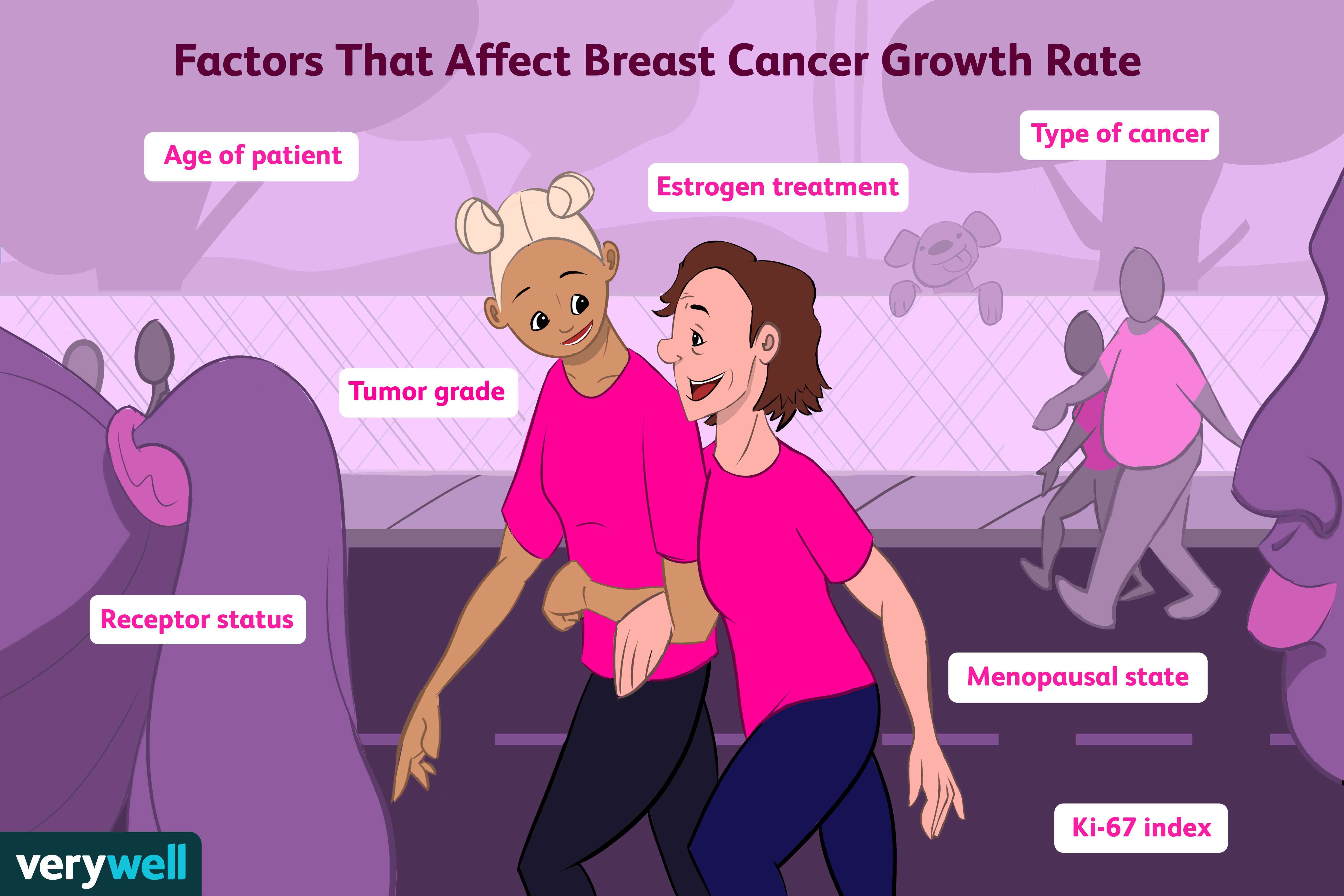
A number of studies have identified other factors that affect the rate of growth of a breast cancer. These include:
Metastasis, the spread of breast cancer to other parts of the body, is responsible for the majority of breast cancer deaths. This makes it important to know how fast a breast cancer spreads.
Breast cancer usually spreads first to lymph nodes under the arm. This is called lymph node-positive breast cancer. Breast cancer is considered early-stage and potentially curable even with the involvement of lymph nodes.
When a cancer spreads to regions such as the bones, brain, lungs, or liver, it is considered stage IV or metastatic breast cancer. This means it is no longer curable.
Most breast cancers have the potential to spread. Carcinoma in situ or stage 0 breast cancer is considered non-invasive because of its limited spread. It is potentially 100% curable with surgery.
All other stages of breast cancer (stage I to stage IV) are considered invasive and have the potential to spread. Spread to lymph nodes, even when early stage, is very important because it indicates the cancer's potential to spread beyond the breasts.
Symptoms and Diagnosis of Breast Cancer MetastasisSome types of breast cancer, as well as their subtypes, are more likely to spread (and spread earlier) than other types. For example, ductal carcinoma is more likely to spread than lobular carcinoma, among tumors that are the same size and stage.
Many breast cancers do not spread to lymph nodes until the tumor is at least 2 cm to 3 cm in diameter. Some types may spread very early, even when a tumor is less than 1 cm in size.
For very small and very large breast tumors, there is little evidence to link tumor size and lymph node spread. For tumors in the range most commonly seen clinically, the size of the tumor does correlate with the risk of lymph nodes being involved.
A number of factors, such as age or having a history of hormone replacement therapy, can influence the growth rate of breast cancer cells. This is important when thinking about whether a breast cancer has spread to the lymph nodes or other organs, or has not spread at all. The type of breast cancer also matters because some can spread more quickly and do so with tumors that are still relatively small.
How Long Can You Wait to Start Treatment for Breast Cancer?The actual time it takes for breast cancer to grow from a single cancer cell to a cancerous tumor is unknown. Part of the reason is that estimates based on doubling time assume that the rate stays constant at all times as the tumor grows.
If this were true, cancer with a doubling time of 200 days would take 20 years to develop into a detectable tumor. A doubling time of 100 days would take 10 years to be found on exam. In contrast, a breast tumor with a doubling time of 20 days would take only 2 years to develop.
Most studies have found the average doubling time to be between 50 days and 200 days. This means it's possible that breast cancers diagnosed now began at least 5 years earlier, but again, this assumes the growth rate is constant. It is not.
The earlier a breast cancer is found, the greater the chance it can be cured. This is what makes routine mammogram screening and self-breast exams so important.
The size at which you can feel a breast lump can vary. Lumps tend to be larger when people find them at home rather than when a healthcare provider does.
When examined by a healthcare provider:
When women perform self-exams:
While there has been controversy over whether women need to perform self-breast exams, it's clear that doing regular breast exams is likely to find a tumor when it is smaller.
Signs of Early, Metastatic, and Inflammatory Breast CancerBreast cancers are sometimes detected when very small by the presence of microcalcifications in the breast. (These are small calcium deposits that may be an early sign of cancer.) The average size of a tumor found by mammogram is 1.1 cm. The earliest a tumor may be found on a mammogram is when it is between 0.2 cm and 0.3 cm in diameter.
Researchers have looked at how effective mammograms are in finding breast cancer. Some believe that a rise in women having mammograms from the 1980s on is associated with trends in the average size of tumors at the time of breast cancer diagnosis.
From 1984 to 2014, the average size of breast cancer at the time of diagnosis decreased 26%, from 2.6 cm to 2.0 cm. However, a different study looked at the size of breast tumors at diagnosis from 2001 and 2014. It found that, unlike earlier, the size of breast tumors increased by 3% to 13%.
So far, there is little data to describe the average size or the smallest size of a breast tumor that can be found by breast MRI. It may be a more sensitive and useful tool for women who have a family history of familial breast cancer.
A newer technique called "fast MRI" may offer a higher detection rate than mammogram alone for people of average risk, especially women who have dense breast tissue.
Fast MRI Screening for Breast CancerHow fast a breast cancer grows is determined by the growth rate of cancer cells. It also relies on "doubling time" models used to estimate that growth. The subtype of breast cancer is a main factor in its growth. Other factors include the Ki-67 tumor marker level and the tumor grade, which involves the physical characteristics of cancer cells when seen under a microscope in the lab.
How quickly the cancer grows can vary, but early detection may lead to better outcomes. Be sure to contact your healthcare provider for routine mammogram screening and exams that may help to find breast cancer in its earliest and most treatable stages.
Women are often told they can wait to begin treatment. It's true that a short wait may be important while getting a second opinion and preparing for care. But waiting longer may not be better, especially with tumors that are triple negative or have other patterns of rapid growth.
How fast some tumors may spread is a key factor when deciding on treatment options. Be sure to see your healthcare provider immediately if you have a breast lump, and to discuss your options if you need breast cancer treatment.
According to the National Cancer Institute, five-year survival rates for breast cancer diagnosed between 2010 and 2016 were as follows:
Inflammatory breast cancer grows and spreads faster than other types of breast cancer. Symptoms develop quickly, usually within three to six months. These include breast swelling, purple or red skin color, and dimpling or thickening of the skin of the breast.
Learn More: What Is Inflammatory Breast Cancer?