
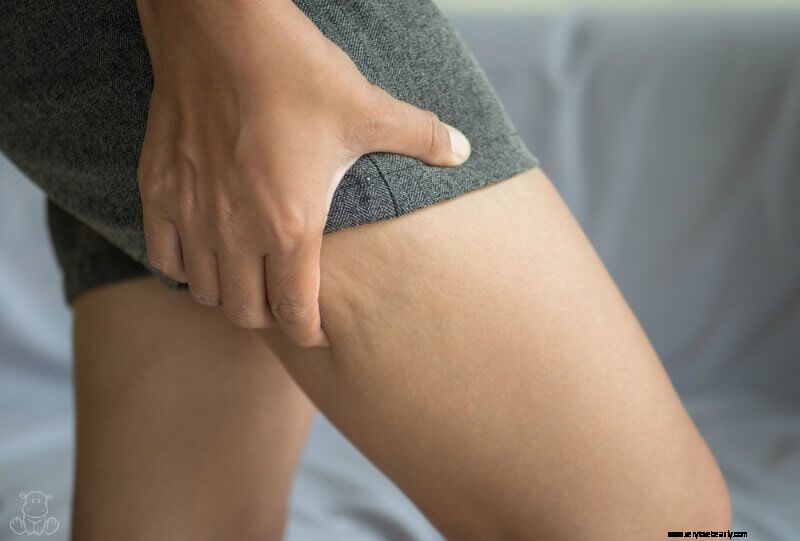
“But why?” <– If there was a phrase that should be taped to my forehead, it’s probably that one. I’ve never given a lot of thought to cellulite because I considered a normal part of life – about ninety percent of women (and girls who have gone through puberty) and ten percent of men have it. Then I heard that in some indigenous cultures cellulite virtually unheard of – even among women in their 60s and beyond – and I had to find out why.
So what is cellulite and what causes it? Although it’s usually considered just a cosmetic concern, cellulite can offer valuable insight into the overall health of our skin, connective tissue, blood vessels and lymphatic system as well as hormone levels. We’ll dive into the details below, plus what research says about cellulite treatments.
The technical terms for cellulite are adiposis edematosa and lipodystrophy, but most of us know it by more common terms like “orange peel skin” or “cottage cheese skin,” which describe the appearance of lumpy or pitted fat deposits under the skin.
It most commonly occurs on the derrière and thighs, but it can also appear on the stomach, hips, and upper arms. According to Dr. Lionel Bissoon, M.D., who wrote The Cellulite Cure, it can be classified into four categories:
Quick side note: Although I learned a lot from The Cellulite Cure and The Cellulite Solution (which was written by an M.D. named Dr. Murad), I don’t recommend either as a complete guide. The Cellulite Cure does a great job of explaining the likely causes of cellulite and prevention, but the only treatment suggested is a medical procedure that is only offered by a few doctors. (The book also contains some comments and cartoon illustrations that some might find insensitive.)
The Cellulite Solution focuses more on diet and lifestyle solutions. Although the overall strategy provided is very helpful, some of the recommendations (especially specific food recommendations) are not supported by current research.
In this series I’ve compiled what I believe to be the most valuable insights from both books, plus research from other studies and sources.
One of the most fascinating sections of The Cellulite Cure was a collection of photos that were taken of the Shipibo women of Peru and the Jaibro women of the Amazon. Even at 60+ years old, these mothers and grandmothers did not have any visible cellulite.
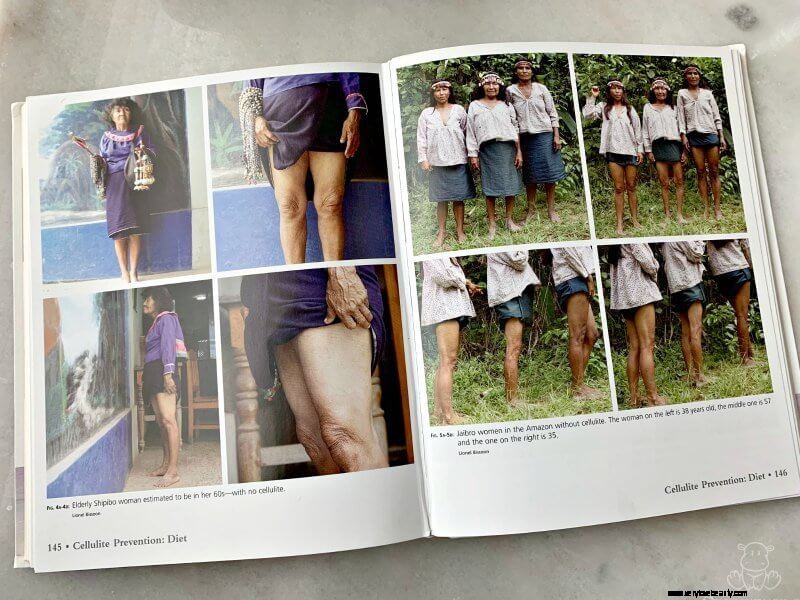
What contributes to the formation of cellulite in most of us that is absent in these cultures? Several factors seem to play a role, including hormone imbalances, inadequate intake of nutrients that support connective tissue (collagen, for example), the type of clothing worn, lifestyle, and poor lymphatic function.
Dr. Bisson and Dr. Murad share similar perspectives on how cellulite forms. Basically, they describe it as a domino effect that goes like this:
In the photo below, the mesh bag represents the skin and collagen matrix that can become weakened and allow fat cells to herniate through and become visible.

Of course, cellulite is known irregular dimples and lumps instead of the uniform bumpy appearance in the photo above. If I cut the mesh bag so that some areas were weaker than others that would more accurately represent cellulite, but I didn’t because I didn’t want to ruin the bag. (And in case you’re wondering, the stuff in the bag is homemade slime that was given to my daughter at a birthday party.)
Now that we’ve got the basics covered, let’s take a closer look at each step of the process:
Estrogen plays a vital role in vascular health, and too little of it can negatively affect blood vessel function.
In a Scientific American interview, Dr. Bissoon explains:
For some people it may be possible to have low estrogen and one point and high estrogen at another.
When estrogen is low, blood vessels in the dermis can’t work as well, which decreases the circulation of blood (bringing nutrients to the area) and lymph fluid (taking waste away). Other factors that contribute to decreased microcirculation include:
Yep, tight underpants reduce circulation, which means the body can’t get optimal levels of nutrients to the area or efficiently clear waste away. There’s actually even something called Panty Girdle Syndrome, which happens when women develop leg edema (swelling) from wearing underwear that severely constricts the groin and buttocks areas. (2)
The groin area contains a lot of lymph nodes, so keeping that area free flowing is essential for healthy lymphatic function. Regarding elastic underwear bands over the derrière, Dr. Bissoon notes that in his experience, a lot of the dimpling he sees in patients coincides exactly with the panty line. Here are the general guidelines he suggests for reducing this effect:
Also, the lymphatic system doesn’t have a pump like the heart, so it relies on movement and gravity to move fluid throughout the body. When we sit for long periods lymph can become stagnant, so it’s best to take breaks and do something active (like a walk) every hour or so.
When the area becomes nutrient deficient and filled with excess lymph waste, the connective tissue in the area starts to become inflamed and break down.
Our skin and connective tissue are like a net that’s supposed to hold fat cells in place. As connective tissue breaks down, it becomes damaged and rigid instead of supple and elastic. Underneath, the fat cells absorb toxins and stuff that have been stagnating in the area, which causes them to swell push their way to the surface. Once the fat cells move close to the surface, they become visible cellulite.
Because men have more testosterone than women, their connective tissue structure is more tightly woven.
There are are other factors that contribute also. In a nutshell, women have:
These factors make it easier for women to store fat in cellulite prone areas and more difficult to burn that fat when needed. If the other factors come into play (decreased microcirculation, for example), there is more fat present to herniate and push through the connective tissue.
Many women report that their cellulite increased during pregnancy. That may be because during the first two trimesters, estrogen is low relative to progesterone, lymph drainage is often slowed, and weight gain can cause hormone sensitive fat cells in the thighs and buttocks to swell and exert pressure on the collagen matrix.
If enough pressure is exerted, this can cause degeneration of the connective tissues that hold fat cells in the normal position
Some doctors say that while cellulite creams, laser treatment, dietary changes and other methods may improve appearance of cellulite in the short-term, they don’t correct the underlying issues.
However Dr. Murad, who conducted a double-blind, placebo controlled study on his 3-pronged (healthy diet, skincare, and lifestyle) approach to cellulite, found that it is possible to repair the collagen matrix and skin.
And by diet, I don’t mean a restrictive approach geared toward weight loss. As Dr. Murad wrote, “Banishing cellulite is not about eating less. It’s about eating enough of the right things.” (4)
However, some of his nutritional advice is based on older research. For example, he recommends large doses of essential fatty acids, which are very important for collagen synthesis. Although I definitely make a goal of getting enough, new research suggests that more is not always better, and in fact taking large quantities of essential fatty acids can actually cause inflammation.
All in all, though, the information definitely points in the right direction in terms of approach – it just needs some modification due to research that was published after the book was written.
Some of his recommendations are things I was already doing (or have done at some point), and others I’ll be implementing for the first time as a personal experiment. I’m working on a follow-up post that outlines his three-pronged approach so you can join me if you’d like to.
Based on Dr. Murad’s work, it seems that the diet, lifestyle and skincare factors that can help in the treatment of cellulite are also beneficial for slowing or stopping its progression. We’ll cover them in the next post.
Have a question about cellulite? Please leave it in the comments!
Article Sources:
1. Harmon, Katherine (2009) Is Cellulite Forever? Retrieved from https://www.scientificamerican.com/article/is-cellulite-forever/
2. deBuda, Yvonne (1968) The Pantygirdle Syndrome and Other Common Problems Related to the Habits of the Modern Woman. Retrieved from https://www.ncbi.nlm.nih.gov/pmc/articles/PMC2281014/
3. Bissoon, Lionel (2006) The Cellulite Cure
4. Murad, Howard (2005) The Cellulite Solution