
7 min read
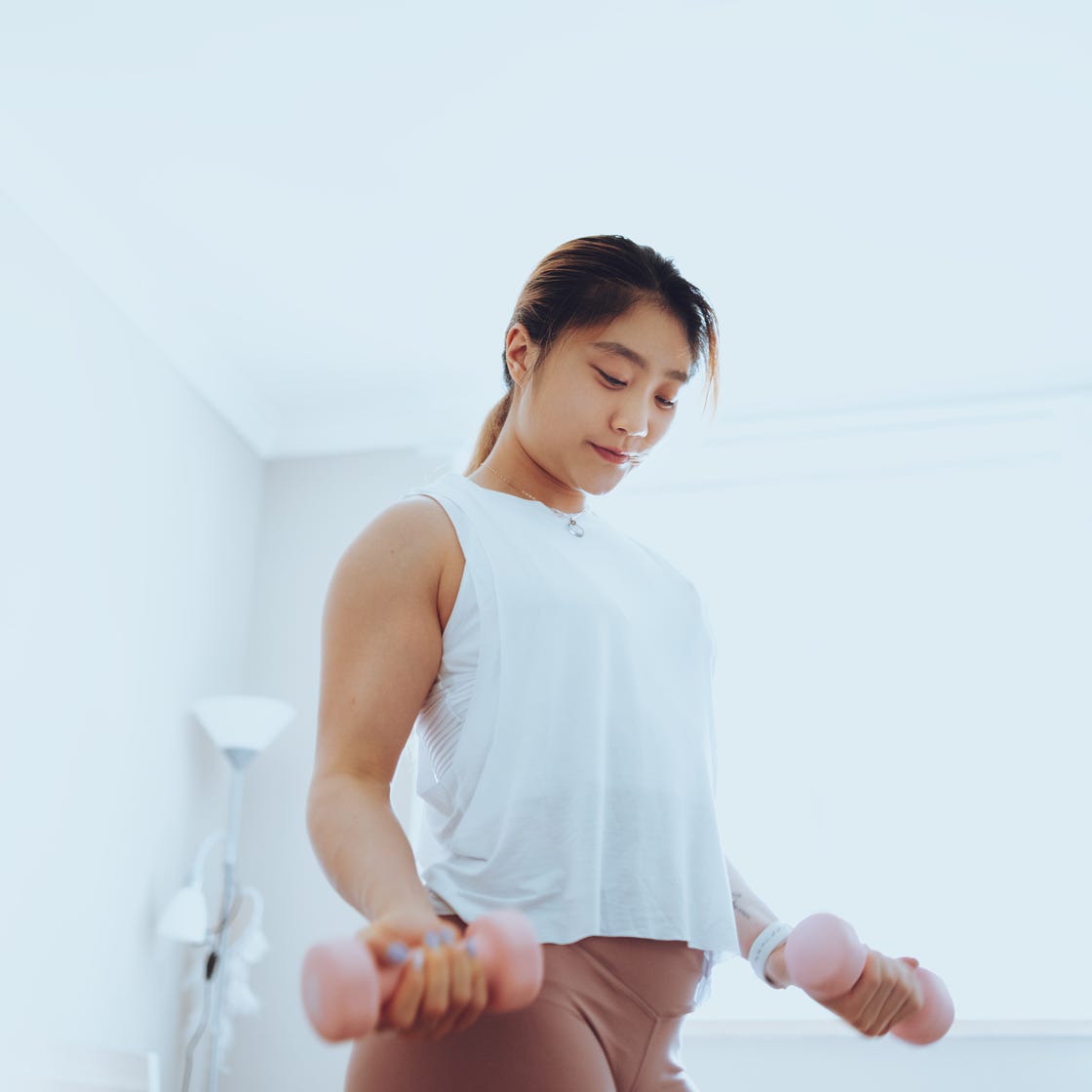
What if you could fit in the same number of exercises in your workout, but cut your total gym time (or home gym time) down significantly? That's the promise of supersets, a simple technique that helps you maximize your sweat sessions.
Basically, since supersets involve grouping two somewhat unique exercises together, you'll minimize the time you spend taking rest breaks between sets, explains fitness coach Rachel Trotta, CPT.
But that's not all: "Supersets increase your muscular endurance and allow you to burn more calories efficiently," adds Brittany Watts, CPT, a personal trainer and head coach at Tone House in New York City.
That's why both Watts and Trotta incorporate supersets with clients who have all sorts of goals—from those who are short on time to those who want to build muscle.
Meet the experts: Rachel Trotta, CPT, is a fitness coach with specializations in women’s fitness, pre/postnatal, nutrition, and therapeutic exercise. Brittany Watts, CPT, is a personal trainer and head coach at Tone House in New York City. Riley O’Donnell, CPT, is an instructor at Fhitting Room in New York City. Annie Cooper, CPT, is a certified personal trainer, running coach, and founder of Tuneintofitness.
But what is a superset, really? And how can you use them to improve your strength, muscular endurance, and maximize the time you spend exercising? Read on for everything you need to know about supersets, including how to do them, the risks involved, the various types you can try, and more.
“A superset is just a way to program your workout in which you go from one exercise right into another, with no rest in between,” says Riley O’Donnell, CPT, an instructor at Fhitting Room in New York City.
So, instead of doing multiple sets of one move and resting in between each before continuing onto multiple sets of a second, you pair the two exercises together and wait to rest until after you've completed both—effectively cutting the amount of time you spend resting in half.
The specific moves you pick for each pair matter. In a superset, your two paired exercises work opposing muscle groups, Watts explains. For example, you might start with biceps curls and then move straight into triceps kickbacks to hit the back of your upper arm while the front of it recovers.
Supersets are often confused with compound sets, but they are unique. In a compound set, you group together two exercises for the same muscle group, Watts says. So, in this case, you might start with triceps kickbacks and continue with overhead triceps extensions to really burn out your tris.
Supersets work well for anyone looking to get stronger, O’Donnell says. People who are used to cardio might also find they love strength training this way because there’s not much downtime.
The lack of rest also makes supersets a great approach for those trying to lose weight, says Watts. After all, the more of your workout time you actually spend moving, the more calories you burn.
Finally, if you’re super busy (please tell me your secret if you're not), you'll save so much time using supersets that you'll never go back.
O’Donnell and Watts break down allll the perks of supersetting your workouts, based on their own experience with clients, plus what research has to say.
Depending on your strength and muscle-building goals, there are a few distinct types of supersets you can try.
Pro tip: If you’re at the gym, “assemble a superset area for yourself by carrying equipment from one part of the gym to another part of the gym,” Trotta explains. For example, bringing dumbbells into the squat rack, so that you can pair up barbell exercises with dumbbell exercises for your super or giant set.
When creating supersets, O’Donnell loves to combine a push and pull move for upper body, and hip- and knee-dominant exercises for lower body.
For upper body, that might look like a chest press and a bent-over row or pushups and pullups. For lower body, try a deadlift and a squat or a hamstring curl and a leg extension.
To help sift through the many combinations, Annie Cooper, CPT, founder of Tuneintofitness, shares her favorite supersets that hit muscles from head to toe.
Example Superset Exercise Pairings:
Or, just go ahead and follow along with this 10-minute superset abs workout the founders of Tone It Up programmed exclusively for Women's Health:
If you already have a slew of go-to moves you use in strength training workouts, all you have to do is reorganize them into the proper pairs to transform your sweat into a superset routine.
To get some cardio into your session, you can also go from your superset into something that gets your heart pumping, like kettlebell swings, med ball slams, or box jumps, O’Donnell recommends.
For the most part, supersets are considered pretty safe to carry out on your own, Trotta explains. That said, “the only time people should be concerned about supersets is if they feel they can’t perform both exercises well because of fatigue." Exhaustion or fatigue can be dangerous during supersets, especially if the second exercise has a high fall risk, like box jumps. At the very least, compromised form can lead to less effective movements, and the whole point of supersets is that they're supposed to be efficient.
For this reason, “I usually recommend that people use higher-coordination moves, even burpees, earlier in workouts as a warmup, rather than as a finisher when they’re already exhausted,” Trotta says. And if you're looking for a high-intensity finisher, Trotta suggests cycling or rowing "sprints" versus a complicated strength move, superset or not.
Though supersets don't really have any downsides, you can mess with their effectiveness if you don't plan (and execute!) them properly. Here's how to do them right, according to experts:
Maxing out on exercises you pair in a superset. Similar to how doing a complex movement while fatigued can up your injury risk, so too can going too heavy: "That's a quick way to get injured," Watts explains. "If you are going to try to attempt a maximum load for a lift, you should focus on that one lift. Attempting another maximum could compromise form and lead to injury." So, don't go trying to squat as much as humanly possible and then immediately do the same on a deadlift.
Being too focused on reps, reps, reps. Work with a challenging-but-doable weight for your usual number of reps (say eight to 12). “The goal shouldn’t be how many reps you do by the end," says O’Donnell. "Instead, focus on feeling a burnout by the end of the full superset.”






Mallory Creveling is an ACE-certified personal trainer and RRCA-certified run coach, who also holds certifications in kettlebell training, sports performance, and more. She has more than a decade of experience covering fitness, health, and nutrition for a wide range of publications, and nearly 10 years of experience as a trainer and fitness instructor. Mallory stays on top of her continuing education in fitness, as well as the latest science in wellness. She has worked with some of the best experts in their medical fields, and regularly interviews researchers, trainers, athletes, and more to find the best advice for readers looking to improve their performance and well-being. As a freelance writer, Mallory's work appeared in Women's Health, Self, Men's Journal, Reader's Digest, and more. She has also held staff editorial positions at Family Circle and Shape magazines, as well as DailyBurn.com. A former New Yorker/Brooklynite, she's now based in Easton, Pennsylvania.

Madeline Howard is a writer, editor, and creative based in Brooklyn. Her work has been published in Esquire, Nylon, Cosmopolitan, and other publications. Amongst other things, she was formerly an editor at Women's Health. Subscribe to her newsletter 'hey howie' at madelinehoward.substack.com.