
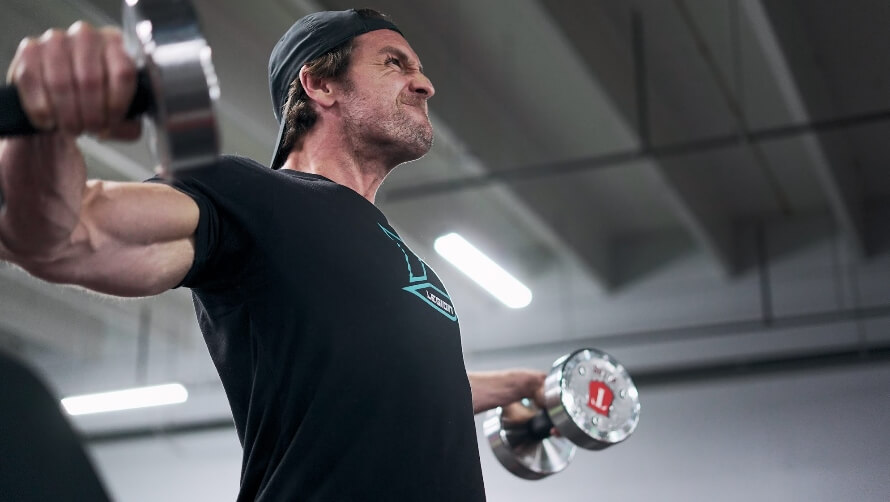
If you want to build muscle, get stronger, and improve your physique without a gym full of equipment, a full-body dumbbell workout is one of the simplest ways to do it.
Dumbbells are versatile tools that let you train every major muscle group with heavy weights and progressively overload your muscles over time. That makes them ideal if you train at home, travel often, or just want a routine that’s effective without being complicated.
With the right exercise selection and structure, you can train your entire body in a few short workouts each week and get results comparable to more complex programs.
That’s exactly what the plan below is designed to do.
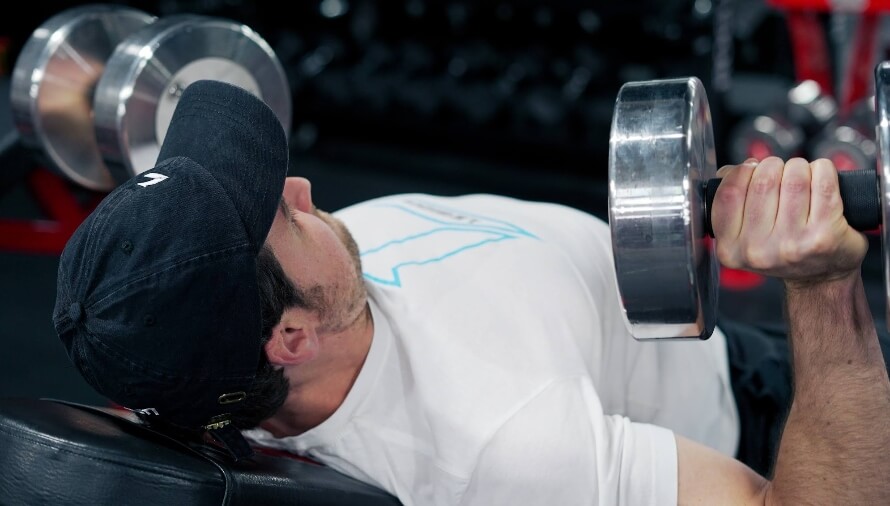
The best 3-day full-body dumbbell workout routines train all major muscle groups multiple times per week using a small number of compound exercises that are easy to progressively overload.
That’s exactly what the routine below does. It uses a small number of exercises that let you train hard and lift heavier weight over time without machines or complex setups.
It’s also highly efficient. The exercises overlap so all your major muscle groups get enough weekly stimulation to grow, helping you build a balanced physique while keeping each workout short and manageable.
This combination of frequency, simplicity, and progression is what makes full-body dumbbell training effective for building muscle, gaining strength, and improving body composition.
Here’s the 3-day full-body dumbbell workout routine:

Each workout above is built around a few key exercises. Here’s how to perform each one correctly so you get the most out of the program.
Muscles Worked: Glutes, hamstrings, lower back, traps
Why: The dumbbell deadlift trains your entire posterior chain in one movement, making it highly time efficient. It also allows you to handle relatively heavy weights, which is ideal for gaining size and strength.
How to:
READ MORE: How to Do the Dumbbell Deadlift with Proper Form
You don't need supplements to build muscle, lose fat, and get healthy. But the right ones can help. Take this quiz to learn which ones are best for you.
Take the Quiz
Muscles Worked: Quads, glutes, hamstrings
Why: The dumbbell lunge trains your entire lower body one leg at a time, helping you build balanced strength and muscle. Because of its dynamic nature, it also helps you develop coordination, balance and stability.
How to:
READ MORE: Dumbbell Reverse Lunge: Muscles Worked, Form & Variations
Muscles Worked: Deltoids, triceps, traps
Why: The standing dumbbell shoulder press trains your shoulders and triceps together, making it an efficient upper-body pressing exercise. Because you’re standing, it also develops core stability and balance.
How to:
Muscles Worked: Biceps
Why: The dumbbell biceps curl directly trains your biceps, which get limited stimulation from most compound dumbbell exercises. Including it ensures you fully develop your arms and avoid muscle imbalances.
How to:
READ MORE: How to Do the Dumbbell Curl: Form, Benefits, and Variations
Muscles Worked: Chest, triceps, shoulders
Why: The dumbbell bench press trains all the major upper-body pressing muscles in one movement, making it highly efficient. Using dumbbells also allows a slightly longer range of motion than barbell presses, which can help stimulate additional muscle growth
How to:
READ MORE: How to Dumbbell Bench Press: Form, Benefits, and Variations
Muscles Worked: Quads, glutes
Why: The dumbbell front squat trains your quads and glutes while also requiring core stability to keep your torso upright. It’s an effective lower-body exercise that’s easy to load and perform with minimal equipment.
How to:
READ MORE: How to Do Dumbbell Front Squats for Leg Mass & Strength
Muscles Worked: Hamstrings, glutes, lower back
Why: The dumbbell Romanian deadlift trains your hamstrings and glutes while deeply stretched, which may help boost growth.
How to:
READ MORE: How to Do the Romanian Deadlift: Form, Benefits, and Variations
Muscles Worked: Lats, chest, triceps
Why: The dumbbell pullover trains your lats and chest in a single movement, helping you build upper-body size with fewer exercises. It also trains your muscles through a long range of motion, which can improve muscle growth.
How to:
READ MORE: How to Do the Dumbbell Pullover for Lats and Chest Size
Muscles Worked: Quads, glutes, hamstrings
Why: The Bulgarian split squat lets you train each leg hard using relatively light weights by placing most of the load on one leg. This makes it an efficient way to build lower-body strength with dumbbells.
How to:
READ MORE: How to Perform Bulgarian Split Squats for Glutes, Hamstrings & Quad Growth
Muscles Worked: Lats, traps, rhomboids, rear delts
Why: The one-arm dumbbell row trains your mid- and upper-back, helping you build a stronger, more balanced upper body. Training one side at a time also helps address strength differences between sides.
How to:
READ MORE: How to Do the Bent-Over Dumbbell Row
Muscles Worked: Pecs, shoulders, triceps
Why: The incline dumbbell bench press emphasizes the upper portion of your chest, helping you build a more balanced upper body.
How to:
READ MORE: How to Do an Incline Dumbbell Press & Common Alternatives
Muscles Worked: Side delts
Why: The dumbbell side lateral raise isolates your side deltoids, which are key for building shoulder width. Including it ensures your shoulders are fully developed.
How to:
READ MORE: How to Do Lateral Raises: Form, Mistakes, & Variations
How many calories should you eat? What about "macros?" What foods should you eat? Take our 60-second quiz to get science-based answers to these questions and more.
Take the Quiz
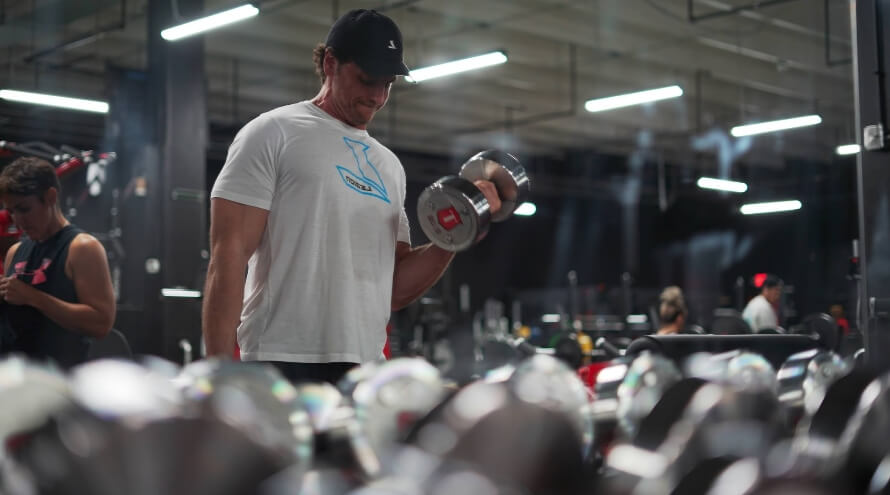
Choosing the right weights for an exercise mostly comes down to quick, common-sense experimentation.
When you’re new to an exercise, start lighter than you think you need, then add weight set by set until you find your “working” weights (those that are appropriate for your hard sets).
A good working weight is one that lets you:
If you finish and feel like you could do 4–5 more reps, it’s too light. If you have to “cheat” (swing the weight, jerk your body, do half-reps, etc.) it’s too heavy.
If you’re completely unsure of where to start, the following chart will help you find your starting weights faster:
Progress drives muscle growth—if you don’t gradually challenge your muscles more, you won’t get stronger or grow.
To progress your full-body dumbbell strength workouts, focus on two things: training hard enough and gradually increasing the difficulty.
First, train close to failure.
Finish most sets 1–2 reps shy of “failure”—the point where you can’t complete another rep with good form.
A simple way to judge this is to ask yourself at the end of each set, “How many more reps could I have done?”
If the answer is more than two, increase the weight or reps on your next set to make it more challenging.
Second, increase the weight or reps over time.
For example, if your workout calls for 8–10 reps of the dumbbell deadlift and you complete 10 reps in a set, increase the weight by 10 pounds for your next set.
If you do 7 reps or fewer in subsequent sets, reduce the load by 5 pounds to stay in the 8–10 rep range.
Apply this approach consistently, and you’ll continue to get bigger and stronger over time.
You don’t need supplements to build full-body muscle and strength, but the right ones can help you get there faster. Here are three worth considering:
Want even more specific supplement advice? Take the Legion Supplement Finder Quiz to learn exactly what supplements are right for you.
A 3-day full-body dumbbell workout is one of the simplest and most effective ways to build muscle, gain strength, and improve your physique.
By focusing on a small number of compound exercises and progressing over time, you can train your entire body efficiently with minimal equipment and get results comparable to more complex programs.
Yes—dumbbells are more than enough to build muscle if you train hard and progressively increase the weight or reps over time.
Research shows muscle growth depends primarily on how much tension your muscles produce (how much force they generate against resistance) and effort, not equipment.3 As long as you use effective exercises and push close to failure, dumbbells work extremely well.
Three full-body dumbbell workouts per week works best for most people, as it balances progress, recovery, and time efficiency.
Yes—full-body dumbbell workouts are ideal for beginners because they’re simple, efficient, and easy to learn. You can focus on a small number of exercises, practice good form, and make steady progress without needing complex programs or equipment. Just start with lighter weights and increase them gradually as you get stronger.
Check out these articles: