
Many things can alter the appearance, shape, or texture of your nipple or areola. Sometimes these are temporary, like a reaction to the cold.
Hormonal changes and aging can cause normal changes in the nipples as well. But in some cases, nipple changes are a sign of a medical problem.
This article will teach you what's normal, what's not, and when you should call your healthcare provider.
Breast Anatomy Is Complex and Intricate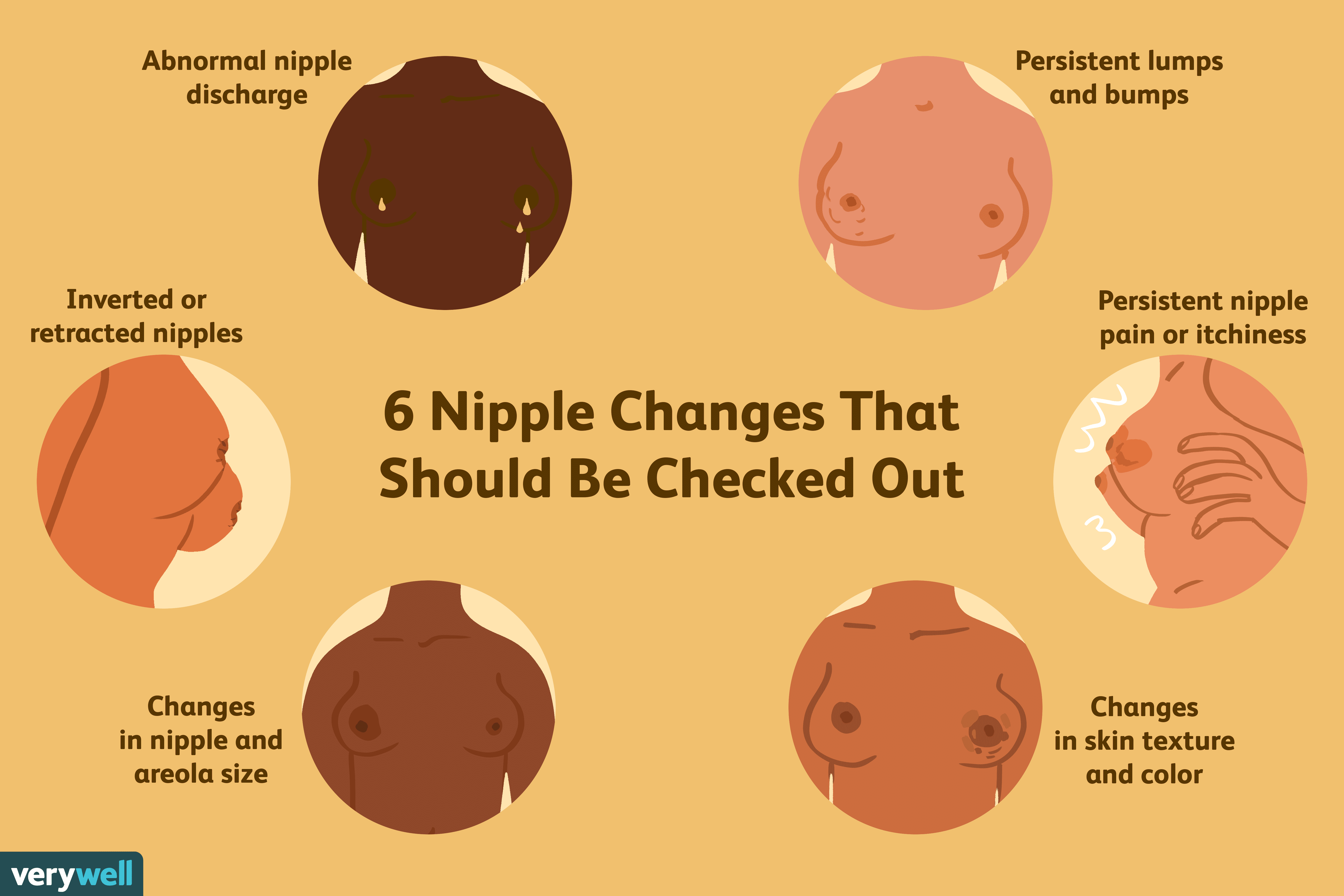
Verywell / Emily Roberts
The areola is a circle around the nipple. Areolas vary in size. On female breasts, they typically range between 3 and 6 centimeters (1.2 inches to 2.4 inches).
The areola is often darker than the nipple itself. Depending on your skin tone, it can range from pale pink to dark brown.
It's normal for breasts, areolas, and nipples to swell at times, such as:
Your nipples and areola may get darker during pregnancy. Your areola may also get larger.
They'll likely stay that way during pregnancy and breastfeeding. Later, they may or may not go back to their pre-pregnancy size and color.
It could indicate a problem is size and color changes accompany:
Changes to the nipple and the areola of one breast are more concerning than changes in both. Still, you should report any unusual changes to your healthcare provider.
The skin on the nipple is normally smooth. The areola has small bumps called Montgomery glands.
Often, a change in areola texture is due to eczema. That's a treatable, itchy skin rash. Eczema is likely if it affects other areas of the body, as well.
More concerning areola texture changes include:
These can be symptoms of inflammatory breast cancer (IBC). That's a rare disease that causes swelling and redness of the breast.
Another rare cancer is Paget's disease of the nipple. It starts on the nipple and spreads to the areola. It may cause breast lumps or tumors over time. The nipple may become red and shiny, or thick, rough, and scaly.
Watch for changes in the size, color, or texture of your nipples and areolas. These may be due to normal hormonal fluctuations. Or they may be signs of a serious problem.
One-sided changes tend to be more concerning. Rare breast cancers may cause an orange-peel texture or rough and scaly nipples.
Your nipple normally becomes erect when touched or exposed to cold. The areola may get bumpy as well.
Mongomery's glands (areola bumps) may change at other times. These changes may be normal or abnormal.
During pregnancy, the Montgomery glands enlarge. That prepares you for breastfeeding. Your areola may get bumpier.
The glands also make lubrication and an odor believed to attract an infant to the breast.
Pimples or ingrown hair can also cause areola bumps.
Montgomery glands can get clogged and become infected. That can cause pain plus one enlarged bump on the areola. This may need to be treated with antibiotics.
You should see a healthcare provider if you're not pregnant and develop any bumps or lumps:
It's normal to have a few hairs on your areolas. But you should watch for problems that can arise and be aware of changes.
Plucking or shaving your areola can cause ingrown hair. That's when a strand of hair grows back into the skin.
Ingrown hairs can cause bumps similar to pimples.
Cutting or shaving are better options. Tweezing can lead to infected follicles.
It's not typical to have more than a few strands of hair on the areola. More than that can be a sign of polycystic ovary disease (PCOS).
PCOS is a hormonal imbalance that can cause infertility. Other symptoms include:
Talk to your healthcare provider if you notice an increase in hair on your breasts.
Areola bumps may enlarge during pregnancy. Pimples or ingrown hair can also cause bumps. The glands also can become infected.
A small amount of areola hair is normal. Excess hair may be a symptom of polycystic ovary disease.
Discharge from the nipple is fairly uncommon and not always abnormal. They can be caused by hormonal changes.
Nipple discharge typically comes out of the milk ducts. It may be:
The consistency can vary from thick and viscous to thin and watery. In benign (not harmful) conditions, the discharge usually comes from both breasts.
It may come out on its own (spontaneously) or only when your breasts are squeezed or stimulated.
During pregnancy, a milky discharge is normal. That's because the breasts are getting ready to produce milk.
Sometimes, the menstrual cycle can cause discharge.
You should have any nipple discharge checked by your healthcare provider. Common causes include:
Nipple discharge is more likely to be related to breast cancer when:
Some nipple discharge is normal. It can be caused by hormonal changes during pregnancy and menstruation. Still, always have it checked. Some causes are more serious, including breast cancer.
Some causes of pain are normal or expected. Others may be cause for concern.
It's common for your breasts and nipples to hurt right before your period. Breastfeeding can cause raw, cracked, and bleeding nipples.
A 2018 study estimated breastfeeding causes sore nipples at some point in 80% to 90% of cases.
Several benign, treatable conditions are associated with nipple pain. They include:
All of these can be easily treated.
Raynaud's phenomenon, or nipple vasoconstriction, occurs during breastfeeding. It causes episodes of pain, burning, and/or tingling when:
No symptoms occur between episodes.
In rare cases, nipple pain is a symptom of breast cancer. That's particularly true of Paget's disease of the nipple.
See your healthcare provider if you have:
Some people's nipples are more sensitive than others. They may be irritated by certain laundry detergents or fabrics.
For example, if you jog or run long distances, you're more likely to have nipple pain. It's caused by chafing from the fabric of a bra or shirt.
A snug-fitting jogging bra or bandages over your nipples can help. Choose bras made of soft fabrics (or padding) for your everyday bras. And use a mild, scent-free laundry detergent.
Causes of Nipple PainNipples may hurt just before your period or during breastfeeding. Other causes are benign but need treatment, like mastitis and eczema.
Raynaud's phenomenon causes pain and tingling. Paget's disease of the nipple can cause pain.
Sensitive nipples can be aggravated by fabric or laundry detergent. Soft fabrics and mild detergents can help.
Nipple variations are usually something you are born with. They include inverted nipples and retracted nipples.
Inverted nipples look sunken or indented. They can occur as part of the normal aging process. It usually happens on both sides.
But if your nipples used to stick out and have become flattened, especially if it's just on one side, talk to your healthcare provider.
Retracted nipples have a slit-like area that is pulled inward. They may appear at birth or develop gradually over time.
A retracted nipple on one side or one that develops quickly should be checked out. In some cases, this can be a sign of breast cancer.
Are Your Nipples Normal?Inverted or retracted nipples can make it difficult to breastfeed. A baby's mouth typically "latches" firmly onto the protruding nipple and part of the areola. That's what stimulates milk production.
Techniques and devices, like pumps that pull the nipple out, can help. You may also want to see a lactation consultant.
Inverted or retracted nipples can be present at birth. If they develop later, have it checked out. These nipple variations can make it hard to breastfeed. You may benefit from seeing a lactation consultant.
If you have extra nipples, it's called supernumerary nipples or polythelia. An estimated 0.2% to 2.5% of the population has polythelia. It's considered a minor birth defect.
Extra nipples are usually small and beneath the breasts. They may not be noticeable until hormonal puberty or pregnancy affect breast tissue.
Extra nipples are benign. They don't need to be treated or removed.
Changes in your nipple or areola may be normal or abnormal. Hormones cause most normal changes.
Abnormal changes in color, size, or texture may be signs of a medical condition. Increased hair, nipple discharge, nipple pain, and variations like inverted or retracted nipples can also be due to disease.
Extra nipples and other variations that are present from birth don't require treatment.
Many of these issues aren't serious and are easy to treat. Others may be more serious, such as some forms of breast cancer.
Never ignore nipple or areola changes—especially if it's a one-sided change. If it is something worrisome, it's always best to have it diagnosed and treated as soon as possible.
Most of the time, though, changes are due to harmless conditions. Having a healthcare provider confirm this can offer you peace of mind.
The areola often enlarges or swells due to hormonal changes during pregnancy and breastfeeding.
If you notice a change in only one areola, or you're concerned for any reason, see your healthcare provider.
Not unless they're enlarged due to a temporary condition, like an infection or ingrown hair.
Healthy Montgomery glands tend to enlarge during pregnancy and lactation. They go back to their normal size once your baby is weaned.