I eat skincare. Wait, that didn’t come out right. I mean skin food . . . or food for vibrant skin, like bone broth, gelatin, and naturally-derived vitamin C.
When it comes to supporting collagen production and skin elasticity, there’s no better approach than nourishing skin from within.
That’s because collagen – despite how often it’s used in face creams and serums to make them more marketable – can’t be absorbed via topical application. Collagen molecules are too large to penetrate the outer layer of skin, but you can provide your body with the basic building blocks to optimize its own production through food.
HOWEVER, that’s not to say that topical formulations can’t do amazing things for your skin.
Hyaluronic acid, for example, is what makes babies skin look so dewy and plump. Our skin makes less of it over time, but we can apply it topically to provide intense hydration. In this article I’ll share a super simple recipe for hyaluronic acid serum that you can incorporate into your skincare routine, but first you might be wondering . . .
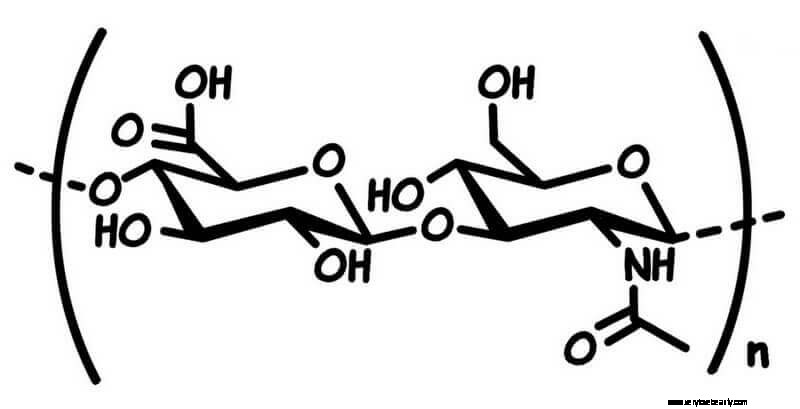
While collagen and elastin are the main proteins that provide structural support for our skin, hyaluronic acid is like a gel-cushion that holds in moisture. This naturally occurring polysaccharide has the ability to absorb up to 1,000 times its weight in water, and when applied topically it can help skin hold in moisture and feel more supple. (1)
High molecular weight hyaluronic acid is also considered helpful for reducing inflammation and supporting tissue repair. (2) (3)
However, in the skincare world, low-molecular weight hyaluronic acid (LMW-HA) is often touted as superior because the smaller molecules are able to penetrate the skin’s surface. It’s made by breaking high molecular weight hyaluronic acid into fragments using enzymes.
So which one is better?
While it’s true that low molecular weight hyaluronic acid does penetrate skin, it’s also well-documented in clinical research that low-molecular weight hyaluronic acid is actually pro-inflammatory rather than anti-inflammatory. (3)
Some doctors believe that while LMW-HA may make skin appear more supple at first, the effect may be due to inflammation rather than hydration, and could lead to accelerated aging. (4) It’s interesting to note that babies primarily make the high molecular weight form. (5)
Now, you might be thinking “Qhat about high molecular weight hyaluronic acid – is it beneficial or similar to collagen . . . too large of a molecule for skin to absorb?”
In terms of topical benefits, it’s agreed that if nothing else, high molecular weight hyaluronic acid is an amazing moisturizer.
However, according to this study, full-size (high molecular weight) HA does actually penetrate skin.
Here’s what cosmetic chemist, Perry Romanowski, had to say on the subject.
And yet, according to the above study, it does. More research needs to be done, but it’s interesting.
You can add a 1% dilution (about 12 drops) of a skin-friendly essential oil such as lavender, frankincense, or helichrysum if you’d like.
However, I prefer not to because I apply the serum liberally around my eyes and it tends to run a bit. (Essential oils + Eyes = Not Good)