
Jarren Vink
While GLP-1 weight loss meds have been a mainstay in pop culture for a few years now, they're potentially about to get even more widespread. Formerly only available as an injection, Wegovy recently released a pill form of the med.
“For many people, a pill is more accessible than an injection,” says Max Petersen, MD, an endocrinologist and assistant professor of medicine at WashU Medicine. There are a few reasons why someone might gravitate to the pill. If you’re afraid of needles, you can bypass having to inject yourself, and the out-of-pocket price of the pill may be slightly cheaper than that of the injections (but more on that later).
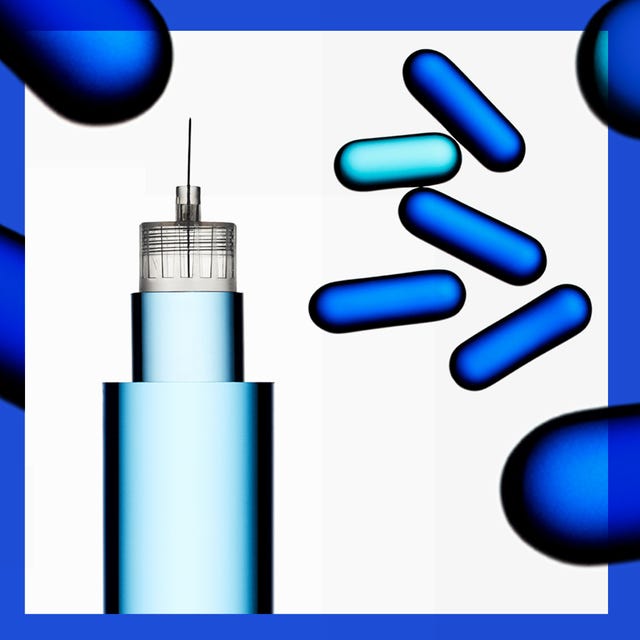
While it lets you avoid needles and comes a lower price, does the new GLP-1 weight loss pill hold up against the OG injections in the other ways that matter? We asked the experts to compare the two between their effectiveness, side effects, and convenience, and more.
Meet the experts: John Morton, MD, MPH, is the medical director of Bariatric Surgery at Yale New Haven Health. Max Petersen, MD, PhD, is an endocrinologist at WashU Medicine. Tirissa Reid, is an endocrinologist and obesity medicine specialist at NewYork-Presbyterian and Columbia University's Metabolic and Weight Control Center and assistant professor of medicine at Columbia University.
The new Wegovy pill is simply an oral version of the Wegovy injection—they’re both semaglutide—and therefore operate using the same mechanism of entering your bloodstream and mimicking the satiety hormone that lives in your gut and brain to signal to your body that you’re full, says John Morton, MD, MPH, medical director of Bariatric Surgery at Yale New Haven Health.
One core difference: How much of the medicine is in a dose, depending on the delivery method. Several years ago, chemists formulated semaglutide into a pill using a chemical called SNAC, Dr. Petersen explains, but that formulation only results in about one to two percent of the drug making it to the bloodstream. For this reason, the highest daily dose of the oral Wegovy (25 milligrams per day) is 10 times greater than the weekly dose of that of injectable Wegovy (2.4 milligrams per week).
In other words, even though the pill technically comes in a higher dose, the amount of semaglutide that actually reaches your bloodstream is more or less the same as the injection. “It’s the same substance, but because you're taking it orally, a lot of it is being degraded by your stomach,” says Tirissa Reid, MD, an endocrinologist and obesity medicine specialist at NewYork-Presbyterian and Columbia University's Metabolic and Weight Control Center and assistant professor of medicine at Columbia University.
With the dosage adjusted to accommodate for the difference in absorption, both the pill and injection have similar efficacy. People taking 2.4 milligrams of injectable semaglutide lost on average 14.9 percent of their body weight over the course of 68 weeks, versus a 13.6 percent reduction in body weight after taking the 25 milligram pill for 64 weeks, according to separate trials published in the New England Journal of Medicine.
Even if the pill is ever-so-slightly less effective than the injection, both have demonstrated effective results for weight loss. “The way I like to look at the weight loss percentages with my patients is typically: If you weighed 200 pounds, and you took the injection and lost 30 pounds, versus taking the GLP-1 pill and losing 28 pounds, is that really significant?” Dr. Reid says.
“It's hard to say for sure, because there haven't been any large clinical trials comparing the oral and injectable form head-to-head,” Dr. Petersen says. Rather, doctors are left having to compare results across trials and listening to the anecdotal experiences of their patients.
Existing research done on the pill and the injection individually currently indicates that the side effects of each form of Wegovy are fairly similar, says Dr. Petersen. In both, gastrointestinal symptoms like nausea, vomiting, diarrhea, constipation are among the most commonly reported side effects. (About half of patients report nausea, and about one-third report vomiting, he says.) With the injection specifically, it’s possible to experience an injection site reaction, though this is rare.
“There's no evidence that there's a significantly different safety profile with oral semaglutide versus injectable semaglutide, with one exception,” he says. There hasn’t been enough data to say if the special chemical that coats the pill, SNAC, in addition to the pill and injections themselves, are safe for people who are pregnant or breastfeeding.
You’re regimented about taking your meds: It may seem like swallowing a pill is easier than injecting a med—but that’s not exactly the case, Dr. Petersen says. The Wegovy injection is taken just once a week, with no specifics on when to take it or what you can eat or drink afterwards. Meanwhile, for the oral medication to achieve a similar level of effectiveness, you’ll need to follow a few very particular conditions every day. The pill needs to be taken on an empty stomach using a maximum of a few sips of water. Then, you have to wait 30 minutes before you can have anything else to eat or drink, including other medications you may take, Dr. Reid says. Essentially, you’ll need to plan every morning around taking the pill, and “if you do not strictly follow those guidelines, it decreases the effectiveness by 30 to 40 percent,” she says.
You want to save some money: If you’re paying out of pocket, the Wegovy pill is cheaper than GLP-1 injections, though not by much. Currently, Novo Nordisk has the 2.5 mg and 4 mg Wegovy pills on offer for $149 per month until mid-April, after which it will jump up to $199 per month. This highest dose of the pill, 25 mg, is listed as $299 a month for 30 tablets. As for the injection, new patients can have two monthly fills of the 0.25 mg or 0.5 mg Wegovy injection for $199 per month until the end of March. After this period, the monthly out of pocket costs for all Wegovy injections, regardless of dosage, is $349 per month. So, depending on the dosage, taking the pills can save between $50 and $150 per month.
You don’t mind needles: Being averse to needles is a very valid reason as to why one might opt for the weight loss pill over the injection. The needle that delivers GLP-1 injectables is hidden discreetly inside the pen-like device, but even if you never actually see the needle, for some people, there’s a psychological element at play, Dr. Reid says. For a person who wants to take a GLP-1, but previously hasn’t tried them due to a fear of needles, the pill could certainly be a more favorable option.
Switching from the injection to the pill (or vice versa), is fairly straightforward. The FDA has provided prescribing information that details the dose equivalence for the max doses of the injection and pill. “The maximum dose of injectable semaglutide and the maximum dose of oral semaglutide produce really similar bloodstream levels of the drug, so they can be [changed] easily,” Dr. Petersen says. Switching at the lower doses can be a little more complex and could involve some trial and error, but moving from the injection to pill, or pill to injectable, is certainly feasible, he says.
Plus, there might be even more pill options coming soon. Pharma manufacturer Eli Lilly (the maker of Mounjaro and Zepbound) isn’t far behind in getting its own GLP-1 pill approved for use in the coming months. “In the next one to two years, several other GLP-1 medicines that are currently in clinical trials are likely to become available,” Dr. Petersen says.

Caroline is a lifestyle writer based in New York who covers beauty, wellness and culture. She regularly writes for USA TODAY's Health and Wellness section, and contributed to a Pulitzer Prize-winning investigation at The Washington Post.