
Have you ever needed to calculate the square root of 43 while checking out at the grocery store? Me neither. But you know what I have done in grocery stores? Googled mysterious ingredients on my phone.
I’ve already shared with you my man-stink killer deodorant recipe along with my sensitive skin formula and my fave pre-made option, but is conventional deodorant really all that bad?
There are literally thousands of synthetic chemicals on store shelves in our grocery stores. Despite the fact that they’re added to food, personal care products, and household cleaners, many of these chemicals have never been tested for safety. (1) (2)
When I realized that, I began switching over to natural options, starting with the products I use most often.
Because it was so easy to replace and I had concerns about the ingredients, conventional deodorant was the first to go. Here’s why I ditched it, and why you might want to consider it, too.
Not all chemicals are well-absorbed through our skin, but “blood tests show that many of the substances commonly included in deodorant products can, in fact, worm their way past the epidermis and into the body.”
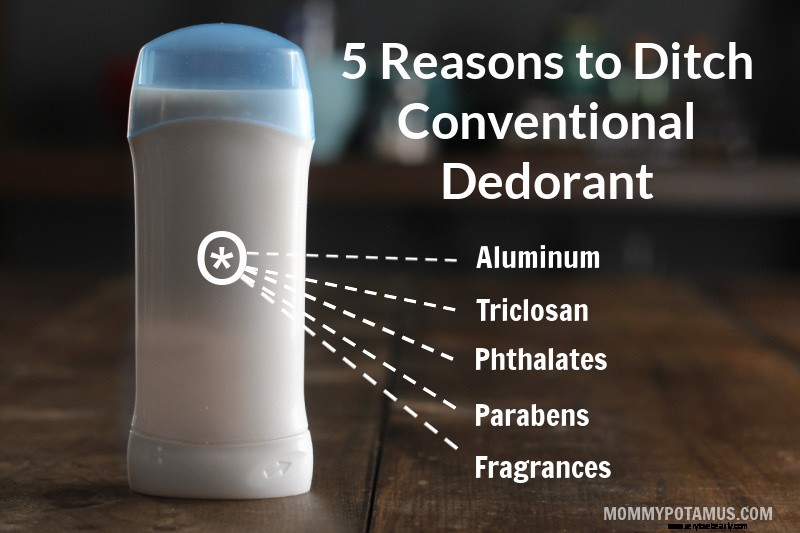
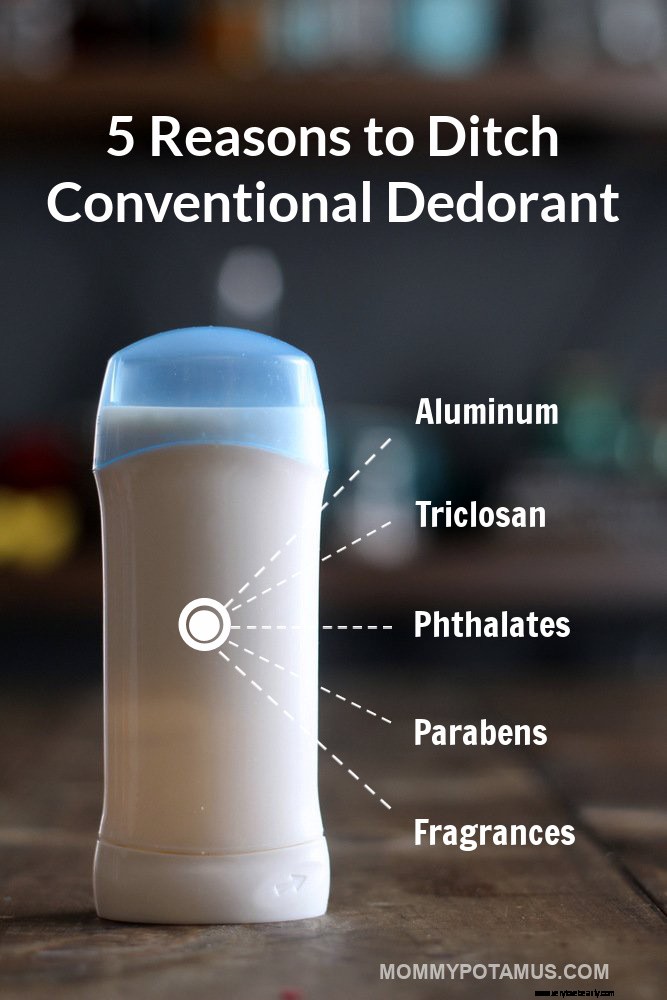
Here are five ingredients to be aware of:
Most antiperspirants and some deodorants – including some “natural crystal” deodorants – contain forms of aluminum, which clog sweat glands to stop perspiration. Research suggests that women who use antiperspirants have higher levels of aluminum than those that don’t, which is a problem because excess aluminum may change how the body makes and/or responds to the estrogen. (4)
The Minnesota Pollution Control Agency lists aluminum as a potential endocrine disruptor, which is a chemical that produces “adverse developmental, reproductive, neurological, and immune effects in humans, abnormal growth patterns and neurodevelopmental delays in children.” (5)(6)
This chemical, which is used in everything from toys to toothpaste, may disrupt normal thyroid function, alter hormones, and increase the risk of breast cancer. (7)(8)(9)(10)
The FDA banned its use in hand soaps beginning in 2017 over concerns that it might contribute to the development of superbugs, but it’s still allowed in personal care products like toothpaste, body wash, hand sanitizer, and deodorant.
This is one chemical to keep a sharp eye out for, even in products that portray themselves as mostly “green” or natural.” Arm and Hammer®, for example, settled a class action lawsuit in 2015 because their Essentials “Natural” Deodorant actually contained Triclosan.
Phthalates help other chemicals stick to our skin and/or penetrate more deeply into the epidermis. They’re linked to:
Although testosterone is most often thought of as a “man’s hormone,” it’s actually vital for all of us. Symptoms of low testosterone in women can include:
Prenatal exposure is also linked to:
Used as preservatives in personal care products, parabens are endocrine disruptors that mimic estrogen. Although a causal connection has not been established, some researchers have hypothesized that the estrogenic properties of phthalates may play a role in breast cancer.
The National Institutes of Health says more studies need to be done due to conflicting results, but some researchers have expressed concern that breast cancer most often occurs in the upper outer quadrant – just under where women rub deodorant on. (22)
Heather Patisaul, Ph.D., an associate professor of biology at North Carolina State University, told TIME Magazine:
In a 2012 study, 99% of breast cancer samples that were analyzed contained parabens. Some say there is no link and that the increased rate of cancer in this quadrant is because it contains the most epithelial tissue.
However, in this study, researchers found that breast cancer rates (specifically in the upper outer quadrant) are rising alongside an increased use of underarm products.
Thanks to a loophole, companies can hide all sorts of chemicals under the label “fragrance” without disclosing them. In one study conducted by the Environmental Working Group, nearly half of the ingredients in the fragrance products they tested were not listed on the label.
Many of these ingredients are phthalates, but others are chemicals that can cause allergic responses or irritation. Ironically, even “unscented” products may contain masking fragrances, which are chemicals used to cover up the odor of other chemicals. (23)
Products labeled “fragrance free” do not contain masking chemicals according to the Environmental Protection Agency. (23)
I promise, it’s easier than you probably think:
Once you’re ready to tackle the next thing, here are a few other products you might want to replace: shampoo, lotion, soap, makeup remover, hair gel, body butter and hair detangler.
Do you have any tips for making the switch to non-toxic personal care? Please share in the comments below!
Do you want to give gorgeous, handcrafted gifts for family and friends, without spending a bunch of time on them?
Then I’d love to give you a free copy of DIY Body Care Gifts Made Simple – my step-by-step guide to making gorgeous handcrafted gifts without stressing yourself out – as a gift for signing up for my newsletter. I’ll show you how to make vintage labels, luxurious lotion bars, lip balms, sugar scrubs, body sprays and more like a pro. Sign up for my newsletter and you’ll be redirected to the download page immediately!
Sources