
Sulfur is rarely the first thing I would recommend for acne, and perhaps that is unfair. After all, sulfur has been around for centuries and was particularly favored by the ancient Romans who bathed in it.
Recently, I had the pleasure of soaking in a sulfur bath in Tbilisi, the capital of Georgia, and I can attest to the fact that my skin felt lovely afterwards, and I haven’t experienced any new breakouts since – unfortunately, a single soak is not enough for skin miracles.
Now, don’t let the rotten egg scent scare you away! Sulfur, which can also be spelled sulphur and was referred to as brimstone in the Bible, is certainly worth a try, especially if you haven’t had much luck with other acne treatments, or if you think your acne might be fungal.
Read on to really learn what sulfur is and how it works on the skin. I list all of the sulfur uses and benefits, as well as the few potential side effects from it. I’ll break down how to use sulfur most effectively in your skincare routine, so you can get the most out of sulfur to kiss your acne goodbye!
It is shocking that we don’t talk about sulfur more frequently, considering it is the fifth most common chemical element on planet Earth. Elemental sulfur is more frequently found near hot springs and volcanic regions. It is an essential element for life, and it occurs naturally in all flora and fauna, though usually as organosulfur compounds rather than in its pure elemental form. Both biotin and thiamine (vitamins B1 and B7) are organosulfur compounds, for example.
In skin care, however, we want to focus on elemental sulfur, which is usually produced as a byproduct of the petroleum and gas purification process. Elemental sulfur is a great acne treatment, especially for those who suffer from fungal acne. It also has other important uses, including as a fertilizer, insecticide, fungicide, and for the preparation of matches.
When elemental sulfur is applied topically to the skin, it acts as a mild antibacterial agent to kill P. acnes, the acne-causing bacteria, and as a kertaolytic agent to promote the exfoliation of dead skin cells that might be clogging the pores. It also acts as fungicide, meaning that it kills fungus.
This is especially important for those who have Malassezia (pityrosporum) folliculitis, which is colloquially referred to as “fungal acne” even though it technically has nothing to do with the acne bacteria. It is difficult to tell the difference between real acne and Malassezia folliculitis, but if your breakouts have not responded to traditional anti-bacterial treatments but they do respond to sulfur, it is possible that yeast was the real issue.
For some people, skincare products with sulfur may cause dryness, itchiness, swelling, or irritation. This is especially likely if you do not moisturize your skin after using a sulfur mask or before using a sulfur for acne spot treatment.
If you experience itchiness or irritation even after using some sort of moisturizing product, then you should probably discontinue your use of sulfur-based skincare products, and turn your attention to other acne treatments instead.
Sulfur has a fairly high pH, so in some instances it can actually make acne worse. However, high pH is also an issue with benzoyl peroxide, another popular and effective acne treatment. The only way to find out how your skin responds is to give sulfur a try, and to mitigate its high pH by prefacing it or following it up with pH-adjusting toner.
As with any keratolyic agent you also run the risk of over-exfoliating your skin when using sulfur masks or other sulfur-based products. Be careful combining sulfur with other exfoliants, and pay close attention to signs of over-exfoliation in your skin like redness, irritation, peeling or rawness.
If you do notice signs of over-exfoliation then stop exfoliating altogether until your skin heals, and once it does, reintroduce chemical exfoliants like sulfur back into your routine very slowly and moderately.
If you are currently pregnant, you should consult your doctor about whether you should use sulfur to treat any hormonal breakouts you might be experiencing.
Here is how you should add sulfur to your skincare routine based on the type of product you choose:
Sulfur masks are one of the most popular ways of using sulfur for acne treatment. Sulfur masks are great because they can be used as often as necessary based on your skin condition, and they can include other ingredients to treat the skin like various clays for oiliness or zinc for sensitivity.
Sulfur masks are best used around 3 times a week, although if you are suffering from a particularly nasty breakout, you can even try using them every day until it clears. Using sulfur masks correctly is important to get the full benefits of sulfur without any of the drawbacks.
Another really popular way of using sulfur for acne is as a spot treatment. Spot treatments are applied only to the area of the skin affected by acne, and they can be a great choice for people whose skin is too sensitive to tolerate a sulfur product all over the face.
Spot treatments with sulfur usually have a pink or white color, so they are best used in the evening when you won’t be walking out and about. Additionally, many sulfur masks can actually double as spot treatments, so you can use your sulfur mask exactly as I outline here!
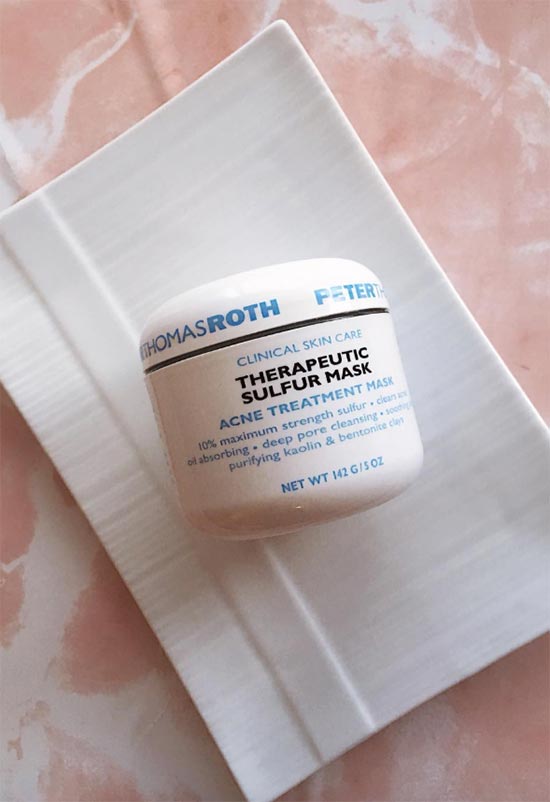
While sulfur usually shows up in masks and spot treatments, sometimes suflur products also come in the form of cleansers, toners, serums or moisturizers. In those circumstances you want to use the product as directed on the packaging.
It is possible to overdo sulfur in your skincare routine, so make sure that your routine only includes one product that contains sulfur at all times.
Photos via @skin.minimalist, Instagram