
In fact, experts say not taking it when needed risks serious harm for both mom and baby.
Bloomberg/Getty Images
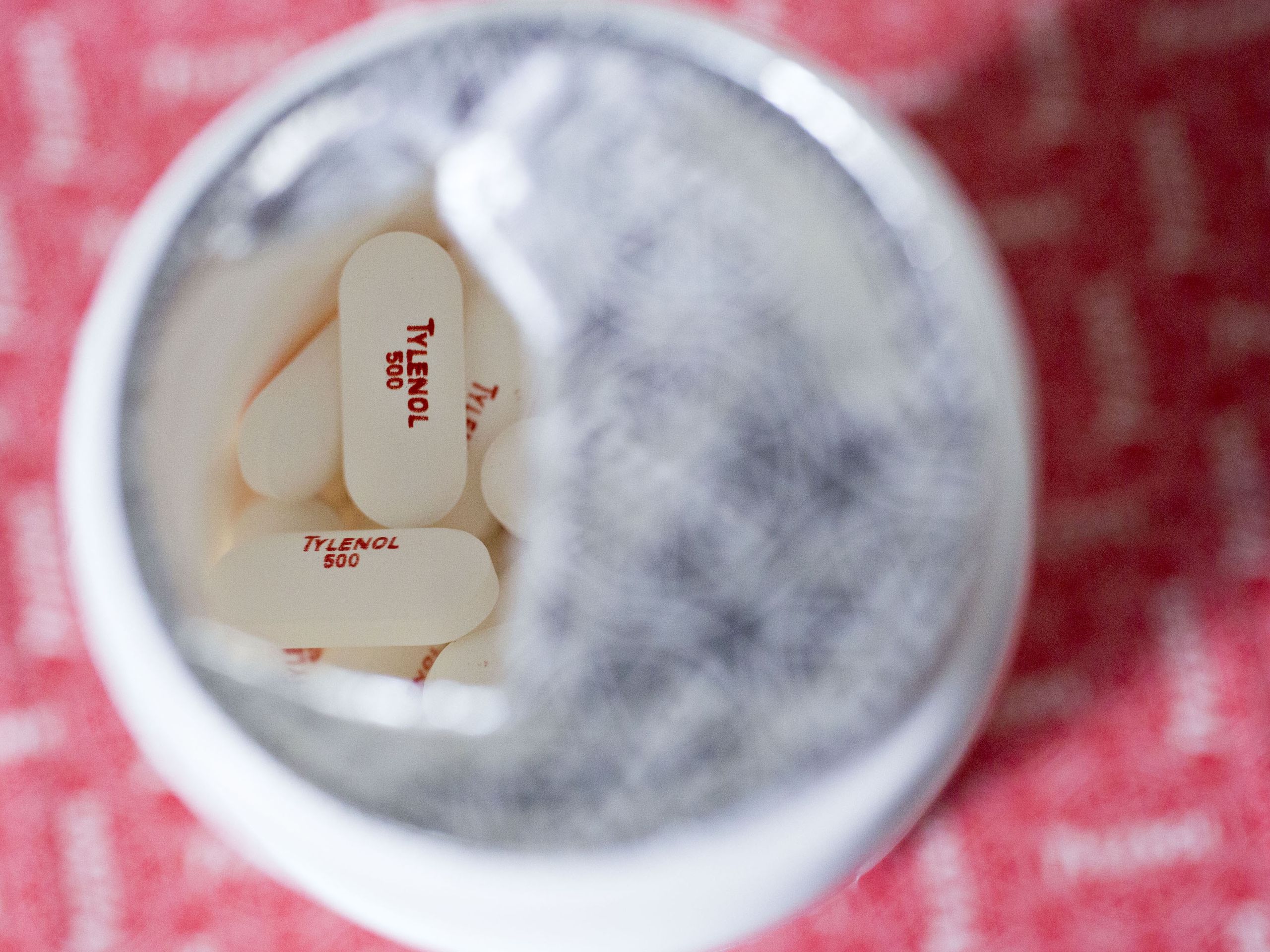
Despite claims from President Trump last fall suggesting the use of acetaminophen (a.k.a. Tylenol) during pregnancy increases the risk of autism in children, research continues to mount to the contrary. A comprehensive review of 43 studies on the topic published today in The Lancet Obstetrics, Gynaecology, & Women’s Health found “no evidence” that taking the medication while pregnant ups the risk of autism, attention deficit hyperactivity disorder (ADHD), or intellectual disability among children.
A bird’s-eye view approach allowed the researchers to synthesize the results of a bunch of studies, which offers a more reliable outcome, and exclude the ones that were at high risk of bias (for instance, questionnaire-based studies that asked women to recall if they took Tylenol; and small or short observational studies that show correlation, not causation).
The result dovetails with longstanding guidelines from major medical organizations, including the American College of Obstetricians and Gynecologists (ACOG) and the Society for Maternal Fetal Medicine, both of which broadly support the drug’s usage during pregnancy.
And that’s not just because of Tylenol’s increasingly clear safety record; it’s also because of the lack of any other safe alternatives for pain and fever during pregnancy. Simply “toughing it out,” as Trump recommended women do, risks causing physical and psychological harm to both mom and baby, several ob-gyns and experts in maternal fetal medicine told SELF.
Questions about the safety of acetaminophen during pregnancy resurfaced in the fall of 2025 largely because of an analysis published in August that suggested a possible tie between prenatal acetaminophen use and autism. The paper, published in the journal Environmental Health, reviewed 46 existing studies on acetaminophen use during pregnancy and neurodevelopmental disorders (like autism and ADHD), though only eight looked specifically at autism. And despite their finding, the researchers also noted in the review that it doesn’t mean one causes the other.
The first author on that study, Diddier Prada, MD, an epidemiologist at Mount Sinai, has since clarified to The New York Times that we “cannot answer the question about causation,” making a comparison to ice cream sales and crime: Both go up in the summer, but it doesn’t mean the ice cream consumption triggers the crime. Here, hot weather is the confounding variable leading to both outcomes. And there may be a host of similar confounders that contribute to both Tylenol use during pregnancy and the development of autism.
“Mothers who take Tylenol often do so because they have fever, for instance from an infection, or they have pain from other conditions and complications, perhaps even stress—and all of these themselves raise developmental risks,” Sura Alwan, MSc, PhD, an epidemiologist based in British Columbia and executive director of the nonprofit PEAR-Net Society (Pregnancy Exposures, Advocacy, and Research Network), tells SELF.
There are also plenty of variables unrelated to Tylenol use—like genetics, household environment, and maternal health history—that could affect the development of autism in the children of moms who took the medication while pregnant. It’s the reason some researchers have opted to compare siblings, where only one had been exposed to Tylenol in utero, Lucky Sekhon, MD, a double board-certified reproductive endocrinologist and ob-gyn at RMA of New York and author of fertility guide The Lucky Egg, tells SELF. It turns out, exposed siblings are no more likely to have autism than those who weren’t.
Considering the findings from these types of rigorous sibling-comparison studies, as well as other reliable studies on the topic, the authors of the new Lancet paper concluded that any previously reported links between Tylenol use during pregnancy and autism are likely the result of “other maternal factors, such as underlying pain, discomfort, fever, or genetic predisposition, rather than any direct effect” from the medication.
Scientists who research autism pin the rise in cases over recent decades largely to improved diagnostic criteria for it—we’re now catching cases that were previously missed, particularly in women—as well as a mix of genetic and environmental factors.
White-knuckling your way through fever or pain during pregnancy isn’t just a terrible way to exist (pregnancy is hard enough on the body as is); it can be actively dangerous. For instance, leaving a fever raging, especially during early pregnancy, “increases the risk of fetal malformation and pregnancy loss,” Veronica Gillispie-Bell, MD, MAS, a Louisiana-based board-certified ob-gyn and the vice chair of ACOG’s Clinical Practice Guidelines Committee–Obstetrics, tells SELF. A cooling blanket or cold shower won’t knock down your internal temperature or protect a fetus from the heat, Dr. Gillispie-Bell emphasizes.
Untreated pain isn’t innocuous either. Dr. Gillispie-Bell and Dr. Sekhon point to how it can raise your blood pressure and spike stress hormones like cortisol, which can threaten healthy fetal development and may increase your risk of preterm labor. And speaking of blood pressure, one of the key signs of preeclampsia—a sudden rise in blood pressure during or after pregnancy—is “a headache that isn’t relieved by Tylenol,” Dr. Gillispie-Bell notes. So if pregnant women are advised to steer clear of the drug, it raises the risk that doctors miss cases of preeclampsia, which is already underdiagnosed—and can restrict fetal growth, increasing the risk of preterm birth and low birth weight, as well as a host of health conditions for the baby, including neurocognitive ones (like, yes, autism).
Should pregnant people opt for other OTC painkillers or fever reducers—which are not recommended during pregnancy—the outcomes could be just as bad, if not worse, than pushing through without treatment. Each of them has documented adverse effects: Non-steroidal anti-inflammatory drugs, or NSAIDs (like Advil and Aleve) can increase the risk of miscarriage in early pregnancy and, later on, interfere with the baby’s developing heart and kidneys, Dr. Sekhon notes. And aspirin, while sometimes used in low doses in the second trimester for those at risk for preeclampsia, can pose a bleeding risk in the first trimester, Dr. Gillispie-Bell notes. (As for prescription options? Opioids, while used in certain situations during pregnancy, come with the risk of dependence as well as withdrawal in newborns and long-term developmental effects, Dr. Gillispie-Bell says, not to mention they don’t work for fevers.)
Hence why Tylenol—which Dr. Sekhon notes is “metabolized differently [than other painkillers] and doesn’t affect fetal circulation”—remains the first-line recommendation for pain and fever during pregnancy. Even the conclusion of the August 2025 analysis recommended “judicious acetaminophen use—lowest effective dose, shortest duration” versus a “broad limitation.” This shouldn’t be interpreted as evidence of risk, Dr. Alwan notes, as it reflects the same guidance ACOG has long offered and that applies to “really any medication at any time,” she says: “Use it how it’s indicated and not beyond that.”
In his announcement last fall, Trump referred to autism as a “horrible, horrible crisis,” “severe problem,” and “epidemic,” among other negative labels. This kind of language is ableist in that it pathologizes people with autism and suggests the need to cure or eliminate it. “It’s stigmatizing—and it’s not right,” Dr. Alwan says. For plenty of people with autism, the condition isn’t a problem at all but just a different way of seeing the world.
At the same time, pinpointing Tylenol use during pregnancy as the culprit for this “crisis” throws moms of children with autism under the bus. “I’ve spoken to women who have children with autism, and there’s a heavy burden of self-blame—they tell me they replay every choice they made in pregnancy,” Dr. Alwan says. The suggestion that if they took Tylenol in pregnancy, they might be the reason their kid has autism can have a huge “psychological impact,” Dr. Gillispie-Bell says. “No women should have to go through the guilt that could come from that when we don’t have the data to show this.” The science overwhelmingly suggests that autism has strong genetic roots and can be influenced by a variety of factors, “not a single decision or medication,” Dr. Alwan says.

Erica Sloan is the senior health writer at SELF, where she covers sleep, mental well-being, and sexual and reproductive health, among other health topics. Previously, she was the senior lifestyle editor at Well+Good, and she’s also held editorial positions at Martha Stewart Living, Prevention, and Washingtonian. Erica lives in New ... Read More