

Comfy mattress? Check. Quiet, dark bedroom? Check. Thermostat set just where you like it? Check, check and check. If you’re like me, you put a high priority on optimizing sleep quality so that you wake up refreshed and ready to take on the day.
Since restful sleep is one of the purported benefits of weighted blankets I felt obligated to try one for, uh, research. . . and it transformed both my sleep and daytime sense of well-being.
As I shared with you recently, I am recovering from Lyme disease, which has a notoriously negative impact on sleep quality. (1) Personally, I experienced a dramatic deterioration in sleep quality several months into my healing journey, which is just when I needed it most. This is one of the tools that helped me get back on track, and it’s beneficial for so much more than sleep.
How is that, you ask? We’ll dive into the fascinating science behind how they work below, along with other benefits of using weighted blankets such as:
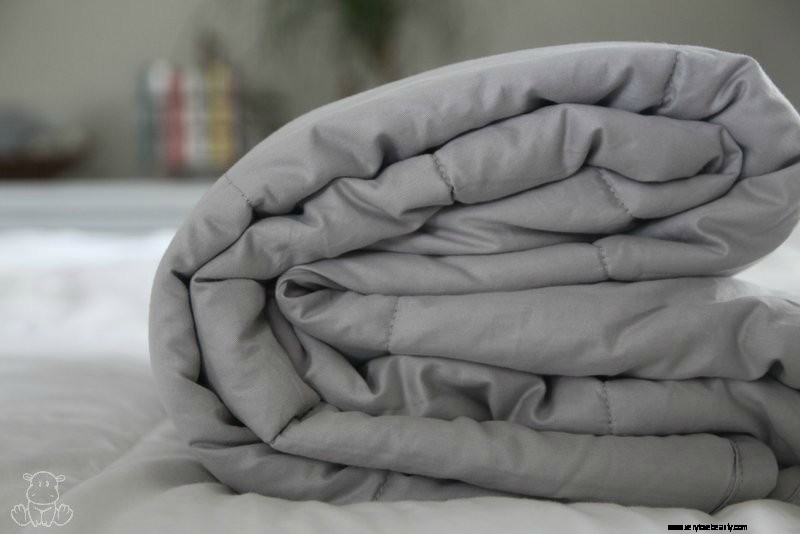
Weighted blankets are filled with heavy materials (usually glass beads or plastic pellets) that are evenly distributed in tiny quilt-like pockets. Also called gravity blankets, they exert a gentle yet deep pressure that feels like a reassuring firm hug, a massage, or swaddling.
Full disclosure: I love to hug my kids, but I’m not much of a hugger in general so the description of a firm hug did not appeal to me at all. If you’re not a hugger, either, don’t let that discourage you from giving one a try.
As always, I want to mention that none of these statements have been evaluated by the FDA, this article is not medical advice, and it is not meant to diagnose or treat any condition. Now that we have that out of the way, let’s dive in.
Weighted blankets use deep touch pressure to help recalibrate your (seriously amazing) autonomic nervous system, which is made up of three parts.
It’s no secret that for most of us, daily life brings so many more moments that activate our sympathetic (fight or flight) response instead of our parasympathetic (rest and digest) response. We don’t even necessarily need to feel stressed for this to happen – our fast-paced environment alone can cause our sympathetic nervous system to kick on frequently.
Weighted blankets help counteract this imbalance via deep pressure stimulation, which increases parasympathetic activity and helps us relax. (3)
Deep touch pressure is exactly what it sounds like – deep yet gentle pressure that activates sensory receptors across your body. It works via a “sixth sense” called proprioception, which is how our bodies are perceived by our brains.
Certain types of proprioceptive input, such as the snug cocooning sensation offered by weighted blankets, relax the nervous system and encourage the release of feel-good neurotransmitters and endorphins.
Also called deep pressure therapy, proprioceptive input can be applied with the hands, “hug machines” found in hospitals, and lap pads in addition to weighted blankets.
This is by no means an exhaustive list – I’ll continue adding research as I come across it!
Deep touch pressure increases the feel-good neurotransmitter serotonin, which helps regulate mood and creates a sense of relaxed calm. (4) It also helps regulate sleep and plays a role in cognitive function, healthy bowel function and sex.
As we’ll discuss in more detail later, serotonin is also a precursor to the “sleep hormone” melatonin. Low serotonin levels are often found in individuals with depression, anxiety, and aggression. (That’s not a comprehensive list . . . just a few that I came across in my research.)
Weighted blankets may also have a positive impact on levels of both oxytocin (the love hormone) and dopamine (the happy hormone). (5) Oxytocin plays a role in sleep while decreasing pain and regulating immune function, and dopamine activates the reward centers of the brain responsible for motivation. (6)
It also helps with attention, memory, and regulating movement.
In this study published in the Journal of Sleep Medicine and Disorders, participants had their sleep tracked while using their normal bedding for one week. Next they slept with a weighted blanket for two weeks, and then returned to their normal bedding again for one week.
The researchers found that when they used the weighted blanket, participants were able to fall asleep faster and sleep more deeply throughout the night. They also slept longer and reported feeling more refreshed in the morning.
As mentioned above, part of the reason may be that weighted blankets increase serotonin, which is what our bodies use as the main building block for making melatonin. Often called the “sleep hormone,” melatonin helps regulate sleep, immune function, and cardiovascular health. Long-term supplementation may have some downsides, especially for kids, so I do my best to help my family optimize levels naturally.
Weighted blankets are one way to encourage serotonin production naturally, thus making more available to be converted to melatonin when the sun goes down.
Researchers have found that weighted blankets have a calming effect in times of intense stress – even wisdom tooth extraction!
In this study, which called wisdom tooth extraction “one of the most common procedures associated with a high pain level, high stress, and anxiety,” researchers found that participants who wore a weighted blanket had increased levels of parasympathetic activity (and thus lower levels of stress) when measured via a reliable marker called heart rate variability.
That may be in part because in addition to encouraging the flow of “feel good” hormones, deep pressure stimulation has also been found to decrease levels of cortisol, aka the “stress hormone.” (4)
Weighted blankets were originally designed to benefit children with sensory processing disorder and/or autism. According to research published in the Journal of Sleep Medicine & Disorders:
In a small study that used a similar type of deep touch pressure – weighted vests – children’s ability to concentrate increased by 18 to 25 percent. (8)
Part of that may be because, as described above, weighted blankets may optimize the production of dopamine, which affects motivation, attention, and memory.
Ahhh, if only. In the study I mentioned above where adults got deeper, longer sleep with a weighted blanket, 4 out of 5 patients preferred using one. So at least in that study most people loved them, but not everyone.
The general guideline is 10% of your body weight plus a couple of pounds. So if you weigh 140 pounds your range would be 10% of that (14 pounds) plus 2 pounds for a total of 16 pounds. However, there is some flexibility in this for adults, so you can opt for a slightly heavier or lighter one if you prefer.
Most experts say the guideline should be more strictly followed with children. According to Occupational Therapist Alisha Grogan,
Please note: Below are recommendations I compiled from various sources while researching weighted blankets for my family. They’re intended as a general guide only. You should always use a weighted blanket in accordance with the manufacturer’s instructions/advice from a registered occupational therapist or healthcare professional.
Because I try to avoid plastic whenever possible for environmental health, I prefer blankets that use glass beads instead of plastic pellets. Also I suggest opting for breathable cotton instead of fabrics like fleece that may get too hot. I love being warm – my sauna is my happy place – and my cotton version keeps me plenty warm without causing overheating.
Here are the two best options I’ve found:
LUNA Blanket – Made with soft 100% Okeo Tex cotton and glass beads, this machine-washable blanket comes in several sizes and weights for kids and adults.
Bearaby – These handmade weighted blankets are made with a gorgeous chunky knit that’s as beautiful as it is functional. Bearaby uses organic cotton, and their blankets are washable. I’ve tested their cotton napper and kids have tested their Nappling which is absolutely adorable. You can see them all here.
Have you ever tried a weighted blanket? What was your experience?
1. Weinstein, ER et. al. (2018) Sleep quality in well-defined Lyme disease: a clinical cohort study in Maryland.
2. Harvard Medical School (2011) Understanding The Stress Response.
3. Hsin-Yung Chen et. al. (2016) Effect of deep pressure input on parasympathetic system in patients with wisdom tooth surgery.
4. Field, Tiffany et. al. (2008) Cortisol Decreases and Serotonin and Dopamine Increase Following Massage Therapy.
5. Breus, Michael (2019) Thinking Of Using A Weighted Blanket? Here’s What You Need To Know.
6. Yu-Feng, Wang (2016) Center Role of the Oxytocin-Secreting System in Neuroendocrine-Immune Network Revisited.
7. Ackerly, R et. al. (2015) Positive Effects of a Weighted Blanket on Insomnia.
8. VandenBerg, Nancy (2001) The Use of a Weighted Vest To Increase On-Task Behavior in Children With Attention Difficulties.
9. Grogan, Alisha. The Must-Read Weighted Blanket Guide for Kids: Calm, Relax, Sleep.
10. Oxford NHS. Guidance on the use of Weighted and Compressing Products.