

When it comes to the “Stuff of Life” that makes up 60% of our bodies, purity absolutely matters. Many of the contaminants of emerging concern listed by the EPA are “forever chemicals” – or chemicals that bioaccumulate in our bodies.
Unfortunately, it’s been nearly 20 years since the EPA has added any contaminants to the list of chemicals covered under the Safe Water Drinking Act, so only a fraction of the estimated 1000 chemicals of concern identified by a network of labs and researchers are monitored and/or regulated in any way. (1)
The good news is that countertop water filters are an affordable option for providing safe, clean water. They require little-to-no installation and, unlike older technologies that primarily focused on removing chlorine, can filter a wide range of harmful contaminants including fluoride.
Of course, there are some downsides, too. We’ll dive into the details below, along with my top product recommendations.
If you’re not sure what kind of filter you want yet – countertop, under sink, or whole house – here’s my in-depth guide to choosing the best water filter for your specific needs. The basic steps are:
With that in mind, let’s take a look at the pros and cons of going with a countertop water filtration system.
1. Ease of Installation: These filters require little-to-no assembly or installation. Some don’t even need to be connected to the kitchen faucet, and you won’t need to drill a hole in the kitchen counter to use them. This is a huge plus if you’re renting and/or just don’t want to make permanent changes to your countertop area.
2. Portability: Because they’re not permanently installed, you can easily take most countertop filters with you on trips and/or when you move to new home.
3. Cost: Countertop filters are usually more affordable than under sink and whole house filtration options, making them a good option for families who want clean water on a budget.
1. Takes Up Counter Space: As the name implies, these filters sit on the kitchen counter and take up space. This can be a downside if you prefer a clutter-free countertop or have a small space to work with, but fortunately there are small models that can work well in compact spaces.
2. May Have To Be Manually Refilled: Some countertop filters hook directly into the faucet, while others are standalone reservoirs that have to be refilled by hand.
3. May Have A Small Reservoir: Some standalone reservoirs hold a relatively small amount of water. When you’ve used all the water, you’ll need to refill the reservoir and then wait until the water is filtered before you can use it again.
4. Filtered Water Is Only Available At Point-of-Use – Unlike whole house water filters which filter all the water that comes into the house, countertop filters only filter water for one area (usually the kitchen sink). They do tend to filter out more contaminants than whole house systems, though, so even people that have whole-house filters often invest in a point-of-use filter for their drinking water. (There is one whole-house system I know of that filters a wide range of contaminants including fluoride, but it is not currently available.)

Price: $81 (Save 15% with MP15)
This is one of my top recommendations in terms of performance and price. Unlike most pitcher filters which barely do more than improve water taste by removing chlorine, Clearly Filtered says it performs as well or better than reverse osmosis systems . . . all while keeping beneficial minerals intact.
Big claims should come with verifiable data, and Clearly Filtered delivers on that front. All of their products have been independently tested and verified by EPA-accredited laboratories at levels exceeding NSF standards, and they post the results in the top right section of each product listing.
Of all the filters mentioned on this page, Clearly Filtered is certified to remove the most contaminants: 365+ versus 203 claimed (not independently certified) for Berkey and 83 for AquaTru.
I personally bought one of their water pitchers to test (and take on road trips so that my family has access to clean water without buying single-use bottled water) and I can say from experience that it delivers fresh, clean tasting water. My kids will each be getting one of these when they leave my nest (or a larger version if it’s available by then).
Clearly Filtered’s activated carbon filters have a unique structure which forces water to pass through the filtration media at different angles:
At the same time, it keeps healthy minerals such as magnesium, potassium, and calcium in.
Clearly Filtered Website (Save 15% with MP15)
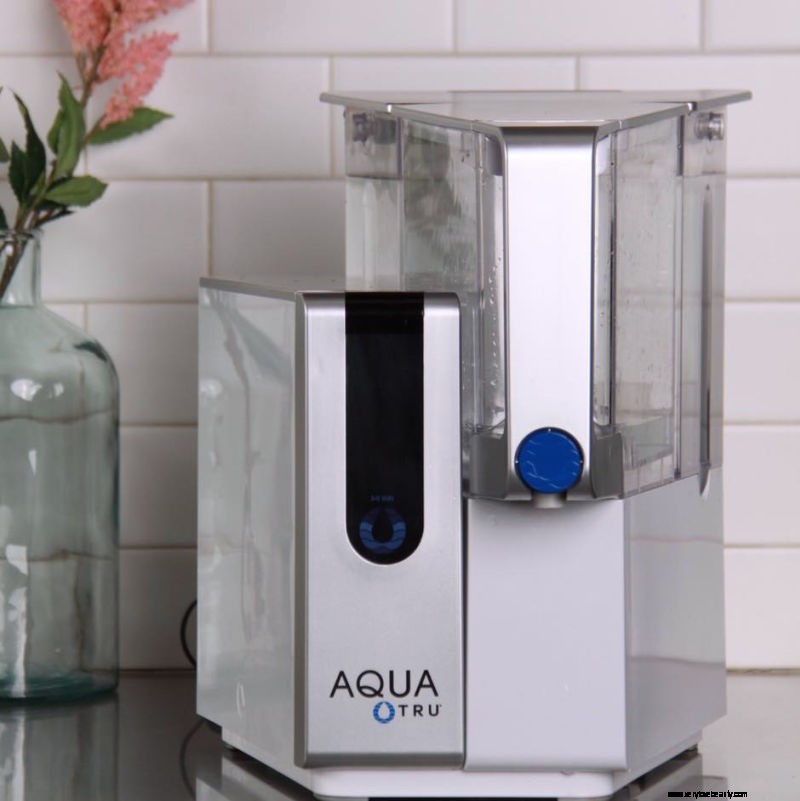
Price: My recommended model, the Classic, is $449 (Save up to $150 herel)
AquaTru is a countertop reverse osmosis filter that is independent lab certified to remove 83 contaminants, including lead, chlorine, radium, nitrates, PFAs, all types of fluoride additives (sodium fluoride, fluorosilicate and fluorosilicic acid) up to 90%, and more.
AquaTru’s 4-stage filtration process uses a pre-filter to remove large particles like sediment and rust, followed by an activated carbon filter to remove chlorine.
After that it runs through a reverse osmosis filter (or membrane) to remove contaminants like lead, arsenic, chromium-6 uranium, nitrates and more, followed by one last pass through an activated coconut carbon block filter to remove compounds like rocket fuel, prescription drug residue, and PFAS.
AquaTru Website
Price Range: Varies based on size, but about $285 to $400+
The Berkey has been one of the most popular water filters among naturally-minded families for many years, and many of you have asked my opinion on recent controversies related to it.
It’s a gravity-fed filter, which means that you pour water into the top of a reservoir and the water is filtered as gravity pulls it down through the filters.
It runs without any electricity – which can be helpful during power outages or emergency situations – and it comes in several sizes that hold between 1.5 and 6 gallons of water.
However, as I mentioned earlier, it has recently become the subject of criticism. We’ll dive into that below, but first here’s are the basic pros and cons.
Berkey uses two types of filtration media (aka materials) – activated carbon that contains proprietary material and aluminum oxide (also called activated alumina).
Berkey claims that their carbon filters remove chlorine, heavy metals (including lead and arsenic), inorganic minerals, Bisphenol-A and pharmaceutical drugs, but as mentioned above their performance test methods have received some criticism.
They also say their aluminum oxide filters remove up to 97% of fluoride and 99.9% of arsenic. At least some forms of aluminum oxide filtration use ion exchange, which basically means that you’re replacing whatever contaminant was in your water with aluminum oxide. (2) Some manufacturers say that the form of aluminum oxide is relatively safe, but others disagree. More on that below.
There are an increasing number of reports from people (like this one) who have compared their tap water with Berkey-filtered water and found that:
Several years ago I personally mailed samples of my tap water and Berkey-filtered water to 3M for analysis. They don’t offer that particular test anymore (it was actually marketed as a way to know if your water had enough fluoride), but according to the results the Berkey reduced the fluoride in my water from .76 PPM to .58 PPM. That’s only about a 24% reduction.
Although I updated my review with that info, we moved soon after that test to a house that did not have fluoridated water so I didn’t look into it more. Unfortunately, it seems that the problem may not just be that the aluminum oxide filters don’t filter all forms of fluoride equally well.
Lab results posted on Facebook along with an explanation of samples taken claim that the activated alumina filters only removed 27% of fluoride while significantly increasing aluminum levels.
I don’t know the individual who ran these tests so I can’t verify the results, but they did I prompt me to do more research about using aluminum in water filtration. I learned that:
So, does Berkey use nano alumina, and if so which kind? I reached out to ask and was told that:
Most water filter companies do keep the exact mix they use as proprietary info to protect it from being used by a competitor, and I get that. For now, though, I have decided to only opt for filters that state they don’t use activated alumina, particularly since it doesn’t seem to filter all forms of fluoride very well.
Another brand of filters – ProOne – is compatible with the Berkey system. I’ll review them next in this article.
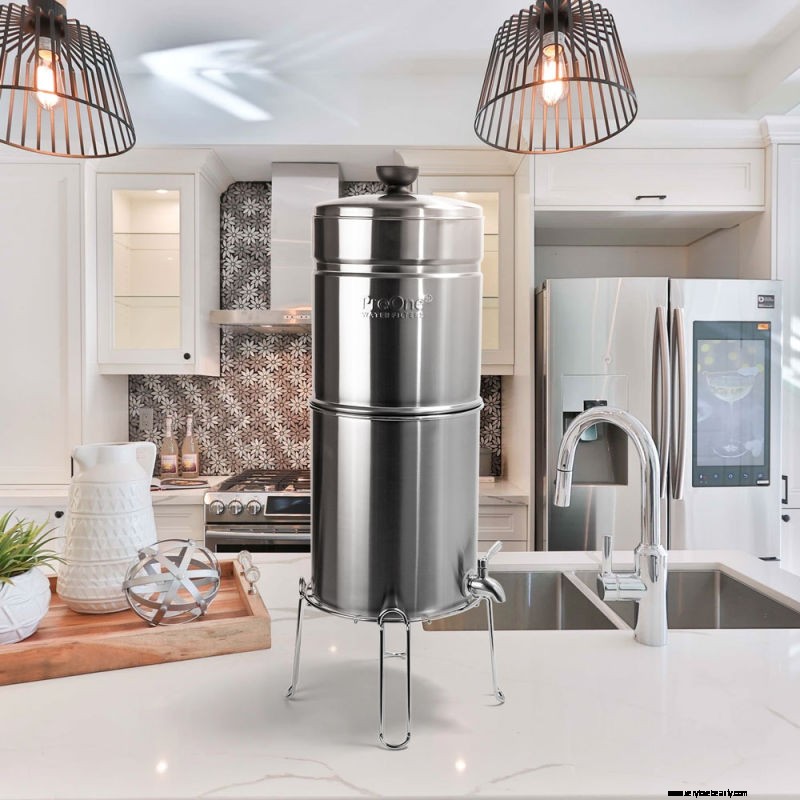
Price Range: Varies based on size, but $199.95 – 364.95
For families that love the Berkey design but want components that have been tested by NSF International – the actual organization that sets the standards everyone is trying to meet – ProOne is the way to go.
They make gravity-fed filters with a variety of capacities, and their fluoride filter is built right into their main filter so you don’t need to buy two. Also, they don’t use aluminum oxide (activated alumina) to filter fluoride.
ProOne uses a silver-infused outer ceramic shell to help prevent the growth of bacteria and a proprietary carbon-based granular filtration media inside the core. Their fluoride removal material is included in the main filter, so you don’t have to buy extra filters.
ProOne Website
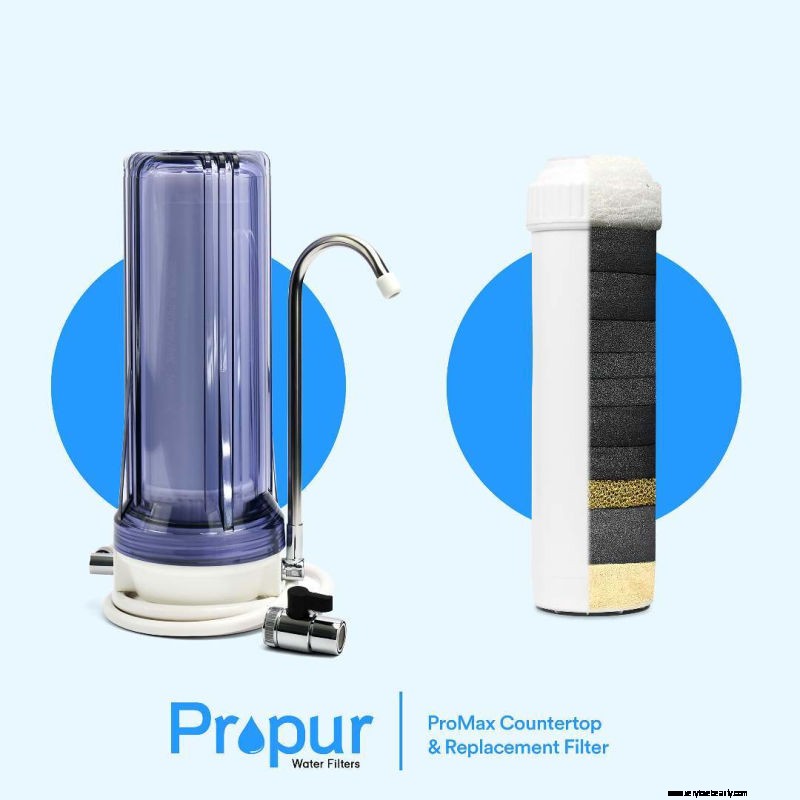
Price: $189 – 218.95
Unlike the other filters on this page which have to be manually refilled, the ProMax Countertop Filter attaches to a standard faucet and can be installed in just minutes. It’s the only faucet filter I know of that removes fluoride and is independently tested.
It removes/reduces a broad range of over 200 contaminants including VOCs, lead, fluoride (sodium fluoride form only), heavy metals, pesticides, SVC’s, disinfectants, inorganic non-metallics, herbicides, pharmaceuticals, PFOA, PFOS, and microplastics. With that said, I only came across this option recently and am not familiar with the filtration technology used. I’ve reached to ProOne for more information and will let you know when I hear back.
Stage 1 includes a 5-Micron standard pre-sediment filter that removes dirt, sand, debris, and rust.
Stage 2 includes ProMaxTM “all-in-one” filter technology, which according to the company is “a highly absorbent filtration material based on infused micro porous foam™ technology. Using different types of water filtration media intended to target specific groups of contaminants staged in layers, ProMaxTM filters are able to absorb a wide range of undesirable contaminants. Contains no resins or beads.”
You can find the ProMax on the ProOne website.
Another model, the ProOne Coldstream, is also worth considering if you’re not looking for a filter that removes fluoride. It uses different filtration materials – a 2-layer outer ceramic shell that is infused with silver to help prevent the growth of bacteria, and a carbon block core.

Price: $69.95
The ProOne pitcher is very similar to the Clearly Filtered pitcher. Both seem to remove around the same number of contaminants – 257 if I’m counting correctly for ProOne, and 365+ for Clearly Filtered.
The ProOne® G2.0M filter used in the pitcher is NSF/ANSI-42 component certified, and it removes contaminants including fluoride, chlorine, chloramines, VOCs, bacteria, pharmaceuticals, lead & heavy metals, all while leaving in beneficial minerals.
ProOne uses a silver-infused outer ceramic shell to help prevent the growth of bacteria and a proprietary carbon-based granular filtration media inside the core.
ProOne Website
Here’s how to find out what contaminants are in your water, and here’s my in-depth guide to choosing the best filter for your specific needs.
Please let me know in the comments below!
1. Network of reference laboratories, research centres and related organisations for monitoring of emerging environmental substances (NORMAN) Emerging substances
2. Duan, Ying (2014) Fluoride adsorption properties of three modified forms of activated alumina in drinking water
3. Shivaprasad, Parimala (2018) Synthesis of nano alumina for defluoridation of drinking water
4. CDC. Types of Fluoride Additives