
Also Known As: Running planks
Targets: Full body, but especially the arms, shoulders, quads, and core
Level: Beginner
Climbing a mountain would be a daunting workout to most, but what if the mountain is the floor? That's the concept behind mountain climbers. Performed from a plank position, you'll alternate bringing one knee to your chest, then back out again, speeding up each time until you're "running" against the floor.
While the move sounds simple, mountain climbers exercise almost the entire body and raise your heart rate. You can easily add mountain climbers to your morning workout at home or the gym, in a hotel room while you're traveling, or even squeeze in a few in the break room at work. The basic move is great for beginners, but more experienced exercisers can take things up a notch with variations.
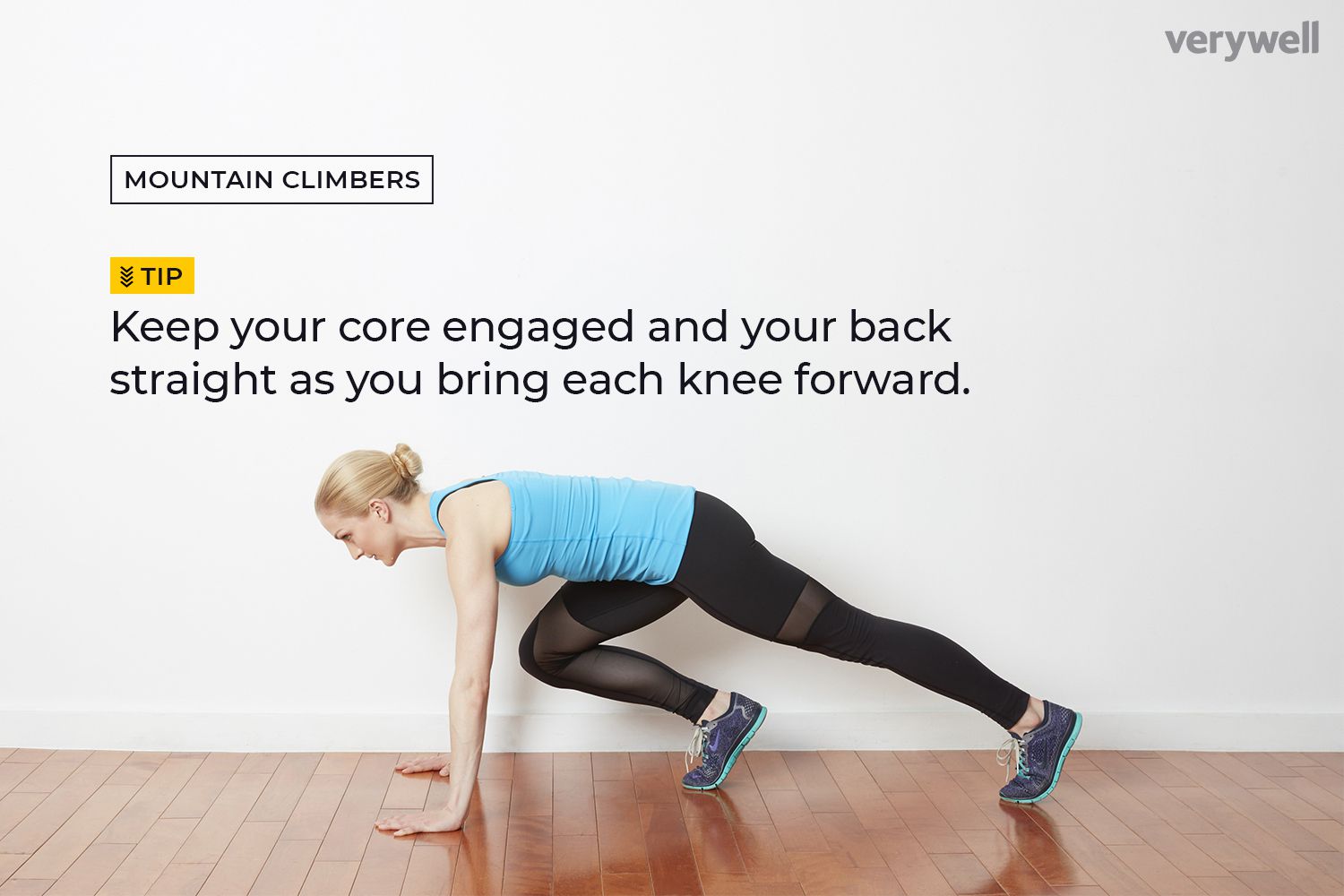
Mountain climbers are great for building cardio endurance, core strength, and agility. You work several different muscle groups with mountain climbers—it's almost like getting a total-body workout with just one exercise.
As you perform the move, your shoulders, arms, and chest work to stabilize your upper body while your core stabilizes the rest of your body. As the prime mover, your quads get an incredible workout, too. And because it's a cardio exercise, you'll get heart health benefits and burn calories.
When you're just starting out, try the classic variation of the exercise:
When you're focused on the move, you might find yourself holding your breath. Remember to breathe.
There are a few common errors that can make mountain climbers less effective or even unsafe.
You need to exercise with proper form not only to maximize effectiveness but prevent injury. For example, a common beginner mistake with mountain climbers is to bounce on your toes as you perform the move. The bouncing might feel like a harder workout, but it actually requires less engagement of your core muscles.
7 Ways to Prevent Exercise InjuryAnother form error you might find yourself making, especially as the move speeds up, is failing to fully complete the movement by letting your toes touch the ground as you bring your knees into your chest. If the toes don't touch the ground, you won't get the full benefit of the exercise and could risk injury.
If you're not used to this movement, it is easy to let your weight shift back so that your body ends up in a down-dog kind of movement. Keep the weight balanced and shoulders over your wrists.
Use these variations of the mountain climber to personalize the exercise for your level and ability.
If you're at the beginner level, start with a low-impact version.
Low-Impact Mountain Climbers
If you feel you need to take some of the weight off your arms, shoulders, and hands, try modified mountain climbers on a step. For this variation, elevate your upper body on a step or block. This can be helpful if you're easing back into a workout after an injury or are still working on developing your upper-body strength.
Once you've mastered the basics, challenge yourself with a more advanced variation.
Foot-Switch Mountain Climbers
This variation is more of a foot-switch than a run. It has more impact and the potential to really get your heart rate up.
Sliding Mountain Climbers
If you have a gliding disc or a towel and hardwood floor, try using them to change up the basic move.
Standing Mountain Climbers
Add some additional cardio to this move by performing it while standing:
You can also try slowing the move down to intensify the stretch (similar to doing a plyo floor lunge).
Mountain climbers of any variation rely heavily on your ability to assume and hold a proper plank position. This includes checking to be sure that:
To ensure the move is effective and safe, review the proper form for planking. Performing a plank with poor form can put you at risk for injury and will greatly reduce the benefit of adding mountain climbers to your workout routine.
Mountain climbers should be avoided if you have injuries or instabilities in your shoulders or pelvis. Mountain climbers are a great workout for your knees, but if you've had surgery or need to have surgery (such as to repair a sports-related injury or replace a joint affected by arthritis), you'll want to talk to your doctor or physical therapist before working these movements into your routine.
If you've recently been pregnant or had certain types of abdominal surgery, you may have a condition called diastasis recti, where the muscles of your abdomen are separated. Until this condition completely heals, you'll want to avoid this type of core workout.
Tips for Exercise After PregnancyMountain climbers can be easily adapted to your level, done as a stand-alone workout, or blended into your existing regimen. The move can be:
Workouts that feature the mountain climber move include:
Once you've mastered planking and mountain climbers, you can try out other exercises that use your own weight for a full-body, strengthening workout: