

Hey y’all, each week I share a useful tip, insight, or recipe from a book I’m reading. As you might imagine, I get a TON of books to review every month. It’s about time I start sharing the best of the best with you, so let’s get started!
So, I may have mentioned a time or TEN that some of you have reported amazing results after using tallow balm on an eczema flare. Seriously, you send me pics.
Unlike steroid creams, tallow balm provides the skin with real nutrition: Vitamins A, D, E, and K, conjugated linoleic acid (CLA), and palmitoleic acid, a natural antimicrobial.
But is there anything else we can do? In other words, can we prevent a flare before it happens? According to Emily Bartlett, LAc,- author of The Eczema Cure – the answer is YES.
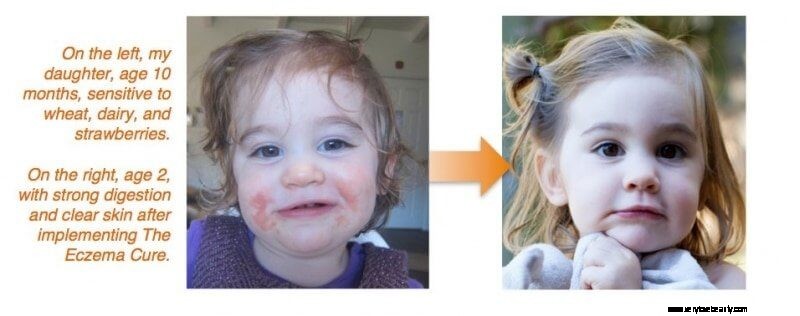
Emily formerly owned a thriving acupuncture and Chinese Medicine practice in LA, but I’d say her most important credential is that she is the mama of “Doodles” – the sweet girl who inspired this book. When Doodles developed eczema, Emily implemented four steps to help her heal. Here’s a snapshot of Doodles before and after the protocol.
In her book, she tackles the big question:
Genetic predisposition, immune system weakness and/or overload, and stress all play a role, says Emily.
“But the root issue involved with eczema is almost always underlying digestive weakness. Even if you donʼt experience tummy upset, your digestive system may be impaired due to poor diet, stress, or other factors.” (Source: The Eczema Cure, emphasis mine)
She then explains why dermatologists can’t cure eczema, saying:
According to Emily, the first step toward healing is to identify and avoid triggers. Today I’m going to share a few of the common “problem” foods she mentions, how to identify if they’re a trigger, and where to go from there.
WHAT TO WATCH FOR: Barley, rye and any oats not specifically labeled as gluten-free. Refined foods and beauty products such as ketchup and shampoo. Yes, seriously. Here are some surprising ways you can get “glutened.”
According to Emily, some may find it helpful to eliminate all dairy temporarily, while others may find that they do well with raw dairy. Except in the cases of extreme allergy, dairy can often be reintroduced after some healing has taken place.
Repeat after me: “I will not eat them in a house, I will not eat them with a mouse,I will not eat them in a box I will not eat them with a fox, i will not eat them here of there i will not eat them anywhere”
Don’t worry, Emily recommends re-introducing them as soon as possible.
WHAT TO WATCH FOR: “Like gluten, corn is found in more foods than you might think. If you find you are extremely sensitive to corn, you may also react to corn-fed meat and poultry, as well as most processed foods that contain ingredients such as cornstarch, citric acid, dextrin, maltodextrin or dextrose (Vishniac 2009). See the film King Corn for more information.” (Source: The Eczema Cure)
Here’s a list of edible nightshades from The Paleo Mom.
“There are two ways to identify and address dietary triggers for eczema – allergy testing and/or elimination diets,” writes Emily. She then goes on to explain why skin tests and blood tests designed to identify allergies may offer incomplete or inaccurate information. For that reason, she recommends avoiding common food triggers for a period of time – this process is known as an elimination diet.
“To start, journal everything you eat for about a week before altering your diet. Note the degree of your eczema for the day (on a scale of 1-10) and any other symptoms, even if you think they’re not relevant.
Next, on the first day of your elimination diet, remove some or all potential food allergens from your diet for a minimum of 7 days to a month.
After the ʻeliminationʼ period, reintroduce one food group to your diet roughly every 5 days. This allows sufficient time to determine any intolerances starting with the foods that you least suspect to be triggers for your eczema. If you find that a particular food flares your symptoms, do not add a new food until your symptoms recede.””
In The Eczema Cure, Emily lists other food triggers to watch for. She also explains how to identify and remove environmental and stress-related triggers, reduce inflammation and boost immune function. Perhaps most importantly, she has a whole section that covers healing with real food.
When it comes to healing from the inside out, but for those who are interested in making real changes The Eczema Cure takes a lot of guesswork out of the process.
Your path will be unique and you may find you need support along the way (Emily includes pointers for where to look if you get stuck), but sometimes the hardest part is just getting a plan together and sticking with it.
Emily has shared this method with hundreds of patients in her California practice and seen great results, so if you . . .
You may have heard some of the tips in The Eczema Cure before, but the beauty of this book is that it makes the process seem less overwhelming.
If you’re interested in making dietary and lifestyle changes without doing the full GAPS diet, you can check it out via the link below.