
There’s arguably nothing more important to the success of your relationships than your attachment style. There’s also a significant relationship between life happiness and your attachment style.
Our attachment style in relationships can mean the difference between living a life of resilience, confidence and ease with intimacy, or a life of low confidence and constant struggle to feel close to others.
When we think of the types of attachment styles in relationships, we must think about the idea of intimacy.
First let’s define intimacy, for ease of understanding.
Intimacy is a state of familiarity or friendship.
Other similar words to intimacy are closeness, togetherness and you guessed it – attachment.
For some of us, intimacy comes easily and naturally. So easily that we would never even question it.
For others, intimacy can mean we experience:
So:
How comfortable are you with intimacy in your relationships? I am not talking about sex here, but rather, intimacy.
Do you find intimacy easy and natural?
Or do you find yourself shying away from intimacy, avoiding any difficult emotions and pushing away people who want more vulnerability from you?
Are long, close and warm hugs easy and natural for you?
Do you like cuddles? Or are cuddles and hugs a matter of formality for you?
Perhaps you find getting closer to someone else a wonderful experience, but you cannot stop worrying about your partner leaving you.
Maybe you experience a lot of confusion and paralysing fear when trying to form relationships with others, making all your relationships feel so overwhelming that you wonder if you’re ever going to have a relationship work in your life.
All of these patterns fall on a spectrum of relational behaviour known as “attachment styles” that are conveniently labelled for our ease of understanding.
Fact: 54% of all women have insecure attachment styles and it affects their relationships daily. Answer the next 10 questions to discover what your attachment style is.
1. When it comes to relating to people in general…
I believe people are generally dependable and kind
I get attached to people easily and they often let me down
I don’t believe I can truly trust anyone
People will always come and go
2. To me, the word intimacy intuitively feels
3. In my relationship, I tend to constantly…
Worry that my partner will stop loving me one day
Feel repelled when my partner gets too intimate and close to me
Want to learn more about my partner without fear of judgment
Find faults in my partner
4. In my partner’s absence, I…
Look forward to seeing him again
Feel anxious and don’t know what to do
Feel incomplete
Feel free
5. In my most ideal relationship… (choose the one you feel strongest about.)
We would have our own lives & wouldn’t have to depend on each other
I would receive constant love and attention
We would be deeply connected above all else
To feel safe, I would want to have more control in the relationship
6. If a man that I was interested in started to banter with me…
I’d effortlessly banter back
I’d freeze and not know what to say
I’d redirect the conversation because banter is childish
7. If I suspect that my partner has been cheating on me…
I would rather not know about it
I’d ask them about it until they confess
I’d investigate it & find out as much as I can without coming to conclusions
I’d instantly get stressed out of my mind and become angry
8. When it comes to sex… I’d rather have
Casual sex with uncommitted partners
Intimate sex with a committed partner
I’d rather avoid sex.
9. If I share my deepest feelings and thoughts
Perhaps no one would care
Perhaps people may no longer love me
Perhaps I can resonate with the deepest feelings of others
I would never share my deepest feelings
10. If someone I’m dating suddenly becomes cold and distant…
I feel indifferent, even relieved as they’ll need less from me.
I feel like perhaps I’ve done something wrong or perhaps they’ve found someone new
I feel like I need to delve deeper into what is happening without feeling sorry for myself.
I feel angry and vengeful.
We are analysing your personal attachment style results right now and preparing a comprehensive summary. On a side note, it is important to understand attachment styles as a sliding scale rather than a fixed set of categories. Here are the reason why…
1. Your attachment style is not fixed but rather plastic, meaning you can over time heal an insecure attachment style, just as you can create more insecurity in your attachment style if you hang around toxic people in your life. Having a sliding scale offers you a solid direction to move towards.
2. Attachment styles should be considered as secure or insecure attachment styles with levels of severity when it comes to insecure attachment. This helps you understand how your own attachment styles developed in the first place and what direction you need to take in order to heal from attachment style traumas. (We’ll explain this further in the first email you’ll get from us.)
3. Almost everyone with an insecure attachment style has multiple categories and patterns within that insecure attachment, (of course to differing degrees).
In other words, you don’t just have a pure anxious attachment style. That may be the predominant pattern in your nervous system, but there is also avoidant in there too when you’re nervous system is overloaded and sick of being anxious all the time. This is why it’s more important to see this framework as a sliding scale and not just a mere set of categories.
So your personal attachment style will fit along the scale you see below.
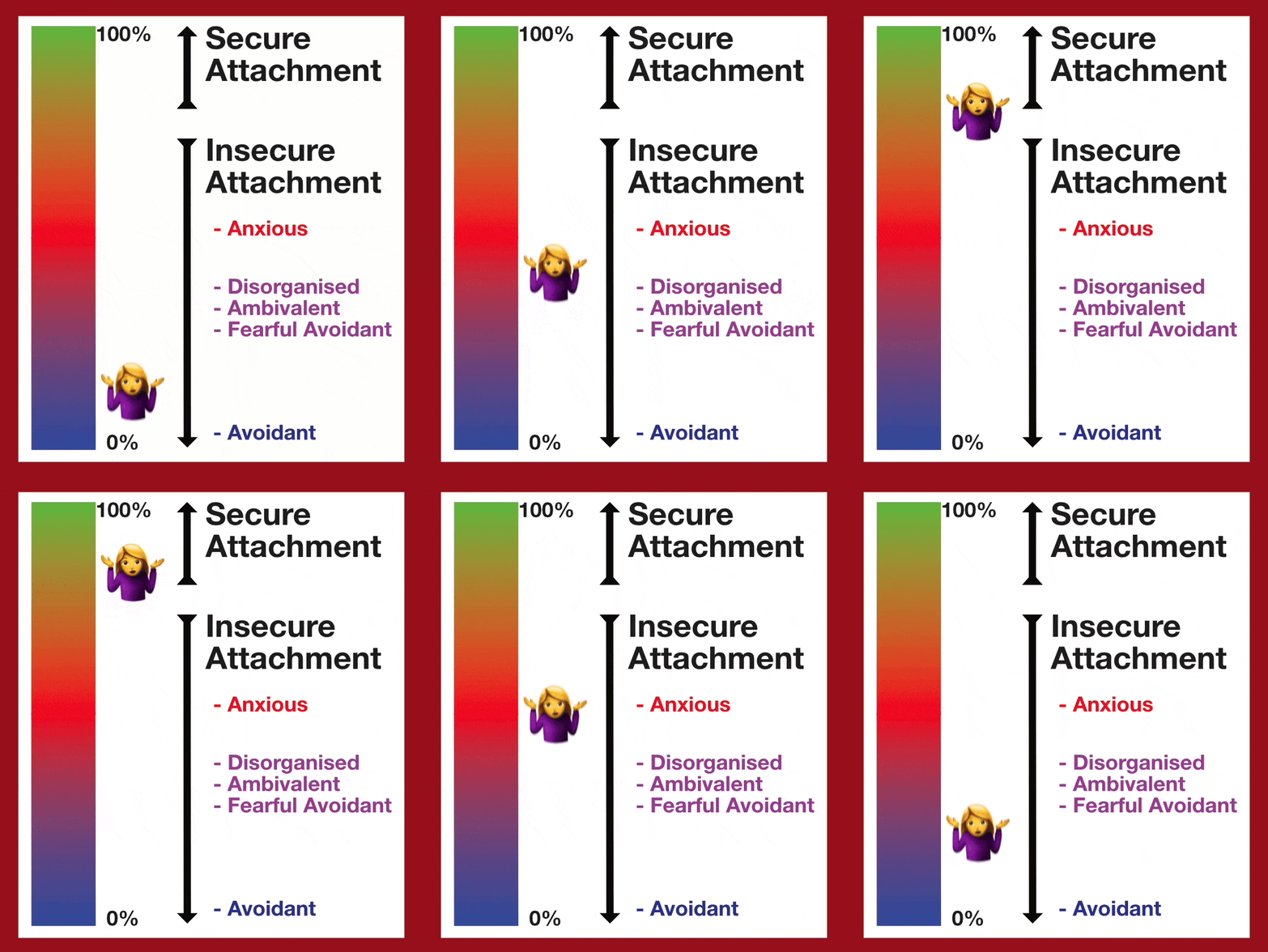
In order to get your personal attachment style score, please enter your best email address so that we can securely send this to you. (As well as give you $3,765 worth of coaching bonuses to help you cultivate secure attachment within yourself!)
And yes, we'll treat your email like it was our firstborn.
Before we get into attachment theory and the 4 attachment styles in relationships, I need to make something very clear:
A lot of well-meaning people unintentionally murky the water of this attachment styles framework with the masculine/feminine behavioural biases.
For example:
Let’s say that Jim starts dating Amy, they have a great connection and are gradually getting closer.
But 4 weeks down the line, Jim is showing signs of not wanting to commit to Amy in the way that she wants to.
In response to Jim’s lack of readiness to commit, Amy begins to feel anxious and begins to ask Jim a lot of questions about what his thoughts are about “where this relationship is going”.
Cue:
Check These 7 Things Before The “Commitment Talk” Threatens Your Relationship.
Jim responds to Amy by saying that he is happy with how things are right now, and doesn’t feel a need to:
Whatever type of commitment Amy is looking for, Jim is just not ready right now.
Some would say that Amy has an anxious attachment style, and Jim is the typical avoidant.
But that’s not necessarily the case.
QUIZ TIME: Is your man serious about committing to you? CLICK HERE to find out with this specially crafted quiz!
It could simply be the natural anxiety that comes up when a man and a woman come together, and they meet some normal conflicts causes by the differences in their:
Related: Relationship Timeline: Men Vs Women.
So we need to keep these two frameworks separate if we want to remain smart and use them with maximum effect in our lives.
Muddying the waters makes for more unnecessary confusion. And we don’t need that, especially those of us with insecure attachment who are trying to heal our attachment system.
The masculine/feminine behavioural biases and the attachment styles biases should remain separate.
So let’s be careful with what we label anxious or avoidant, yes?
Because even securely attached people can experience some low levels of healthy and calibrated anxiety, in the right contexts.
Now let’s quickly look at what attachment theory is before looking at the types of attachment styles in relationships.
Attachment theory is the theory that babies are born with an instinctive need to form close emotional bonds with their mother or caregiver in order to:
And that this bond will successfully develop in the first year of life if the baby’s caregiver was consistently:
Every baby comes out highly vulnerable and with needs that could be considered extreme.
And I say extreme because in this modern world, many parents sadly do find that being highly responsive to their baby’s needs 24/7 is just not possible.
Not when many parents still have to work during the day. And especially not with all the advice out there that pushes mothers to effectively abandon their babies at night (let them cry alone) and pretend that they can soothe themselves.
So:
If your mother, father or caregiver were responsive and sensitive to your needs most of the time, chances are you came out of your first year of life with a secure attachment style.
Thus, you would be one of the lucky ones.
If your caregiver personally experienced depression, high stress, trauma, they would have showed up differently as a parent for you.
If they abused you regularly or ignored your emotional needs, then you would most likely have what is called an insecure attachment style.
There are three types of insecure attachment styles:
On the opposite end of insecure attachment lies the secure attachment style which is, according to studies, the most common attachment pattern and the only type of secure attachment.
So now let’s discuss the 4 types of attachment styles in relationships so that you can get a clearer picture of which attachment style you have.
The secure attachment style is characterized by low levels of anxiety when getting close, and low levels of avoidance (of intimacy) when getting close to people.
You would most likely have a secure attachment style if your mother and father were highly responsive to your cries and kept you physically close in your first year of life.
The fact that you successfully secured adequate attention, love and the maternal resources that you needed in order to survive meant that you were blessed enough to start your life with a healthy self esteem and ease with having close relationships with others.
This secure style of attachment then transfers to your adult romantic relationships and even friendships.
As children and adults, securely attached people:
Studies also show that secure attachment is also associated with:
As you can imagine, all of these things translate to a higher likelihood of success in one’s life.
If you have a healthy, calibrated emotional and neurological system, then you’re more likely to be able to have available resources to properly focus on what you want to achieve and be well calibrated in social contexts.
SPECIAL REPORT: How to Become the World’s Most Attractive & Feminine Goddess (Even if you have no self esteem or no man has ever paid you any attention…) CLICK HERE to download it at no cost.
Anxious attachment style is the pattern of attachment we develop when our caregiver was inconsistent in attending to our needs.
Anxiously attached babies and toddlers cannot be sure whether their needs will be attended to at any given moment, so they exaggerate their needs and are always on high alert for potential threats to their emotional safety and survival.
In essence, their nervous system is under chronic stress as they have to hyper-activate their attachment strategy.
Instead of being able to trust in their worth and their ability to be sensitively responded to, they become extra clingy, demanding and at times resentful of their caregiver.
So what are anxiously attached adults like? In close relationships they tend to be:
Overall, anxiously attached people can develop all kinds of behaviours, often negative, in order to secure the much needed attention and love from their parents (and later, their romantic partners).
Cue:
How to Self Soothe Anxious Attachment In 2 Easy Steps.
How To Fix An Anxious Avoidant Relationship.
On the more extreme end of anxious attachment are behaviors such as:
(But usually do achieve the aim of receiving much needed attention…even if it makes the other person hate you.)
I know this all doesn’t sound very nice or “normal”, but for 20% of the population, it’s their way of life.
Obviously, some people with anxious attachment have proportionally more endearing behaviors whilst others have proportionally more behaviors that are likely to push people away.
Cue the following articles:
It’s easy to see anxious attachment as a negative thing, and while it definitely can be, research has also shown that anxiously attached people have unique value, and so do avoidants.
In one particular study, researchers got a group of people together, and they measured their attachment styles.
They informed the participants that they were going to analyze data on a computer screen. But that wasn’t the point of the study – they had rigged the computer so it started smoking.
The people who were anxious were the first to detect the smoke, while the avoidants were the first to find a way to escape the situation.
So:
Try to see the attachment styles as an adaptation to the person’s early life circumstances, and see the anxious attachment style as a mechanism of attuning to personal threats…even when they’re not imminent.
So there is value in anxious attachment, it just comes at a cost.
Take my husband and I for example. He is secure whilst I am (at least when we first met) anxious.
Though my attachment style has become mostly secure over the last 15 years, in the right circumstances, the anxious attachment system becomes activated.
And here’s what’s interesting:
Under legitimate stress or threat, we can respond differently.
I’ll use the example of a recent earthquake we experienced in Melbourne Australia.
Myself, my husband and our three boys were sitting in the play area when the upstairs of our house started swaying one calm morning.
Within two seconds, I was up yelling at everyone to go down the stairs and to get out of the house.
I wanted to protect my family, obviously.
Meanwhile, there’s my husband sitting calmly, and upon hearing my urgent voice, he stood up and looked around, but then paused while I was waving my arms frantically for everyone to get out.
I then began to run with the baby downstairs (taking two steps at a time and almost chucking a whole cup of tea all over my stairs in fear, mind you)…
And when near the top of the stairs, I turned around once again to yell for the boys to get out of the house. But I see my husband standing there calmly, just looking around.
Of course the house is still rocking back and forth through all this.
Then I tell him with more urgency to get out of the house again, and I make a run for the front door, baby in arms.
When I got out of the house to safety, I looked back to see only my middle son outside with me, a little scared, but still walking calmly.
I then see my husband on the bottom floor inside the house still. And to my dismay, I see my oldest son, just calmly walking down the stairs, looking at the rocking objects in the house, not phased at all.
In the end it wasn’t a huge earthquake. Sure some people’s houses were damaged and our indoor plant fell over, but nobody in Melbourne died.
So would my actions have saved us if it were a bigger earthquake? Hard to know.
But did I cause myself (and to a much lesser extent my boys) a bit too much unnecessary stress and look too frantic? Highly possible.
Do you see the cost in my response with little reward?
Contrast that with the rest of my family’s response, who are all securely attached, and you’ll see that my response wasn’t entirely necessary, even though well intentioned.
So I was explaining that if my husband doesn’t act on a possible threat urgently, usually I act on it.
He, on the other hand, sees the threat and responds much more gradually (but at the same point in time, to me his response usually seems slow).
I’ll be all like :
“C’mon, don’t be so slow – it’s urgent! We need to do something.”
He’ll be like:
“It’s alright. Everything is alright…”
So here’s the crux of it:
In select stressful scenarios I act quickly and I get (unpredictable) results quickly, whilst he acts much more slowly and gets reliable results slower.
The benefit of my reaction is that I respond faster, but it is by no means a better outcome.
Because my response is fuelled by more stress, the result I get isn’t as calibrated.
The benefit of his response is that the end result we get with his decision making is closer to the ideal.
Related: 12 Anxious Attachment Triggers: How To Recognise & Heal Them.
Point being:
Anxiously attached people can perceive threats early and intensely, sometimes causing them to respond in an intense way. This may successfully ward off threats, but it comes at a larger cost – usually to themselves and to their relationships.
Think of the female partner who is always checking her boyfriend’s instagram for new women who follow him (or new women he follows). The second she sees a new female on his list, she’s all like:
“You’re gonna cheat on me with her aren’t you?”
“You think she’s prettier than me, don’t you!”
The new female may or may not actually be a threat to her. But on the possible chance that she is a threat, the way she approached her boyfriend about it causes their relationship more unnecessary stress.
…And potentially pushes him away.
I hope that makes sense. Let me know in the comments if it does or doesn’t.
Now let’s discuss the avoidant attachment style.
The avoidant attachment style tends to present in adulthood as a low desire to bond and connect, thus also low commitment to intimacy and relationships.
Avoidants don’t tend to want to or be able to share thoughts and feelings with others, and they don’t tend to trust people or close relationships.
Not only that, but avoidants also tend to have lower empathy, and are more likely to present with mental disorders.
It is not often mentioned, but avoidant attachment is also significantly correlated with secondary psychopathic traits.
Which one of these 8 feminine archetypes are you? Answer these 21 questions to discover which feminine archetype you are and how it positively and negatively affects every relationship you have. (Especially your intimate relationship with men.)
1. True or false... A man and a woman should get along if they love each other.
True
False
I don't know...
2. In my old age, it’s more important to look back and know that
You’ve connected with others and created strong bonds
You’ve achieved all your dreams
You had truly cared about those around you
You ticked everything off of your bucket list
3. Regarding sex...
I prefer he initiated sex with me
I’m more than comfortable taking what I want from him in the bedroom
4. When I’m faced with something unknown, I trust
My gut feelings more than my thoughts
My thoughts more than my gut feelings
5. When I meet someone for the first time, I get a gut feeling whether I can trust them or not.
Very true
It usually takes me a while to figure this out
6. Confrontations are...
To be avoided if possible
Can often work in my favour
7. The thought of newborn babies make me feel…
Very emotional and tender
Terrified
Happy and calm
I’m relatively indifferent to newborn babies
8. I would prefer to be more...
Liked by others
Envied by others
9. When I have to make a tough decision…
My brain always knows the better answer
My gut always tells me what to do
I will get all the facts and data and make a decision
Give it some time and the answer will come to me
10. I would prefer...
Pleasure of the mind
Pleasure of the soul
11. I believe in premonitions
True
False
I’m willing to entertain the idea
It’s a load of nonsense
12. When someone hurts themselves...
I rush to see if they need help
I’d rather see them help themselves
13. Which is more true?
Conflicts serve a good purpose in my relationship
Conflicts are to be avoided in my relationship
Conflict will cause my relationship to die
With the right man, conflicts only strengthen our relationship
14. I can often feel other people’s intentions from a mile away
15. In social situations, I am...
The peacemaker who ensures everyone feels included.
The dominant personality who likes to lead.
The enigmatic figure who draws others in with mystery.
The observer who watches from the sidelines.
16. In my current or previous relationship…
I enjoy how a man is so different to me
I get annoyed that a man is so different to me
We are so different I often thought I’d be better off alone
His differences make me appreciate and love him more
17. How important are other people’s feelings?
Super important to me.
Little importance to me.
Other people’s feelings are none of my business.
18. In terms of dancing…
I love to dance and move my body
I find it a chore
19. On a rainy day, I prefer…
The safety and warmth of my home
The excitement of a new exotic location
20. When a friend is upset, my first instinct is to:
Run away, I’ve been used by enough friends
Give them some space until they're ready to talk.
Suggest practical solutions to their problems.
Give them a hug and listen to them
21. It’s more important to…
Pursue my own dreams and goals
Live cohesively in my tribe
We are analysing your feminine archetype right now and preparing your personalised summary.

Here’s something interesting to know before moving forward…
Every single one of these archetypes has strengths and weaknesses. No matter how ego stroking it may be to identify with your archetype, know that it’s just a starting point.
It is your job to be aware of the strengths and weaknesses so that you can grow, evolve and become who you are meant to become.
Ultimately you want to become a full multi-dimensional human being. In order to truly become a high value individual, you want to tap into the value that every part of you has to bring to the table.
This feminine archetype quiz is one step along this journey to help you discover who you are, and who you will become.
So here is the next step.
Please enter your first name and email below so that we can safely deliver your feminine archetype results and send to you the extended explanation. (As well as give you $3,765 worth of coaching bonuses!)
And yes, we'll treat your email like it was our firstborn.
It usually forms when one or both of your caregivers were:
Over time, the child becomes less and less trusting of others, and less and less likely to call out for help or support.
Ultimately, this pattern is cemented in adulthood, leading to a lack of close emotional bonds in their life.
Children with avoidant attachment style likely had one or two parents with an avoidant attachment style.
Avoidants have a propensity to ignore emotional needs, assuming that, like my own father stated: ”a roof over your head and food on the table” is enough.
Of course, nothing could be further from the truth. Humans needed close emotional and physical bonds in order to survive and this is the key: to thrive!
If they were not given this sense of attunement and closeness from their parents, this ultimately affects the quality of their life and relationships in the future.
The next attachment style to understand is the disorganized attachment style, also known as fearful avoidant.
Of all the types of attachment styles in relationships, this one presents with the most confusing symptoms.
Those with a disorganized attachment style express high levels of anxiety and avoidance simultaneously.
Whilst the first three attachment styles are pretty straightforward and show a relatively consistent response to attachment, disorganized attachment is different.
It is labelled as disorganized because individuals with this attachment style show responses to intimacy and attachment that are:
This erratic behavior can lead to tumultuous relationships where your partner is constantly confused by you, and is on edge about how you may respond to their attempts to connect.
So how does this bizarre behavior show up? In response to moments of intimacy, adults with disorganized attachment may:
CLICK HERE to LEARN the One Specific Emotional Trigger Within Every Masculine Man That Inspires Him to Want to Take Care of You, Worship You and Deeply Commit to You.
You’re sitting down having a nice intimate chat with your partner who has disorganized attachment. We’ll call him Disorganized Damien.
You’re feeling really bonded to Damien in the moment, and seemingly, Damien is feeling bonded to you.
You reach out and hug him. But just as you do that, Damien’s body freezes like a rock, and he doesn’t return your hug.
Feeling concerned, you lean back to take a look at him, and you notice that he is not only frozen – he is zoned out, staring into space.
What on earth…?
This would understandably make you somewhat confused when getting close to Damien.
And this fearful confusion you now feel is the reciprocal response to their eccentric behavior, that was itself inspired by the abusive behavior of their mother/father.
It’s usually formed due to having abusive parents – or an abusive parent – while growing up.
An abusive mother who is deeply troubled and struggling with child rearing may not always strike her child. But rather, she may make seemingly kind comments towards her child whilst secretly and suspiciously trying to insult and derogate her child.
This passive aggressive behavior causes hope and fear in her child at the same time.
When this is done enough times, the child develops a disorganized style of seeking comfort and attention.
Thus when experiencing distress, this child who might have some surface memories of his mother being warm to him may walk towards her, crying for comfort.
But his body still remembers that she doesn’t always have good intent and can abuse him in the same breath, so suddenly he experiences debilitating fear. That fear then causes him to stop in his tracks, freeze or walk in the opposite direction.
Imagine feeling like your mother could seemingly comfort you on the surface, whilst also denigrating you or emotionally torturing you.
You wouldn’t develop an ease with relationships and nor would you trust closeness, instead you would develop a very real fear of getting close to people.
This is also why disorganized attachment is sometimes called fearful avoidant attachment.
MORE: Fearful Avoidant Attachment: 10 Signs & How To Overcome It.
Now we must ask the question of whether your attachment style can be changed.
The answer is yes, of course. But you need to be wary of who you allow into your life, and you need to be serious about moving from insecure attachment to secure.
Also, you need to make a conscious effort to form new (or deeper) relationships with those who have secure attachment.
Speaking from personal experience, forming a bond with someone who has a secure attachment style is one of the most healing things you can do.
Unfortunately, the problem with those who have an avoidant attachment style is that they can really devalue the person who is secure.
Avoidants can tend to see secures as weak (because they’re warm and actively seek bonding). They may even see a secure person as fake (because they don’t trust their attempts to get close).
Or, avoidants can be so unwilling to be vulnerable and trust, that they end up pushing the secure person away through their defensive self-inflation.
Anxiously attached people can cause themselves and their love interest so much extra stress that any love and attraction gets drowned out.
So that is something that you need to be on the lookout for.
SECRETS REVEALED… Discover how you too can use this little known “Dark Feminine Art” to weed out the toxic men whilst cultivating real emotional attraction with high value high esteemed men. (CLICK HERE to enrol in this free class before it’s gone.)
After reading this, have you got a general idea of what your attachment style may be?
You may have an idea about what your personal attachment style is, but it’s very important to be sure.
So what we have done is we’ve created a quiz for you to take. It will help you determine what your attachment style is. CLICK here to take this quiz.
We are also creating a very special online study program to help you move from insecure attachment to secure. If you get on our email list, you can remain informed about this.
If you find yourself among those with an insecure attachment style, it’s natural to feel a bit sad and disappointed.
Nobody wants to have to shoulder the responsibility of neglect or trauma that happened long ago, that was no fault of their own.
But see it like this:
Securely attached people take their resilience for granted. They just don’t know how good they have it. And nor did they have to work for it themselves.
When you have to work towards a secure attachment style as an adult, it gives you a vulnerability and humility that will help you bond deeper with others who are struggling in this world.
And that in itself is so valuable; it gives your life deeper meaning.
What if you could be a great lover or friend, not only to yourself, but to others who are like you?
Most of all, know this:
I can tell you that it’s possible to move from insecure attachment to secure, because I’ve done it!
Of course I haven’t managed to fully rid myself of anxious attachment 100% – but I’ve managed to experience attachment security a good 70-80% of the time now.
I’ve also managed to raise 3 securely attached sons (picture below)…
It wasn’t an easy road. I mean 10 years ago there were times where it felt like all I did with my husband was work through my early trauma and re-learn the art of intimacy and bonding.
But that is no longer the case. Once you’ve done the initial hard yards, you never have to do it again.
I also want you to know that David and I will be releasing a program on becoming securely attached this year, so stay tuned for it. We’ll be doing some live q & a videos as well.
Finally…I hope you found this article helped you in understanding the 4 types of attachment styles in relationships.
I suggest you come back to it after reading it for the first time. Because what I’ve found is that with any important information, I can read it many times and always discover new insights when I re-read them.
Be kind to yourself, understand that whatever pattern you developed growing up, it was adopted subconsciously to serve you in meeting your needs.
P.S. CLICK HERE to check out my full article archives! Or you may greatly benefit from one of our highly popular paid programs, CLICK HERE to see what we offer right now.
If you want to be supported by a warm community of high value feminine women, then join our Facebook Group. (It’s free and so incredibly valuable!) CLICK HERE TO join thousands of other women in our “High Value Feminine Women” Community.
By the way, while you’re at it, connect with me on social media.
Renee is the founder of The Feminine Woman & co-founder of Shen Wade Media where we teach women how to show up as a high value high status woman whom easily inspires a deep sense of emotional commitment from her chosen man. She graduated with a bachelor of Law and bachelor of Arts majoring in sociology and psychology. She has been a dating and relationship coach for women in the past 15 years and together with her husband D. Shen at Commitment Triggers blog, they have positively influenced the lives of over 20 million women through their articles and videos as well as 10’s of thousands through paid programs through the Shen Wade Media platform.
Connect deeper with her work through the social media links below.