
Sometimes confidence for an anxiously attached person seems almost impossible.
After all, your anxious attachment system is screaming at you all day long, making you doubt your every move and every thought.
I mean I would know, I used to live with it every day.
And we’re talking real anxious attachment style here, not just someone who is secure deep down inside and just has some anxiety here and there.
You can determine your core attachment style (and get a score for where you are on the sliding scale of secure to insecurely attached) by taking my free quiz. I’ve embedded it below:
Fact: 54% of all women have insecure attachment styles and it affects their relationships daily. Answer the next 10 questions to discover what your attachment style is.
1. When it comes to relating to people in general…
I believe people are generally dependable and kind
I get attached to people easily and they often let me down
I don’t believe I can truly trust anyone
People will always come and go
2. To me, the word intimacy intuitively feels
3. In my relationship, I tend to constantly…
Worry that my partner will stop loving me one day
Feel repelled when my partner gets too intimate and close to me
Want to learn more about my partner without fear of judgment
Find faults in my partner
4. In my partner’s absence, I…
Look forward to seeing him again
Feel anxious and don’t know what to do
Feel incomplete
Feel free
5. In my most ideal relationship… (choose the one you feel strongest about.)
We would have our own lives & wouldn’t have to depend on each other
I would receive constant love and attention
We would be deeply connected above all else
To feel safe, I would want to have more control in the relationship
6. If a man that I was interested in started to banter with me…
I’d effortlessly banter back
I’d freeze and not know what to say
I’d redirect the conversation because banter is childish
7. If I suspect that my partner has been cheating on me…
I would rather not know about it
I’d ask them about it until they confess
I’d investigate it & find out as much as I can without coming to conclusions
I’d instantly get stressed out of my mind and become angry
8. When it comes to sex… I’d rather have
Casual sex with uncommitted partners
Intimate sex with a committed partner
I’d rather avoid sex.
9. If I share my deepest feelings and thoughts
Perhaps no one would care
Perhaps people may no longer love me
Perhaps I can resonate with the deepest feelings of others
I would never share my deepest feelings
10. If someone I’m dating suddenly becomes cold and distant…
I feel indifferent, even relieved as they’ll need less from me.
I feel like perhaps I’ve done something wrong or perhaps they’ve found someone new
I feel like I need to delve deeper into what is happening without feeling sorry for myself.
I feel angry and vengeful.
We are analysing your personal attachment style results right now and preparing a comprehensive summary. On a side note, it is important to understand attachment styles as a sliding scale rather than a fixed set of categories. Here are the reason why…
1. Your attachment style is not fixed but rather plastic, meaning you can over time heal an insecure attachment style, just as you can create more insecurity in your attachment style if you hang around toxic people in your life. Having a sliding scale offers you a solid direction to move towards.
2. Attachment styles should be considered as secure or insecure attachment styles with levels of severity when it comes to insecure attachment. This helps you understand how your own attachment styles developed in the first place and what direction you need to take in order to heal from attachment style traumas. (We’ll explain this further in the first email you’ll get from us.)
3. Almost everyone with an insecure attachment style has multiple categories and patterns within that insecure attachment, (of course to differing degrees).
In other words, you don’t just have a pure anxious attachment style. That may be the predominant pattern in your nervous system, but there is also avoidant in there too when you’re nervous system is overloaded and sick of being anxious all the time. This is why it’s more important to see this framework as a sliding scale and not just a mere set of categories.
So your personal attachment style will fit along the scale you see below.
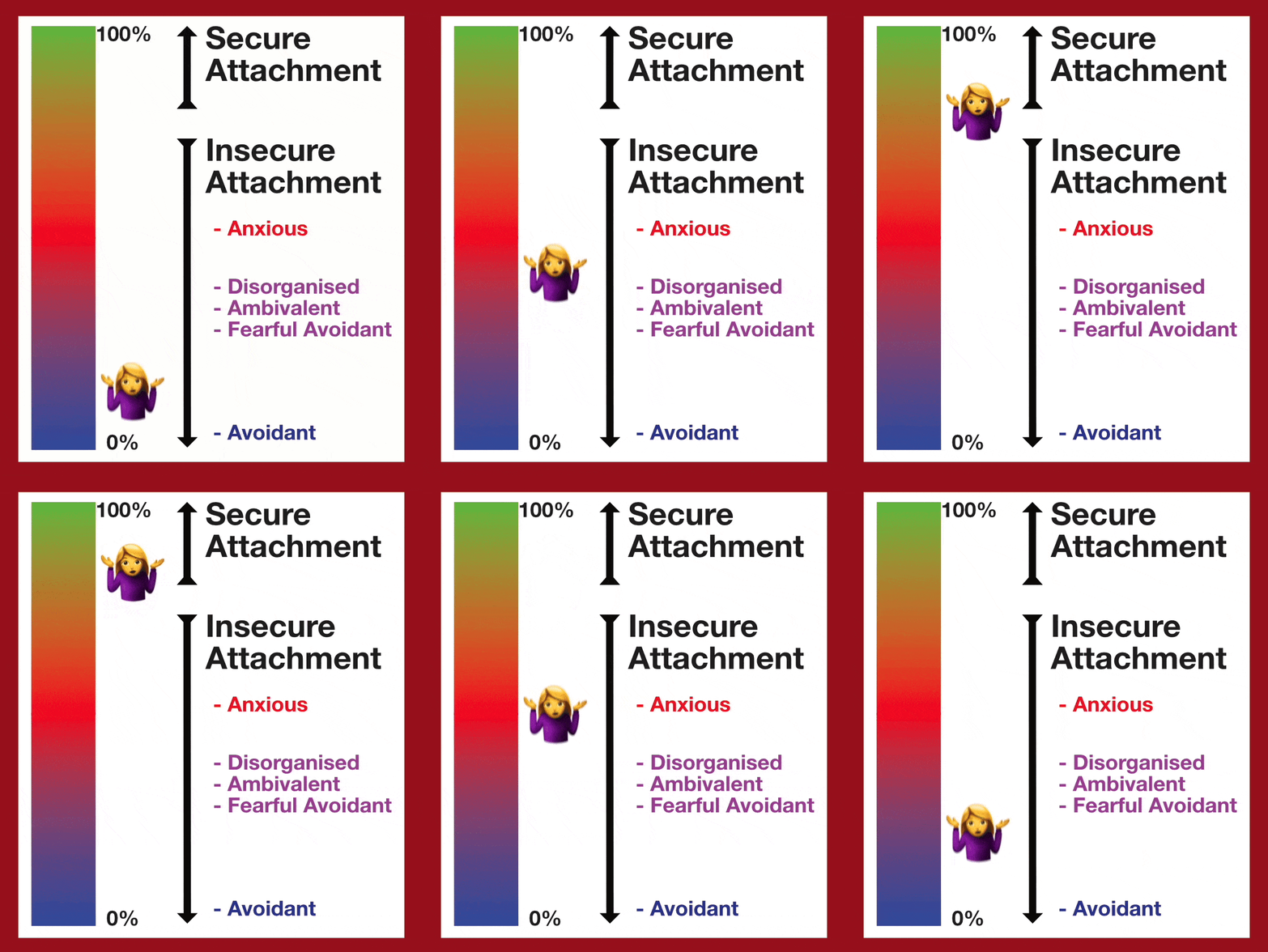
In order to get your personal attachment style score, please enter your best email address so that we can securely send this to you. (As well as give you $3,765 worth of coaching bonuses to help you cultivate secure attachment within yourself!)
And yes, we'll treat your email like it was our firstborn.
Anxiety is anxiety. Anyone can have it. But real anxious attachment style can be often debilitating and you need to understand the difference.
So as I’ve mentioned before, anxiously attached people are prone to negative affect.
What is negative affect? In psychology, negative affectivity, or negative affect, is a personality variable that involves the experience of negative emotions and poor self-concept.
Imagine trying to be confident with that as your inner template! Can you imagine?
A poor self concept is literally embedded into your attachment template and you’re trying to be confident?
Well, fear not. I’m here to help.
As simple as the answer may be, the real pathway to unwavering confidence from anxious attachment is a deeper level of self appreciation.
Related reading: Breakups: How Anxious Attachment Styles Cope & Behave.

This is the real path to confidence as an anxiously attached person.
And I’m not talking about positive thinking or straight up narcissism here.
I’m talking about appreciating your actual anxious attachment and where you’ve come from.
In other words, appreciating the parts of you that you may not like.
Here is the thing:
Very often anxiously attached individuals like to push their anxiety down and avoid it at all costs as a way to cope with it.
That might be useful in the short run as you escape the terror that the anxiety has on your life, however that just moves you more towards avoidant attachment.
And avoidant attachment is never the answer.
Instead, we need to move towards our anxiety and practice self appreciating through our anxious attachment.
That is the real and only pathway to heal from anxious attachment.
MORE: How to Self Soothe Anxious Attachment in 2 Easy Steps.
Here’s the video I made on turning your anxious attachment into confidence:
So right now I want you to have an image in mind for our final goal…
Imagine yourself as someone who is walking beneath a dark, rainy cloud that is constantly hanging over your head. I mean every second of every day. You just can’t escape the rain even if you tried.
Now imagine yourself walking around every day with a bright and gentle sun constantly following you everywhere.
The trick here is replacing the rainy cloud with the gentle sun that shines on you as a source of warmth and yes, vitamin D.
Now, you’re going to become the sun for yourself through self appreciation. That’s the goal we need to have in mind.
But first, we have to be considerate of what it means to appreciate yourself when you’re an anxiously attached person.
Self appreciation is not a thing when you have anxious attachment, because of two things:
We have to acknowledge that self appreciation doesn’t come with the territory of anxious attachment.
How do you convince yourself you’re awesome when your attachment template always tries to bring you back to the equilibrium of: “me negative others positive?”
You have to work with the wound itself. Here’s what I mean:
Having anxious attachment is like having a gaping wound on your leg.
When you have a huge gaping wound on your leg, sometimes you just want to cover it up with a surface band aid and not think about it, because it reminds you of how it got there in the first place.
But the real way to address the wound is to look deeply into it, see what it needs to heal, and then give it exactly what it needs so that it can not only heal, but heal without succumbing to new infections and assaults from your environment.
What does that look like in the context of anxious attachment?
SPECIAL REPORT: How to Become the World’s Most Attractive & Feminine Goddess (Even if you have no self esteem or no man has ever paid you any attention…) CLICK HERE to download it at no cost.
As with anyone who’s anxious, you don’t appreciate yourself enough.
You don’t appreciate your progress and where you’ve been, and that’s something you’ve got to focus on.
Also know that your anxious attachment, as maladaptive as it may seem on the outside, there’s still a good intent behind it. So don’t berate yourself for the good intent that it has.
Adjust your expectations of yourself and your actions. You see, expectations for yourself shape the meaning you make out of things.
If you expect yourself to act like a secure person when you’re truly not secure, then you’re going to gain a very poor meaning out of any mistakes you make, and even the positive things you do.
Nothing is ever going to be enough.
If instead you expect yourself to still be scared and anxious when triggered sometimes, you’ll be able to address it quicker and help yourself manage your stress levels quicker.
Why?
Because you’re not wasting all your energy on trying to push the anxiety down or expecting yourself to be perfect.
Related reading: How To Let Go Of An Avoidant Man When You’re Anxious (+ Advice If You’re Secure).

So I’ve mentioned previously that I’m roughly 80% healed at this point.
(That’s my very subjective perspective), but sometimes in novel situations I get caught off guard and my anxious attachment patterns show up again.
Like recently for example, I was caught off guard…
We were staying in an airbnb in Vietnam, and suddenly the fire alarm goes off.
So the fire alarm sounded like it was in the distance, and initially I wasn’t too alarmed, and then that alarm stopped completely for a minute or so.
But suddenly a second fire alarm sounded much louder than the first. It escalated and it was now coming from our floor.
Now for some context, Vietnam is really known for buildings burning down, due to the hot weather, the building codes etc, so knowing that, my stress instantly went up.
I’ve got 3 young kids and I wasn’t about to see any of them die in a fire.
I yelled to everyone to get out of the house.
By the way, half my kids were naked at the time. But I didn’t care.
I opened the door, looked outside, I heard the blasting fire alarm, and then I made eye contact with this cleaning lady who was casually mopping the hallway like nothing was wrong.
She smiled at me and 5 seconds later the fire alarm ends.
Then, a loud announcement is broadcasted throughout the building:
“This is a fire alarm test. Do not evacuate. This is a test.”
I look over my shoulder and I just see David laughing playfully.
The more David laughed the worse it made me feel about my actions, even though he didn’t mean anything bad by laughing.
I am sensitive and in took offense to that, being frustrated with him for laughing at me in a playful way.
I interpreted his laughing as a signal that I was “broken” and unfixable and hopeless. But that perpetuates shame.
Because I’m expecting myself to be perfect.
A lot of the time, we expect ourselves to be perfect, we try to hide our anxiousness deep down, we try to stay in control and keep a strong facade, but this is counter-productive to healing.
Instead, we must not expect ourselves to be any less than anxiously attached.
If you’re interested in the potential triggers for your anxious attachment, I’ve written about the 12 Anxious Attachment triggers: How to Recognise and Heal them. CLICK here to read this article.
So instead of expecting yourself to be perfect, ask yourself these questions.
Now I’m not trying to justify you being constantly anxious here.
I’m just trying to suggest to you that your expectations shape the meaning you place on how you show up in relationships.
For example, if you try to hide the maladaptive coping mechanisms, or expect perfection from yourself, you’ll just perpetuate the cycle of shame.
Shame is the biggest secret of anxious attachment style. Of course most anxious people experience far too much shame.
So anything that perpetuates the cycle of shame is counterproductive to healing.
Of course, shame does serve a purpose in human life when it’s calibrated.
For example, you should feel ashamed for deliberately harming someone else. That’s fair, wouldn’t you say?
But feeling shame for having a desire for emotional closeness and intimacy as a baby and never ultimately receiving it is not really deserving of shame, is it?
So what we want to do is free you from chronic shame as much as possible.
Tell yourself that you are this way because it was the best adaptation to life that was available to you, given the lack of nurturing you received in your first 1 to 3 years.
Here’s what I mean.
Even though anxious attachment is a maladaptive response to stress, it’s just an attempt to secure emotional safety.
It’s an attempt to protect your own life and your own relationships because they really meant so much to you.
It’s certainly a lot better and a lot more manageable than if you had gone to the extreme end of avoidant attachment style, that’s for sure.
But we don’t want to make avoidants wrong here.
We just want to appreciate that your nervous system did the very best it could for the environment it was forced into.
So don’t expect yourself to never be anxious.
Instead, expect yourself to have hiccups. Expect yourself to occasionally feel so much fear that you blow things out of proportion.
I know it’s not nice to hear. But this is what anxious attachment is. You can’t heal it by ignoring it.
Remember the analogy of the gaping wound? You can’t slap a band aid onto it, hoping everything will be ok.
If you expect that this hypervigilance and clinging is a part of your inner working template, then every time you do have a set back, you can be more aware of how to better approach it and manage your anxiety next time.
Instead of hiding shame by expecting perfection from a naturally imperfect being, you say this to yourself:
“Hey, I am exactly who I am and who anyone else would be, given my circumstances.
This might mean I do things I don’t like and that other people don’t like every now and then.
But I will first appreciate my anxious attachment for being there for me and doing its best for me.
Then, I will reduce my anxious response the next time by consciously bringing down my stress levels from 100 to 95, and then from 95 to 85 and so on.”
Forgive yourself for the stress and yes, even the toxicity you may bring to the situation because of that underlying stress.
(Here are 10 Seemingly Harmless Signs of A Toxic Relationship.)
Know that you didn’t know any better at the time, and that it’s now your responsibility to bring more peace to yourself and the people you relate to.
Also remember, this isn’t some delusional thinking such as: “my anxious attachment is a special power that others don’t have”.
That’s just upside down, backwards and delusional all at once.
The world is enough upside down right now, let’s not add to that by doing it to ourselves.
It’s simply about knowing that anxious attachment was the best solution the universe has for anyone given your circumstances.
And know that the best way to help yourself is to be aware that it is a solution of sorts, it’s just an energy wasting solution that you need to manage.
Fact: Some men will string you along for as long as you will tolerate and never fully commit to you. Answer these 8 questions to discover precisely how commitment friendly your man is.
1. When I speak to other guys, and give attention to other men...
He gets jealous and isn't afraid to show it.
I know he gets jealous underneath but he tries to keep it cool
He doesn't have a hint of jealousy!
I don't know.
2. How willing is he to have a fight or argument with me?
He tries hard to avoid fights or arguments
He always wants things his way and won't listen to me
He doesn't show any avoidance to arguments.
I don't know.
3. What is his relationship with his father like?
He has a huge respect and talks fondly of his father.
There's not really a relationship between him and his father.
He talks about his father with disdain.
I don't know.
4. When I first started dating him, he mentioned commitment & long term relationships
Quite often, and he has been happy talking about it.
Occasionally, and he's a bit guarded when talking about it.
Never, he never likes to mention commitment at all.
I'm not sure...
5. How many long term committed relationships has he had?
At least 3 long term relationships...
Just one or two.
He's never had a long term relationship before...
I don't know...
6. How often does he push for sex?
All the time, and he gets pissed off if I don't give him sex.
Rarely ever, he cares about how I feel.
Never, he is a real gentleman
I'm not sure...
7. How keen is he to introduce you to his friends and family
Very keen, he wants everyone to get along with me.
He's not sure, he says he needs to find the right time.
Not keen at all, he tends to avoid the topic and drag it out.
I'm not sure...
8. How much effort has he shown you that he wants to learn about your friends and family?
Not much at all, he never asks me about my friends or family.
On the odd occasion, but he doesn't care about it too deeply.
He is always very fascinated with my friends and family
I don't really know...
We are analysing your quiz results right now and preparing a comprehensive summary. (It's a 15 min read)
In your personalised results email, we will also give you free advice and coaching to help you inspire a deep sense of emotional commitment from the man of your choice, even if you've had no luck with men so far.
Please enter your first name and email below so that we can safely deliver your results and explanation to you. (As well as give you $3,765 worth of coaching bonuses!) And yes, we'll treat your email like it was our firstborn.
The more you appreciate your anxious attachment, the more energy you have for gaining earned secure attachment.
Before you go, I recommend you take my free quiz to determine your true core attachment patterns.
QUIZ TIME: Do I have secure or insecure attachment patterns? CLICK HERE to find out with our specially crafted women-specific 10 Question Quiz!
(Why is this important? It is because your core attachment style largely dictates and influences what happens in your relationship. Thus it’s imperative you understand your core attachment style!)
The quiz will give you a score for where you sit on the sliding scale of attachment styles, and the explanation you receive afterwards will be another leap forward towards your healing.
And kindly leave me some feedback below in the comments. Let me know where you are on your journey. Let’s talk about this gaping wound that is anxious attachment style.
P.S. CLICK HERE to check out my full article archives! Or you may greatly benefit from one of our highly popular paid programs, CLICK HERE to see what we offer right now.
If you want to be supported by a warm community of high value feminine women, then join our Facebook Group. (It’s free and so incredibly valuable!) CLICK HERE TO join thousands of other women in our “High Value Feminine Women” Community.
By the way, while you’re at it, connect with me on social media.
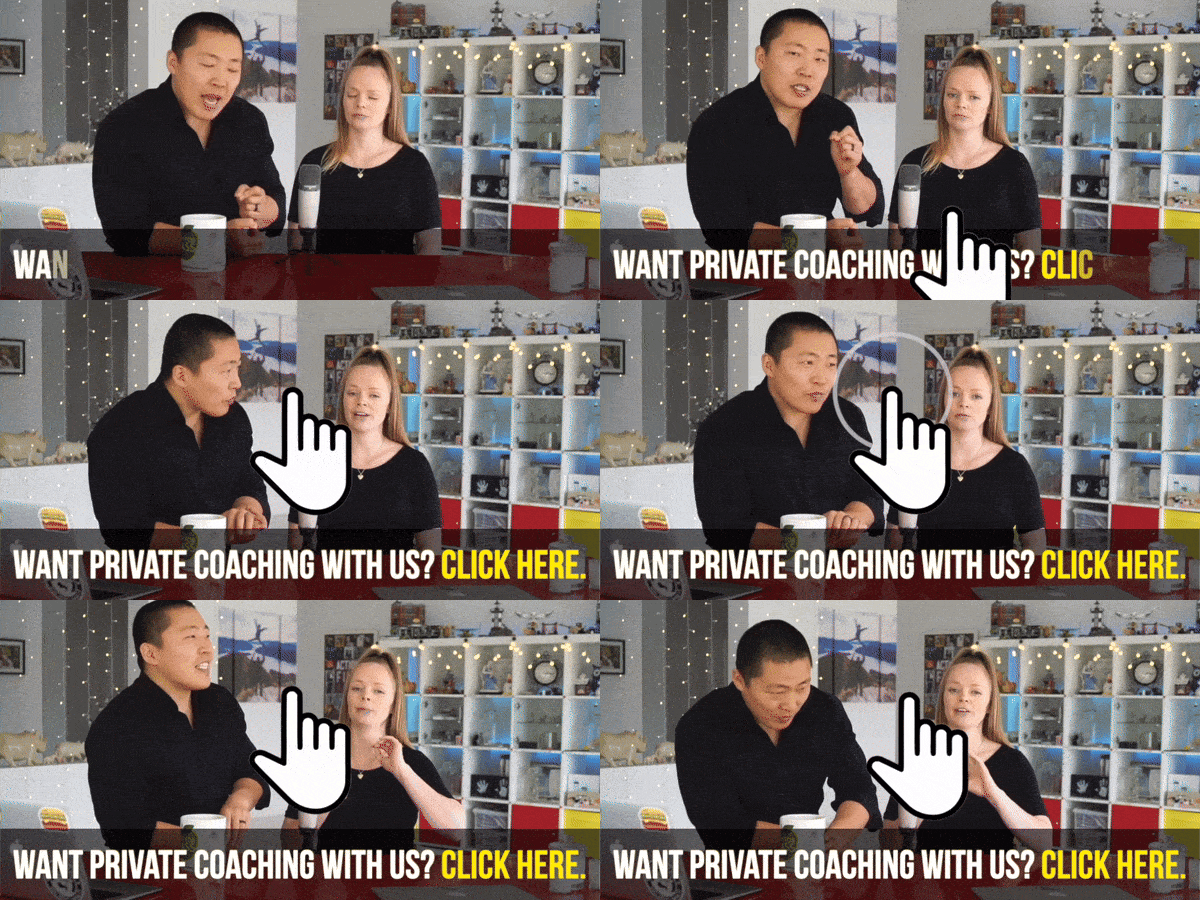

Renee is the founder of The Feminine Woman & co-founder of Shen Wade Media where we teach women how to show up as a high value high status woman whom easily inspires a deep sense of emotional commitment from her chosen man. She graduated with a bachelor of Law and bachelor of Arts majoring in sociology and psychology. She has been a dating and relationship coach for women in the past 15 years and together with her husband D. Shen at Commitment Triggers blog, they have positively influenced the lives of over 20 million women through their articles and videos as well as 10’s of thousands through paid programs through the Shen Wade Media platform.
Connect deeper with her work through the social media links below.