
Your avoidant pulling away can me maddening, but it doesn’t have to cause you to spiral, and we’re going to discover exactly how securely attached people respond to avoidants pulling away, so that you can:
QUIZ TIME: Is your man serious about committing to you? CLICK HERE to find out with this specially crafted quiz!

First of all, understand that secure attachment is an inner resource by which secure people draw from during stressful times.
This means that secure people would be able to react without a fight or flight response when the avoidant pulls away, because their nervous systems are well regulated.
Instead, they seek to understand or to problem solve. Now:
Just so that you understand the general differences in behavior of men and women, I have to make a distinction here between the masculine and feminine responses of secure people…
SPECIAL REPORT: How to Become the World’s Most Attractive & Feminine Goddess (Even if you have no self esteem or no man has ever paid you any attention…) CLICK HERE to download it at no cost.
In general, masculine men tend to problem solve in their default state, whereas feminine women would go to nurturing in terms of their actions.
But their actions both come from a place of resourcefulness, not from a place of fighting or fleeing if they’re truly securely attached.
And this is a general bias in the behavior of masculine men and feminine women. But the problem solving and nurturing behaviors of secure people usually don’t carry an air of stress or anxiety.
So I want you to be aware of the masculine and feminine biases in behavior, and don’t assume that they come from insecure attachment styles.
Because insecure attachment styles have at their core a fight or flight response under stress. Secure people go to that response only when it’s truly necessary.
Simply put, it’s not always the behavior that betray insecure attachment, but rather, it’s the energy the behavior carries with it.
Recommended: Why Avoidant Men CHEAT.
So a secure person, (man or woman) would notice the avoidant pulling away and acknowledge the sudden change in behaviour. Then they’d get curious and ask themselves a question:
“This is unexpected, did I do something to cause this?”
They might reach out to ask if the avoidant is ok, or if they need anything.
Related: 11 Genius Ways to Communicate to An Avoidant Partner.
Remember, secure people who are invested in a relationship are able to put connection first. That’s the privilege of securely attached individuals.
And this is also why I often say, focus on building emotional connection and emotional attraction. It is these two factors and these two factors alone that keep a relationship healthy long term. This is the secure behavior you should emulate.
If you want to discover your CORE attachment style and get a score for how secure you are, take my free attachment quiz below (it only takes 3 minutes):
Fact: 54% of all women have insecure attachment styles and it affects their relationships daily. Answer the next 10 questions to discover what your attachment style is.
1. When it comes to relating to people in general…
I believe people are generally dependable and kind
I get attached to people easily and they often let me down
I don’t believe I can truly trust anyone
People will always come and go
2. To me, the word intimacy intuitively feels
3. In my relationship, I tend to constantly…
Worry that my partner will stop loving me one day
Feel repelled when my partner gets too intimate and close to me
Want to learn more about my partner without fear of judgment
Find faults in my partner
4. In my partner’s absence, I…
Look forward to seeing him again
Feel anxious and don’t know what to do
Feel incomplete
Feel free
5. In my most ideal relationship… (choose the one you feel strongest about.)
We would have our own lives & wouldn’t have to depend on each other
I would receive constant love and attention
We would be deeply connected above all else
To feel safe, I would want to have more control in the relationship
6. If a man that I was interested in started to banter with me…
I’d effortlessly banter back
I’d freeze and not know what to say
I’d redirect the conversation because banter is childish
7. If I suspect that my partner has been cheating on me…
I would rather not know about it
I’d ask them about it until they confess
I’d investigate it & find out as much as I can without coming to conclusions
I’d instantly get stressed out of my mind and become angry
8. When it comes to sex… I’d rather have
Casual sex with uncommitted partners
Intimate sex with a committed partner
I’d rather avoid sex.
9. If I share my deepest feelings and thoughts
Perhaps no one would care
Perhaps people may no longer love me
Perhaps I can resonate with the deepest feelings of others
I would never share my deepest feelings
10. If someone I’m dating suddenly becomes cold and distant…
I feel indifferent, even relieved as they’ll need less from me.
I feel like perhaps I’ve done something wrong or perhaps they’ve found someone new
I feel like I need to delve deeper into what is happening without feeling sorry for myself.
I feel angry and vengeful.
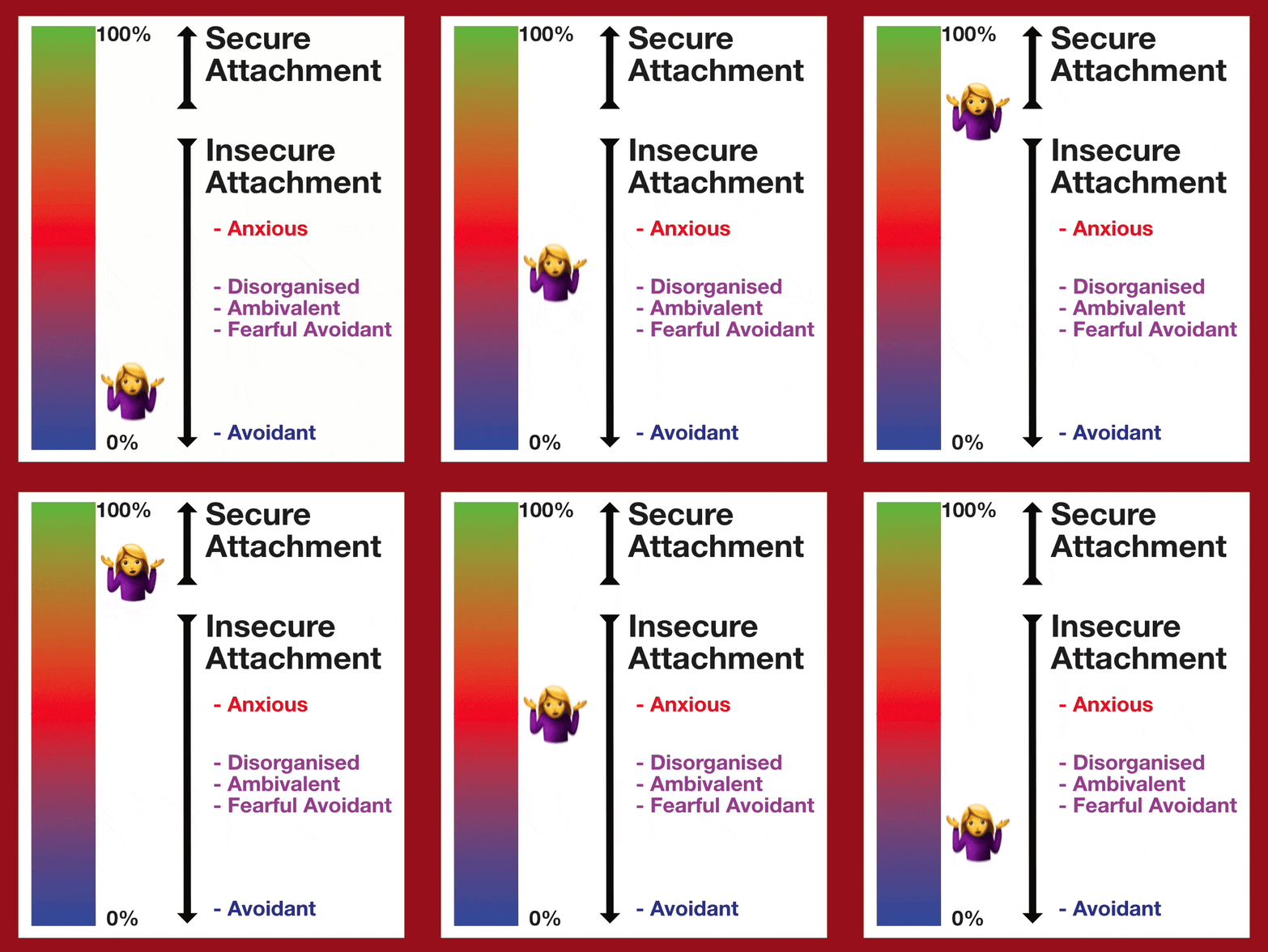
We are analysing your personal attachment style results right now and preparing a comprehensive summary. On a side note, it is important to understand attachment styles as a sliding scale rather than a fixed set of categories. Here are the reason why…
1. Your attachment style is not fixed but rather plastic, meaning you can over time heal an insecure attachment style, just as you can create more insecurity in your attachment style if you hang around toxic people in your life. Having a sliding scale offers you a solid direction to move towards.
2. Attachment styles should be considered as secure or insecure attachment styles with levels of severity when it comes to insecure attachment. This helps you understand how your own attachment styles developed in the first place and what direction you need to take in order to heal from attachment style traumas. (We’ll explain this further in the first email you’ll get from us.)
3. Almost everyone with an insecure attachment style has multiple categories and patterns within that insecure attachment, (of course to differing degrees).
In other words, you don’t just have a pure anxious attachment style. That may be the predominant pattern in your nervous system, but there is also avoidant in there too when you’re nervous system is overloaded and sick of being anxious all the time. This is why it’s more important to see this framework as a sliding scale and not just a mere set of categories.
So your personal attachment style will fit along the scale you see below.
In order to get your personal attachment style score, please enter your best email address so that we can securely send this to you. (As well as give you $3,765 worth of coaching bonuses to help you cultivate secure attachment within yourself!)
And yes, we'll treat your email like it was our firstborn.
If the secure person has experienced this pulling away with the avoidant many times in the past, their behaviour will look a little different. There are two possibilities the secure person will choose.
Let’s start with the first possibility.
The first possibility happens when the secure person wants to continue the relationship with the avoidant despite the avoidant repeatedly pulling away, and here’s what they’d do.
They may tell the avoidant:
“I’m here if you need anything”.
The second possibility occurs if the secure person has come to the realisation that the avoidant is repeatedly sabotaging the connection.
And this realisation has allowed them to see that the relationship is not going anywhere.
Since secure people typically try in earnest to create connection in a relationship, and the avoidant would’ve responded with hostility or pulled away, the securely attached person would choose to end the relationship with the avoidant.

I want you to remember this: a secure person would only waste their valuable energy on an avoidant for one reason:
They’re misguided about the psychology of avoidants.
In other words, they project their own inner security onto the avoidant, believing erroneously that the avoidant sees them positively and that the avoidant will return with more presence when they’re ready.
And that’s just not the case, because avoidants see only themselves positively and others negatively. Also, be aware that I’m talking about pure avoidants.
If you’re dealing with a fearful avoidant or someone with disorganised attachment style, that person would swing the pendulum from seeing you negatively and themselves positively (the avoidant’s inner blueprint) to seeing themselves negatively and you positively – basically putting you on a pedestal.
And that tendency to see themselves negatively comes from the anxious attachment pattern in the disorganised framework.
So let me know in the comments below: what is your typical response when your avoidant pulls away? What have you done in the past?
P.S. CLICK HERE to check out my full article archives! Or you may greatly benefit from one of our highly popular paid programs, CLICK HERE to see what we offer right now.
If you want to be supported by a warm community of high value feminine women, then join our Facebook Group. (It’s free and so incredibly valuable!) CLICK HERE TO join thousands of other women in our “High Value Feminine Women” Community.
By the way, while you’re at it, connect with me on social media.

Renee is the founder of The Feminine Woman & co-founder of Shen Wade Media where we teach women how to show up as a high value high status woman whom easily inspires a deep sense of emotional commitment from her chosen man. She graduated with a bachelor of Law and bachelor of Arts majoring in sociology and psychology. She has been a dating and relationship coach for women in the past 15 years and together with her husband D. Shen at Commitment Triggers blog, they have positively influenced the lives of over 20 million women through their articles and videos as well as 10’s of thousands through paid programs through the Shen Wade Media platform.
Connect deeper with her work through the social media links below.