
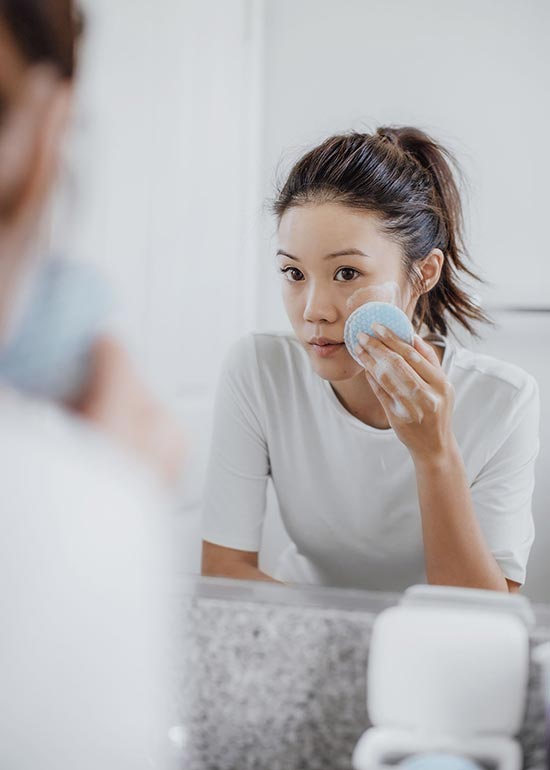
Face washing is the mandatory skincare step you shouldn’t avoid. In this article, we’ll exactly show how to use facial cleansers, and when, and we’ll cover a few other frequently asked questions about the topic. Keep reading to learn how to have your facial cleansing process become a total breeze.
The most important time to wash the face is before going to bed (i.e. in the evening for most of us). Nighttime is when our whole body is able to rest and become rejuvenated, and this includes our skin. To help it along, we want to make sure it is clean (as well as moisturized).
Additionally, throughout the day our faces can become quite dirty. Invisible impurities from the air (especially in polluted cities) land on our face where they can both cause free-radical damage (the damage that causes premature signs of aging) and simply clog the pores. Many of us also wear makeup, which should absolutely be removed before bed.
When we wake up, however, a full cleansing is not mandatory. If you feel like your skin produces a lot of oil, you may choose to do a second cleansing in the morning, perhaps with lighter cleanser than the one you use in the evening, but if it doesn’t, rinsing the face with water or wiping it with a gentle toner will certainly suffice.
You may also choose to cleanse your skin in the middle of the day, after strenuous physical activity or if you happened to participate in an activity that got you very dirty, like fixing a car, working in a greasy kitchen, or going on a muddy hike.
Different facial cleansers have slightly different directions for use, but for the most part, the basic principles are the same.
Squeeze out a quarter-sized amount of cleanser into your hand. If you are using a gel or mousse cleanser, you can add a bit of water and foam it up, or splash your face with water beforehand. For cream and oil facial cleansers, keep your hands and skin dry.
Beginning below the jawline, begin massaging the cleanser into your skin in circular motions that move upwards and outwards. Use the top part of your palm and the length of your fingers, to cover a lot of skin quickly and to give yourself a massage that will stimulate the skin and the muscles below it.
If you are using the face wash to remove makeup, make sure that you can see the facial cleanser break down and dislodge it completely.
Read the directions on your cleanser to see if it is appropriate to use around the eyes. If you are following the oil cleansing method, you can go ahead and use your oil around the eyes. If your cleanser is not fit for the eye area, use an eye makeup remover instead.
Once you have massaged your whole face with the cleanser, you can begin removing it, along with the sweat, oil, dirt, and makeup it has dislodged.
For most store-bought facial cleansers, rinse your skin with water until all of the cleanser and impurities are gone. You can also wipe your face with a damp face cloth or cotton pad. For cold creams and oil cleansing, a dry cloth or cotton pad will likely work better.
If not all your makeup has been removed, you might choose to do a second cleansing, either with the same cleanser, or with a different product.
Once your skin is completely clean, it is very important to nourish it. It is up to you whether you want to layer toners, serums, spot treatments, actives, or chemical exfoliants over your skin, but it is very important to moisturize it with a cream or lotion that is appropriate for your skin type and concerns.
Cleansing the skin is a fairly straightforward process, but we have a few suggestions that will make the process easier for you. We do have some advice for how you can keep your skin healthy while using your face wash.
If you’ve been been hearing about the Clarisonic, or about different kinds of facial brushes, you may have wondered if you really need one. Some people make facial brushes sound like a mandatory tool that must be used, although really, most people don’t use them. Keep reading, and I’ll tell you exactly what you need to know about them.
Whether you opt for an electric facial brush or a manual one, the principle is the same. The light bristles do the job of massaging your skin with the cleanser, so they can give a more thorough cleanse as well as a gentle exfoliation.
Some facial brushes are more aggressive, and should be considered on the same level as any other physical exfoliant, while others are featherlight, and can be used twice a day.
So are they as mandatory as some people make them sound, you might wonder. The answer is no. If a normal cleansing routine works for you, and you already have an excellent exfoliant, you really don’t need a facial brush. However, if you find that your makeup is difficult to remove, or you simply like the idea of using a brush to exfoliate – go for it!
Some people try facial brushes out and discover that they offer the perfect cleansing and exfoliation for their specific skin, while for others they simply do not make a difference. No matter what, they are not likely to hurt anywhere except in the pocket, since they can be quite pricey.
Photo via @tsangtastic